Breadcrumbs: Home > House Sitting Guide > Is House Sitting Worth It
📊 QUICK FACTS:
Our documented savings: €32,400+ across 15+ sits in 9 countries
Sits completed: 15+ via TrustedHouseSitters
Pets looked after: 1 Great Dane, 1 Swiss Shepherd, 1 Pomeranian, 1 Shiba Inu, 3 Labradors, 1 German Shepherd, 1 toy poodle, 1 Chihuahua, 1 Dalmatian, 1 French Bulldog, 15+ cats
The honest answer: Yes, but not for everyone and not in every situation
Who it works best for: Digital nomads, van lifers, retirees, and anyone who already travels and wants to slow down
It was 6:30am in Cortona, Italy. We were on the third floor of an 18th-century farmhouse, tucked into a warm bed, when Teddy appeared besides the bed. Teddy was an 11-year-old Labrador who had climbed three flights of stairs specifically to sleep in the same room as us every night of the sit. He stood there, nose level with the mattress, and nudged us awake with the quiet certainty of someone who knows breakfast is non-negotiable.
We got up. We walked him through the Tuscan countryside as the light came in over the hills. We came back to a kitchen stocked by homeowners who had left us a pot of vegetable soup that reminded Konrad of his grandmother's cooking.
That morning was free. It cost us nothing except the TrustedHouseSitters membership we had already paid for.
So: is house sitting worth it? After 3 years, 15+ sits, and €32,400 in documented accommodation savings, here is the full and honest answer.
The Financial Case
Accommodation is almost always the largest single cost in travel. House sitting removes it almost entirely.
We calculate our savings conservatively at €100 per night, which is below the market rate for most of what we have stayed in. The Swiss chalet in Leysin, the 18th-century farmhouse in Cortona, the AUD $3.4 million house in Sydney 500 metres from the Harbour Bridge. At €100 a night that figure adds up to €32,400 across our sits. At actual market rates, it is considerably more.
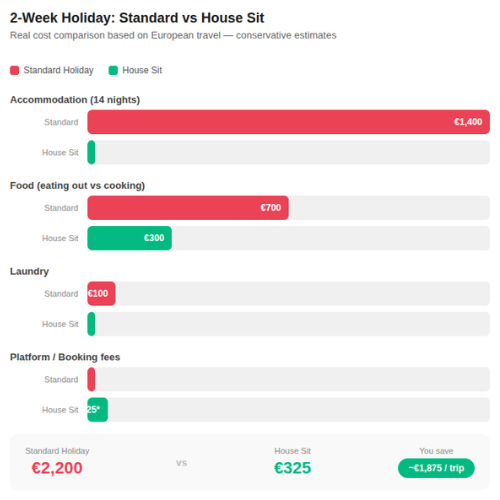
The chart below shows what a single 2-week trip actually costs side by side. Accommodation is only part of it: eating out every day versus cooking in a proper kitchen, laundromat visits versus a washing machine in the hall.
The annual cost of a TrustedHouseSitters Premium membership is $259 USD. Our membership paid for itself in the first two nights of our very first sit. Every sit since has been compounding returns on that original investment.
To be fully honest about the numbers, house sitting is not completely free. Here is what it actually costs us:
| Expense | Estimated Cost |
|---|---|
| THS Premium membership | ~$259 USD/year |
| Travel to each sit | €50–€200 per journey |
| Pet emergency fund | €500+ should be accessible |
| Thank you gift or dinner | €5–€20 per sit |
| Platform booking fee (Basic and Standard plan) | $12 USD per confirmed sit |
The travel cost is the one that varies most and the one people underestimate. We cover it in detail in our travel costs guide, but the short version is: if you build sits into trips you are already taking, the travel cost is near-zero. If you fly internationally specifically for a sit, the economics change considerably.
The emergency fund is one people rarely mention. You should always have enough accessible to cover a vet visit, a night in a hotel if something goes wrong, or an unexpected cost at the property. It is not money you will necessarily spend, but it needs to exist.
The thank you gift is optional but we include it because it reflects the reality of how good sits tend to end. A bottle of wine, a small local gift, contributing to a dinner with the homeowners. It is never expected and always appreciated, and it is part of why homeowners invite the same sitters back.
There is also an opportunity cost worth naming. A sit with a high-energy dog that needs four hours of walking per day is not compatible with a full remote workday. Most sits are not that demanding, but some are. Read the listing carefully and be honest with yourself about what you can manage alongside your work commitments before applying.
But the savings are not only in the nightly rate. Having a kitchen means you cook rather than eating out three times a day. Having a washing machine means you are not spending money at laundromats or packing two weeks of dirty clothes into a backpack that starts to smell by day ten. These are small things individually. Over a month-long sit they add up to a meaningful amount, and the quality-of-life difference is not small at all. Waiting hours at a laundromat to wash and then dry clothes feels like a genuine waste of time. At a house sit, it is just part of the day.
What You Actually Get Beyond the Money
The financial argument is the easy one to make. The harder one to explain is what house sitting does to the quality of travel itself.
When you stay somewhere for a week or two, you stop being a tourist. The bakery in our French village in Lullin started gifting us samples, which was clever of them because it worked: we bought more every visit. Our local coffee shop in Athens now starts making our drinks when we walk in the door.
You could technically get this from a hotel or Airbnb if you stayed long enough. But returning to a home each evening is different from returning to a room. You are in the neighbourhood, not adjacent to it. You go to the same shops, walk the same streets with the dog, nod at the same faces. You are moving into the community temporarily rather than observing it from the outside. It changes the texture of being somewhere entirely.
There is also something that is harder to quantify: house sitting helps you figure out how you actually want to live. Konrad has always wanted a French Bulldog. Right now we are looking after one in Athens and learning what that actually means day to day. Caro always wanted to spend real time in Portugal. We have a six-month sit locked in from May. We have lived in Switzerland and discovered we love it. We have lived in Italy and Greece and France and learned things about ourselves and what we want from a home and a life that no amount of hotel stays would have taught us in the same way.
We are no longer ticking countries off a list. We are experiencing them. That is a different kind of travel entirely.

The Real Downsides
House sitting is not without genuine trade-offs, and anyone telling you otherwise is selling something.
You have made a commitment. When you confirm a sit, you have taken on responsibility for living animals. You cannot decide on a Tuesday to take a spontaneous long weekend somewhere four hours away. In Lullin, our month-long French sit, there were moments when it would have been nice to go further afield for a few days. The two outdoor cats were fairly low-maintenance, so it was not a constant constraint, but it was a consideration. Anyone who has owned a dog understands this: a pet is a responsibility that reshapes what is casually possible. House sitting is the same, temporarily.
The way we think about it: this is the same limitation every pet owner lives with permanently. For us it is two weeks at a time, after which we are back in the van with total freedom. The constraint is real but it is finite, and the upsides on the other side of it are significant.
You are in someone else's home. You live by their rules. Most homeowners are entirely reasonable, asking you to keep things tidy and respect certain rooms. But it is not your space. You cannot invite people over without asking, you are responsible for their possessions, and you are accountable in a way that a hotel guest is not. For the right person this feels natural. For someone who struggles with that kind of responsibility it could feel stifling.
The early days are competitive. Before you have reviews, getting confirmed for sits is harder. You are competing against sitters with five-star track records and no way to demonstrate yours yet. The solution is to start local and start small, but it does require patience and some early rejections before the momentum builds. We cover how to handle the early phase in our house sitting profile guide.
One thing worth knowing about competition in 2026 specifically: THS now limits listings to five applicants before closing to new applications. Popular sits in desirable locations fill within minutes of posting. If you see something you want, apply immediately with a personalized message rather than sitting on it. Speed matters more than it used to.
What If Things Go Wrong?
An honest review has to address this. House sitting involves real risk and real emergencies, and if you go in unprepared for them you will not handle them well.
A homeowner cancels before you arrive. It has happened to us. We had a sit confirmed in the Netherlands and received a cancellation message the week before. In our case we had not booked travel around it, so the impact was disappointment rather than financial damage. If you had booked non-refundable flights specifically for that sit, the situation would be significantly worse. THS has a cancellation cover provision but it is decided case by case, not guaranteed. The protection is: do not book non-refundable travel until a sit is confirmed, and even then factor in the possibility. Our cancellation guide covers exactly what to do and in what order.
A pet gets sick on your watch. This also happened to us. Our first sit together in Bochum, one of the cats developed a swollen paw from a bee sting. We used the THS 24/7 vet line, had a qualified vet assess the situation remotely via photos within minutes, and had a diagnosis and care plan before the homeowner had even fully read our message. That safety net is one of the genuine reasons we pay for Premium over Standard. It does not eliminate the stress of an animal emergency, but it means you are not handling it alone. If you are on the fence about which THS plan to choose, the vet line alone is worth the upgrade for anyone who takes animal care seriously.
"House sitting isn't a free holiday. It's a job where your pay is a beautiful home and a temporary best friend."
That framing matters. The people who thrive at house sitting treat it as a responsibility they happen to love. The people who struggle treat it as a perk they have to tolerate. Know which one you are before you confirm your first sit.
The sit is not what the listing described. Kefalonia was listed as one dog and one cat. We arrived to nine cats, several of them with fleas, and spent two weeks managing the aftermath. We chose to stay. If we found the same situation today, we would seriously consider leaving. The advice: document everything immediately, contact the platform, and do not feel obligated to endure conditions that were materially misrepresented. A difficult conversation with the homeowner is better than two weeks of misery. Our unpaid labour guide covers where the line is.

Who It Works Best For
House sitting works best when it complements something you are already doing rather than replacing everything else.
For full-time van lifers and digital nomads, it is close to perfect. We drive the T4 around Europe, and house sits are the reset points along the way. After a month of continuous travel and van life, arriving at a sit with a proper kitchen, a washing machine, reliable Wi-Fi, and a dog who wants a morning walk genuinely feels like a holiday within the holiday. We always look forward to getting back in the van after a sit, and we always appreciate the van more for having had the sit first. The rhythm works.
For retirees and seniors, house sitting offers a way to travel slowly and affordably with all the comforts of home included. Our house sitting for seniors guide covers this specifically, including how Konrad's mum and stepdad have built a successful track record sitting in Australia despite his stepdad having Parkinson's.
For remote workers, the combination of free accommodation, reliable Wi-Fi, and a quiet home office environment is genuinely compelling. Our remote worker house sitting guide covers how to make the working side of it function smoothly.
For one-off holiday makers who want to try it once, it works best when it is already aligned with a trip you were planning. Flying to a country specifically for a house sit introduces a level of financial and logistical risk that is hard to justify. Using a sit to solve accommodation on a trip you were already taking is a different calculation entirely.
Who House Sitting Is Not For
Equally important: who should not do this.
People who want to party. You are in someone's home, responsible for their animals, and accountable for the condition of their property. A homeowner who returns to find the house in a worse state than they left it, or discovers from a neighbour that you had people over every night, will leave a review that follows you permanently. The lifestyle attracts a specific kind of person and repels another. Know which one you are before you join.
People who see pets as an amenity. The animals are not a cute background detail of your accommodation. They are the reason you are there. A homeowner choosing a sitter is primarily choosing someone to care for their pet, not someone to enjoy their home. If the animals feel like a burden or an inconvenience rather than the point of the whole arrangement, house sitting will frustrate everyone involved.
People who are not naturally tidy. You are living in someone's private home and leaving it in the same or better condition than you found it is non-negotiable. This is not about being obsessive. It is about basic respect for someone's space. Homeowners who come back to dirty dishes, unwashed bedding, or a messy kitchen do not forget it and they do not keep it to themselves.
People who need total spontaneity. If you are the kind of traveller who makes every decision the day of and finds any fixed commitment stifling, the responsibility of confirmed sits will feel like a cage. House sitting works best for people who enjoy depth and routine as much as freedom.
The One Thing We Wish Someone Had Told Us Earlier
The moment house sitting clicked for us was not when we looked at the savings figure. It was when we realised we had stopped trying to see everything and started actually experiencing somewhere.
The conventional approach to travel is to optimise for coverage: as many countries, cities, and landmarks as possible in the time available. House sitting inverts that. It pushes you toward depth over breadth. You spend two weeks in one place, learn its rhythms, find your coffee shop, walk the same route enough times that it starts to feel familiar. That is the thing most travellers are quietly hungry for and do not know how to access without the anchor that house sitting provides.
Whether that sounds appealing or constraining tells you almost everything you need to know about whether house sitting is worth it for you.
If you are ready to start, our TrustedHouseSitters discount code brings the entry cost down and our complete profile guide covers how to get your first sit confirmed.
Konrad & Caro 🐾🚐
DM us @housesittersguide if you have questions — we answer everyone!

FAQ
How much money can you actually save house sitting?
We have documented €32,400 in accommodation savings across 15+ sits, calculated conservatively at €100 per night. That excludes the additional savings from having a kitchen to cook in and a washing machine to avoid laundromat costs. The TrustedHouseSitters Premium membership costs $259 USD per year. Ours paid for itself in the first two nights of our first sit.
What is the biggest downside of house sitting?
The commitment to the animals. When you confirm a sit, you are responsible for living creatures and cannot simply leave for a spontaneous long weekend. This is the same constraint every pet owner lives with permanently. For house sitters it is temporary, but it is real. Anyone who finds that kind of responsibility stressful rather than grounding should weigh it carefully.
Do you need experience with animals to start house sitting?
No formal qualifications, but a genuine comfort around animals is non-negotiable. Homeowners are trusting you with their pets, which for most people are family members. Specific breed experience is helpful and worth highlighting in applications. We have now looked after a Great Dane, a French Bulldog, Labradors, a Shiba Inu, a Pomeranian, and 15+ cats across our sits. You build that experience sit by sit.
Is house sitting worth it for a one-off holiday?
It depends on how you structure it. If you are building a trip specifically around a confirmed sit, the risk is too concentrated. If a sit happens to align with a trip you were already planning, the value is significant. Use sits to solve accommodation on trips you are already taking rather than as the reason for the trip itself.
Can house sitting become a full-time lifestyle?
Yes, and it works best when combined with something else: a campervan, remote work, or a flexible home base to return to between sits. House sitting alone as your entire accommodation strategy leaves you exposed during gaps between sits. As part of a broader nomadic setup, the combination is very strong. We have been doing it full-time since November 2025 alongside van life across Europe.
What types of homes and pets can you expect to look after?
Across our sits we have stayed in Swiss chalets, Italian farmhouses, Greek city apartments, beachside properties in Belgium, canal houses in the Netherlands, and a multi-million dollar home in Sydney. Pets have ranged from a single elderly cat to nine outdoor cats in Kefalonia. The variety is one of the genuinely underrated aspects of the lifestyle: every sit teaches you something about how you want to live.