

Home > Blog > House Sitting Profile Guide
Quick Facts
| Quick Facts | |
|---|---|
| What actually gets you selected | Your first message, not your profile |
| Profile photos | Genuine, bright, smiling, with pets comfortable around you |
| AI tool for profile writing | Use the interview prompt below, then edit everything yourself |
| Time investment | An hour or two upfront saves months of poor results |
| Reviews needed to gain momentum | Around 10 before the profile starts doing the work for you |
| Our track record | 20 sits across 12 countries, five stars on every single one |
The profile is not what gets you the sit. The first message is. After 20 sits across 12 countries, every one of them rated five stars, the pattern is consistent and clear: a strong first message gets the homeowner excited enough to look at your profile, the profile confirms you are the right person, the photos show you are comfortable with animals, and the video call closes the deal. That is the funnel. Most people spend all their energy on the profile and almost none on the message. It should be the other way around.
Caro and I have not changed our profile significantly since we first created it. We have updated it to reflect our growing experience, from zero sits to 20, but the core of who we are and what we offer has stayed the same. What has changed is how we write first messages, how we read listings, and how quickly we respond. Those things matter far more than any profile tweak.
If you are interested in getting into house sitting, our book Travel More for Less puts the whole process in one place: clear, step by step guidance from your first questions to your first confirmed sit, and the reviews that open the door to the next one.
The Funnel: How You Actually Get Selected
Most sitters think the selection process works like a job application: submit a profile, wait for someone to review it, hope for the best. It does not work that way. The process is a funnel with four stages, and the first stage filters out the majority of applicants before the profile is ever opened.
Stage 1: The first message. The homeowner posts a listing. Applications arrive. The homeowner reads the first few lines of each message. Most are generic. A few are specific, warm, and reference the listing directly. Those are the ones that get a response. Everything else is ignored, regardless of how strong the profile behind it is.
Stage 2: The profile. The homeowner clicks through to the profiles of the sitters whose messages caught their attention. They scan the photos, read the bio, check the reviews if there are any. The profile confirms or disconfirms the impression the message created. It rarely creates excitement on its own.
Stage 3: The video call. The homeowner invites their shortlisted candidates to a video call. This is where the real decision happens. The call reveals whether the person communicates well, whether they have read the listing, whether they ask about the pets by name, and whether the homeowner feels comfortable handing over their keys.
Stage 4: Reviews. For sitters with a track record, the reviews do significant work at Stage 2. A homeowner reading a profile with ten five-star reviews and specific, detailed feedback from other homeowners does not need much additional convincing. The reviews function as social proof that shortens the entire process.
The practical implication: put most of your effort into the first message. The profile needs to be good, but good is a lower bar than most people think. The message needs to be exceptional, because it is the thing that determines whether anything else you have built ever gets seen.
Writing the First Message
This is the most important section of this entire article.
A first message that works does three things. It shows the homeowner you have actually read their listing. It names the pet. And it explains, briefly and warmly, why you are suited to this specific sit rather than sits in general.
Here is what a bad first message looks like: "Hi, we are Caro and Konrad. We love animals and would love to house sit for you. We are reliable, tidy, and experienced. Please check out our profile."
Here is why it fails: it could be sent to any listing on any platform. It contains nothing specific to this homeowner, this pet, or this home. The homeowner reads it and learns nothing about whether this person actually cares about their specific situation.
Here is what a strong first message does: it opens with something from the listing itself. "We saw your listing and were immediately drawn to it because [specific detail about the pet, the home, the location]." It mentions the pet by name. It connects something in the sitter's experience to something in the listing. "We looked after a similar breed in Switzerland and found [specific relevant detail]." It closes with warmth and availability rather than a sales pitch.
The message does not need to be long. Five to eight sentences is often enough. What it needs to be is specific. Every sentence should contain something that could only apply to this listing. If you could copy and paste the message to a different listing and it would still make sense, it is not specific enough.
In competitive markets like London or Los Angeles, a strong first message is the difference between being one of five applicants who gets a response and being one of fifty who doesn't. Our article on using AI for winning applications covers how to personalise messages efficiently when applying to multiple sits.

Building the Profile Itself
The profile needs to answer three questions for a homeowner who has just read your message and clicked through: Who are these people? Are they genuinely good with animals? Will my home be safe with them?
Who you are: A brief, warm description of who you are, where you are from, what you do for work (relevant because it tells the homeowner about your schedule and availability), and why you house sit. This does not need to be a life story. Two to three paragraphs that feel like a real person wrote them, not a template.
Animal experience: Specific and honest. What animals you have looked after, for how long, in what contexts. If you have breed-specific experience, mention it. If you have experience with medical needs, anxiety, or specific behavioural situations, mention that too. Do not oversell. A homeowner who selects you based on an exaggerated profile will be disappointed by the reality, and the review will reflect it.
Reliability and home care: A sentence or two about how you approach the home itself. That you leave it cleaner than you found it, that you respect the homeowner's space and belongings, that you communicate regularly during the sit. This does not need to be extensive. It just needs to be present.
The profile should sound like you, not like a corporate bio and not like a sales pitch. Caro and I wrote ours in our own voice, with our own phrasing, and it has worked across 12 countries without modification. The voice is what makes a profile feel real. A homeowner reading it should feel like they are getting a sense of who you actually are, not who you think they want you to be.
Using AI to Build Your Profile
If you are staring at a blank profile and do not know where to start, AI is a genuinely useful tool for getting a first draft down. The key is to use it as a starting point, not a finished product.
The approach that works is an interview-style prompt. Instead of asking AI to write a profile for you (which produces generic, templated output), ask it to interview you first. Here is the prompt:
"I want you to help me write a house sitting profile for TrustedHouseSitters. Before you write anything, I need you to interview me. Ask me questions one at a time about my background, my experience with animals, why I house sit, what I can offer homeowners, and any specific skills or experiences that would make a homeowner trust me with their home and pets. After the interview, write a profile based on my answers. Keep it warm, genuine, and specific. Do not use generic phrases like 'passionate about animals' or 'reliable and trustworthy.' Use the specific details from my answers instead."
The AI will ask you questions. Answer them honestly and in detail. The more specific your answers, the more specific the output. After it generates the profile, read every single word and edit it. AI can fabricate details, add things you did not say, or phrase things in a way that does not sound like you. The human editing pass is not optional. It is the step that turns a decent AI draft into a profile that actually sounds like a real person.
A well-crafted profile, built from a thorough AI interview and then properly edited, can be done in an hour or two. That investment of time at the beginning saves months of poor results from a generic profile that homeowners scroll past without reading.
Profile Photos That Work
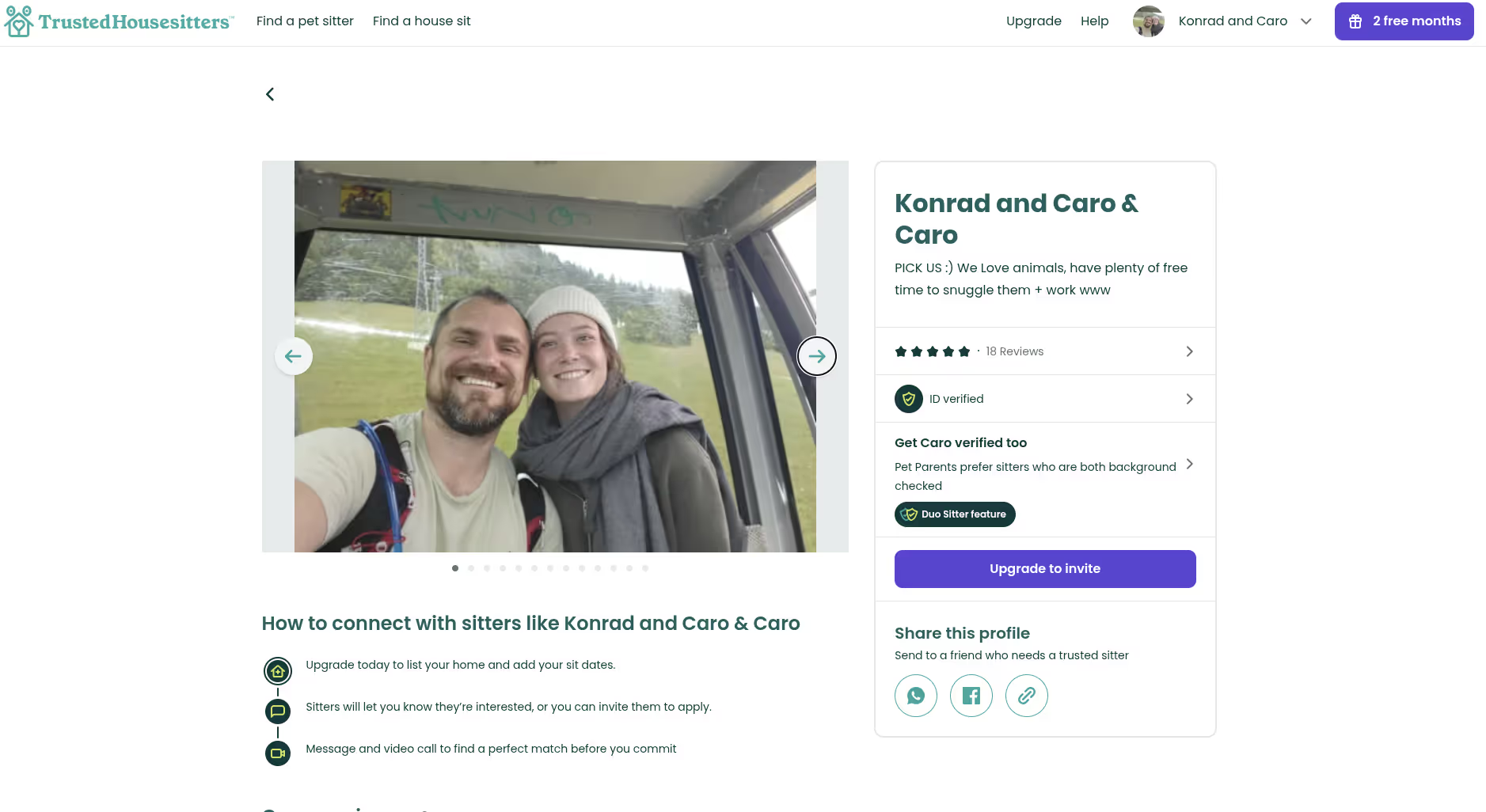
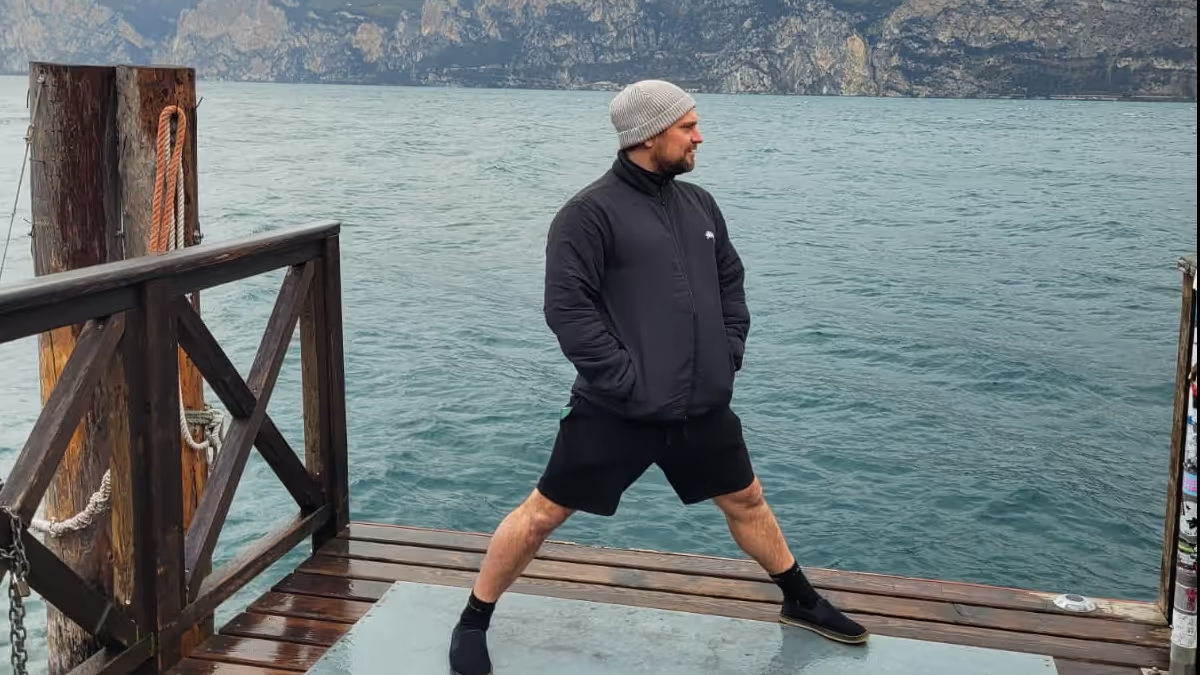
The photos on your profile are doing a specific job: showing homeowners that you are a real, approachable person who is comfortable around animals. That is it. Professional photography is not required. Expensive editing is not required. What is required is clarity, brightness, and a genuine smile.
Caro and I have not changed our photos significantly since we started. They show us smiling, in bright natural light, with pets around us. The pets in the photos are visibly comfortable, not restrained or posed, just lying near us or being patted. That combination, a clear photo of a smiling person with a relaxed animal, communicates more about suitability than any written description.
A few practical points from our experience. Avoid blurry photos. Avoid dark indoor shots where faces are hard to see. Avoid group photos where the homeowner has to guess which person is you. Avoid photos without animals unless you are using them to show something specific about your lifestyle (the van, a previous sit location). The first one or two photos should show you with an animal that is clearly comfortable in your presence.
If your current photos are not great, ask someone to take a few new ones next time you are with an animal. Even a phone photo in good natural light is enough. The bar is not professional quality. The bar is "this person looks friendly and the animal looks happy."
The 10-Review Turning Point
There is a specific point in a sitter's trajectory where the profile stops being the thing that gets you sits and the reviews take over. For us, that point was around the 10-review mark.
Before 10 reviews, homeowners are reading the profile carefully, assessing the photos, and relying on the video call to make their decision. The profile has to work hard because there is limited external proof that you are who you say you are.
After 10 reviews, especially if they are specific and detailed, the dynamic shifts. A homeowner scanning your profile sees a wall of five-star reviews from other homeowners across multiple countries and multiple pet types. The written content of the reviews does most of the convincing. The profile and photos become confirmation rather than persuasion.
This means two things practically. First, the early sits are the hardest and the most important. Every review you earn in the first 10 makes the next sit easier to get. Start with less competitive listings, sit locally if possible, and treat every early sit as an opportunity to build the foundation that the rest of your house sitting life will stand on.
Second, the profile still matters after 10 reviews, but the pressure on it reduces significantly. You do not need to constantly update and optimise it. What you need is to keep the reviews coming by continuing to do excellent sits. Our building trust as a new sitter guide covers how to approach the early phase specifically.
Common Profile Mistakes
| Mistake | Why it hurts | What to do instead |
|---|---|---|
| Generic opening line ("We love animals and travel") | Every applicant says this, it provides zero differentiation | Open with something specific about your experience or what you offer |
| Talking only about yourself | Homeowners care about what you will do for them, not your life story | Frame everything through the homeowner's perspective: what they get from choosing you |
| Exaggerating experience | A homeowner who selects you based on inflated claims will be disappointed | Be honest. Growing experience is not a weakness, it is relatable |
| No photos with animals | The homeowner cannot assess your comfort level with pets | Include at least two photos showing you with relaxed, comfortable animals |
| Dark or blurry photos | Creates an impression of low effort or something to hide | Take new photos in natural light, even a phone camera is fine |
| Copy-pasting the same first message to every listing | Homeowners can tell immediately and it signals low investment | Personalise every message with at least two specific details from the listing |
| Not mentioning the pet by name in the first message | Misses the single easiest way to show you read the listing | Always name the pet in your opening message |
| Waiting days to apply | In competitive markets, sits fill within hours | Apply immediately when alerts come through, speed matters |
Platform-Specific Considerations
The core profile works across platforms without major changes. Caro and I use essentially the same profile on TrustedHouseSitters, Aussie House Sitters, and every other platform we have used. The voice, the photos, and the substance are the same.
What differs is the first message, because each platform has a different application format and a different competitive dynamic. On THS with its five-applicant cap, speed matters more than anywhere else. On House Sitters America or MindMyHouse, listings stay visible longer and the competition per listing is lower, which means the message can be slightly more considered and the response time is less critical.
On platforms where homeowners can browse sitter profiles proactively, such as HouseCarers where sitters can upload video introductions, the profile does more of the initial heavy lifting because homeowners may find you before you find them. In that context, investing more time in the profile and its visual elements is worth doing.
What to Do If Your Profile Is Not Working
If you have applied to multiple sits and received no responses, the problem is almost certainly the first message, not the profile.
Before changing anything on the profile itself, look at the last five messages you sent. Are they specific to each listing? Do they name the pet? Do they reference something particular about the home or the location? If the messages are generic, that is the fix. Rewrite them to be specific and try again.
If the messages are specific and you are still not getting responses, check the photos. Are they clear, bright, and showing you with animals? If not, update them.
If both the messages and photos are strong and you are still not getting responses, the issue may be the listings you are targeting. Start with less competitive options. Rural sits, longer sits, sits in less popular regions. Build reviews there and then move to the competitive markets once you have a track record that does the convincing for you.
Our what homeowners wish sitters knew article covers what homeowners are actually looking for, which can help you understand why certain applications succeed and others don't. If an owner asks for more than a profile and a review record provide, our guide to social media requests from homeowners covers where the line usually sits.
Conclusion
The profile gets too much attention. The first message gets too little. After 20 sits across 12 countries, all of them five stars, the pattern is clear: a specific, warm, personalised first message that names the pet and references the listing is the thing that opens the door. The profile confirms what the message promised. The photos show you are real and comfortable with animals. The video call closes the deal. And after about 10 reviews, the whole process gets significantly easier because the reviews start doing the heavy lifting.
Spend an hour or two building a genuine, well-written profile. Use the AI interview prompt if you need help getting started, but edit everything it produces. Take a few bright, clear photos with animals. And then put 90% of your ongoing effort into writing exceptional first messages for every single listing you apply to. That is the system that works.
Caro and I have completed 20 house sits across 12 countries, driven 19,000km in Australia and 24,000km in our 1998 VW T4, and saved over $26,500 in accommodation costs over three years of house sitting. If you need help with your profile or first messages, send us a message on Instagram, we read every DM.
Frequently Asked Questions
What is more important, the profile or the first message?
The first message. It is the first thing a homeowner reads and determines whether they ever look at your profile. A generic message gets ignored regardless of how strong the profile is. A specific, warm message that names the pet and references the listing gets a response, and that response is the beginning of the process that leads to the sit.
Should I use AI to write my house sitting profile?
Yes, as a starting point. Use an interview-style prompt that asks you questions about your experience and background before generating anything. Then edit every word of the output. AI can fabricate details or phrase things generically. The editing pass is what turns a decent draft into something that sounds like a real person rather than a template.
What photos should I put on my house sitting profile?
Clear, bright photos in natural light showing you smiling with animals that are visibly comfortable around you. Professional photography is not required. Avoid blurry photos, dark indoor shots, or group photos where the homeowner has to guess which person you are. The first one or two photos should show you with a relaxed animal.
How many reviews do I need before getting sits becomes easier?
Around 10 specific, detailed reviews is the turning point where the reviews start doing most of the convincing and the pressure on your profile and messages reduces significantly. Before that, every application requires more effort because you are building credibility from scratch.
What should my first message include?
Something specific from the listing that shows you actually read it. The pet's name. A brief connection between your experience and what the listing requires. Warmth and availability. Five to eight sentences is usually enough. Every sentence should contain something that could only apply to this specific listing.
What if I keep applying and getting no responses?
Check your messages first, not your profile. If your messages are generic, rewrite them to be specific to each listing. If they are already specific, check your photos. If both are strong, target less competitive listings to build your review base before going after popular sits in competitive markets.


Responses
What are your thoughts on this post?