

Breadcrumbs: Home > House Sitting Guide > House Sitting for Seniors
Quick Facts: House Sitting for Seniors in 2026
| Why owners pick retirees | Time, reliability and decades of home and pet experience |
| Membership cost | TrustedHouseSitters runs €129 to €259 a year |
| Our 3-year spend | About €400 on accommodation across 20 sits |
| Longest sit booked | Six months in Portugal from May 2026 |
| Biggest risk | Applying for a sit beyond your physical capability |
| Age limits | No platform sets an upper age limit |
Retirees are strong candidates: homeowners want time, reliability and decades of pet and home experience. Our three years of sitting cost roughly €400 in accommodation across 20 sits in 12 countries, and we have a six-month Portugal sit starting May 2026. Match the sit to your physical capability first.
The most common myth about house sitting for retirees is that it is a golden ticket, a carefree lifestyle of moving from one beautiful home to another with minimal effort and no real complications. That version is not quite accurate, and believing it can lead to situations that are uncomfortable for everyone involved.
Caro and I started house sitting in our twenties and thirties. We are not retirees. But after 20 sits across 12 countries we have spoken to enough homeowners and spent enough time in the community to understand two things clearly: from a homeowner's perspective, a retired sitter with time, settled habits, and genuine life experience is about as close to an ideal applicant as they are going to find. And the retired sitters who build long, strong review records are the ones who approached it with honest self-assessment rather than enthusiasm alone.
This guide covers both sides of that.

Why Homeowners Are Drawn to Retired Sitters
The two things every homeowner is looking for when they read applications are time and reliability. Retirees, as a group, offer both in ways other demographics simply cannot match.
A working couple in their thirties might be excellent sitters, but a homeowner looking at their profile knows they have jobs, competing commitments, and a schedule that may flex unpredictably. A retired couple has none of those constraints. They are available. They are not going to cut a sit short because of a work emergency or treat the property as a base for extended day trips. They are, in all likelihood, going to spend a significant portion of each day exactly where the homeowner wants them: in the house, with the pets.
We observe this preference consistently across community discussions and in conversations with homeowners. It is not that homeowners dislike younger sitters. It is that when a retired couple with a long home-owning history, genuine animal experience, and an unhurried schedule applies, the homeowner's anxiety about what might go wrong drops noticeably. That reduction in anxiety translates directly into acceptances.
The profile advantage extends to the application itself. If you have owned homes for thirty or forty years, maintained gardens, looked after pets through their full lives including the harder end-of-life decisions, and generally demonstrated the domestic competence that only comes with time, say so explicitly. Many retired applicants undersell this experience, and it is the exact thing homeowners are screening for.
The Belgian Coast Story: The Lesson Every Sitter Needs to Hear
When we arrived at a sit on the Belgian coast, the homeowner greeted us with a visible sigh of relief. We asked why.
She told us about the couple who had sat for her previously. Perfect five-star reviews. A great video call, warm and experienced and clearly capable on paper. She had confirmed the sit feeling confident. But the moment they stepped out of the car at the property, she knew immediately something was wrong. The husband could barely stand properly. He had not mentioned any mobility issues during the call, and nothing in their profile had flagged it. The listing was for a young, boisterous Labrador near the beach that needed substantial daily exercise. It was not a match, and there was nothing she could do about it at that point. She left an honest review explaining the situation so future homeowners would have the full picture.
She was not unkind about it. She understood they had not set out to mislead her. But the sit could not be fulfilled as agreed, and the honest review was the right outcome for the community.
We think about that story often, because the lesson is not specifically about age. Caro and I are reasonably fit, but we would not apply for a sit with horses. Not because we could not care for them generally, but because we have no experience handling a large animal that decides to bolt, and no experience managing the safety situation if something went wrong. Applying for that sit anyway would be doing exactly what that retired couple did: letting enthusiasm override an honest assessment of what we could actually deliver.
One bad match can produce a difficult review that follows your profile for years. One honest assessment of your capabilities before submitting an application prevents that entirely.

The Honesty Audit: Your First Step Before Browsing Any Listing
Before you open a single platform, the most useful thing you can do is assess your own capabilities clearly. This is not a discouraging exercise. It is the thing that makes the rest of the process work.
Ask yourself the following without softening the answers. Can you walk a dog that pulls hard on the leash twice a day? Are you comfortable in a property with multiple flights of stairs? Could you physically intervene if a dog bolted or two animals needed separating quickly? Are you prepared to administer medication, manage separation anxiety, or handle a pet with complex care needs?
Beyond the physical: do you need to be close to amenities, or are you comfortable in a remote location where the nearest town is a thirty-minute drive? Do you drive, and are you comfortable driving in an unfamiliar country?
The answers are not pass or fail. They are a filter for the right sits. A retired sitter who writes clearly in their profile that they are confident with cats, small dogs, and low-energy breeds, and that they are not the right fit for large high-energy animals, is giving every homeowner exactly the self-awareness they want to see. It signals that when you do apply for a sit, it is a genuine match. That is what builds a strong review record over time.
Platforms that use verified reviews for house sitting make this honesty even more valuable. A review from a homeowner confirming your reliability with a specific type of animal carries real weight with every future homeowner who reads your profile.
| Sit category | Best match for | Why it works |
|---|---|---|
| Cats and small dogs | Solo retirees or low-mobility couples | Low physical impact with a focus on companionship rather than exercise |
| Rural farmhouses | Active retirees with gardening skills | Large space, outdoor animals, and far fewer fragile items than city apartments |
| Long-term sits | Full-time travellers and van lifers | Allows for a grounded routine, local immersion, and genuine cost savings |
| Multi-pet households | Experienced former pet owners | High homeowner demand for this profile; decades of care experience is exactly what they want |
The Real Financial Case: What 3 Years Actually Looks Like
Many people are drawn to house sitting by the idea of free accommodation, and while that is significant, it understates the actual financial picture.
Over three years and 20 sits, Caro and I have spent roughly €400 on accommodation in total. That covers platform memberships and very little else. In exchange we have stayed in properties across Switzerland, France, Italy, Greece, Australia, and beyond, none of which we could have afforded to rent at market rate.
For retirees on a fixed income, this arithmetic is meaningful in a specific way. Accommodation is almost always the largest variable cost in any travel budget. Removing it does not just make travel cheaper. It makes destinations accessible that would otherwise be out of reach entirely. London, coastal Portugal, rural Tuscany: these become viable not because they got cheaper but because you are no longer paying to sleep there.
The annual cost of a TrustedHouseSitters membership is between €129 and €259 depending on the plan. A single two-week sit in a destination where hotels cost €100 a night returns the membership cost many times over before the sit ends. Our TrustedHouseSitters review covers the plan differences if you want to understand which tier makes sense to start on.
Beyond Free Accommodation: The Lifestyle Upgrade
The financial case is real, but it is also the most surface-level reason to do this. The deeper argument for house sitting in retirement is about how it changes the quality of the travel itself.
This is slow travel in its most practical form. You arrive to a comfortable sofa, a full kitchen, a washing machine, and fast WiFi. You are not living out of a suitcase or navigating a new hotel every few days. You have a garden, a routine, an animal that is pleased to see you in the morning. You have a reason to find the good local bakery, learn a few words of the language, and discover the walking trail that does not appear in any guidebook.
We create the kind of memories that last because we live in a place rather than pass through it. A week in a city leaves you with photographs. A month in a house with a dog leaves you knowing the place in a way that is different in quality, not just quantity. That depth of experience is not available to most travellers at any price point, and it suits the pace of retirement far better than the ten-countries-in-ten-days version of travel ever could.
Long-Term Sits: The Real Opportunity for Retirees
Weekend sits and short breaks are a good way to start. But the genuine opportunity for retirees is in long-term sits, and this is where the advantage compounds most clearly.
We have secured a six-month sit in Portugal starting May 2026. Six months in a country where we will establish a proper routine, become regulars somewhere local, form a real bond with the animals, and actually understand the rhythms of a place rather than just passing through it. That kind of depth is not available from short visits at any price.
For retirees, long-term sits offer something specific that shorter arrangements cannot: the feeling of having a home rather than being a guest. You are not unpacking and repacking every few days. You are waking up in the same place, walking the same dog on the same morning route, and building the kind of familiarity that makes extended travel feel sustainable rather than exhausting.
Many homeowners taking extended trips of several months are actively seeking reliable retired sitters precisely because they want someone settled and consistent. These longer listings appear across most major platforms, but THS has the largest global inventory. Our long-term house sitting guide covers how to find them and what to discuss with homeowners for stays over a month.

House Sitting and Campervan Travel
For retirees who travel by motorhome or campervan, house sitting fits naturally into the rhythm of van life in a way that works particularly well.
Caro and I travel full-time in a 1998 VW T4. The campervan gives us freedom between sits: we take our time getting from one location to the next, stop where we want, and build proper exploration around each sit. When we arrive at a sit, we get everything the campervan does not provide: a full kitchen, a proper washing machine, reliable WiFi, a comfortable sofa. We catch up on everything that has been accumulating and then move on refreshed.
The gaps between sits are not a logistical problem to solve. They are the part of the journey where you travel freely. The sits are where you put down roots for a while and spend almost nothing doing it. For retirees with a motorhome, this combination removes two of the most common pain points of long-term van travel: the cumulative cost of campsites, and the difficulty of maintaining a routine that keeps life grounded.
Taking It International: What to Plan For
House sitting makes international travel financially accessible in a way little else does, and for retirees with flexible schedules the opportunities are significant. A few practical areas to address before going international.
Visa rules vary by passport and destination, but most tourist visas allow stays of up to 90 days, which covers the majority of sits. For longer stays, research the specific rules for your passport well in advance. Comprehensive travel and health insurance is not optional: ensure it is in place before any international trip. Our guide to insurance for house sitters covers what to look for. For banking, a travel-friendly card such as N26 in Europe avoids international transaction fees that add up quickly on longer trips.
With these in place, the range of house sitting opportunities available internationally is genuinely broad, and the slow-travel model that works so well for retirees suits international sits particularly well.
Finding the Right Platform and Building Your Profile
For global reach, TrustedHouseSitters is the strongest starting point. The inventory is the largest of any platform, the ID verification is mandatory for sitters, and the double-blind review system means the reviews you earn reflect genuine homeowner satisfaction. For the US, House Sitters America covers the suburban and rural market well but I would still recommend TrustedHouseSitters because it has many more listings in America.
For Australia, Aussie House Sitters is the industry standard.
Start local. Your first sit does not need to be abroad. A nearby weekend sit looking after a cat while a neighbour visits family gives you a real verified review, and that changes the weight of every subsequent application. The first review is the hardest to earn and the most valuable one on the profile.
Be specific about your experience. Write out your home-owning history, the pets you have cared for over the years, and any relevant practical skills. Homeowners are trying to assess calm competence, and your history answers that more convincingly than any amount of enthusiastic description.
Do not be modest and do not overclaim. Both reduce trust. Stating clearly what you are good at and where your limits are is read by homeowners as exactly the self-awareness they want to find. Our house sitting profile guide covers the specific elements that convert homeowner interest into an acceptance.
Is House Sitting Worth It for Retirees?
From everything we have observed: yes, and more so for retirees than for almost any other group.
The financial case is straightforward. Removing accommodation from a travel budget at a fixed income level changes what is possible entirely. The lifestyle case is subtler but equally real. House sitting offers a version of travel that is slower, more domestic, and more genuinely connected to a place than tourism usually allows. You are not moving through somewhere. You are briefly living there.
The match just needs to be right. Know what you can offer, be honest about what you cannot, and apply for the sits that suit you rather than the ones that look appealing on paper. That discipline is what the most successful retiree sitters in the community share, and it is what makes their profiles accumulate strong, consistent reviews over many years.
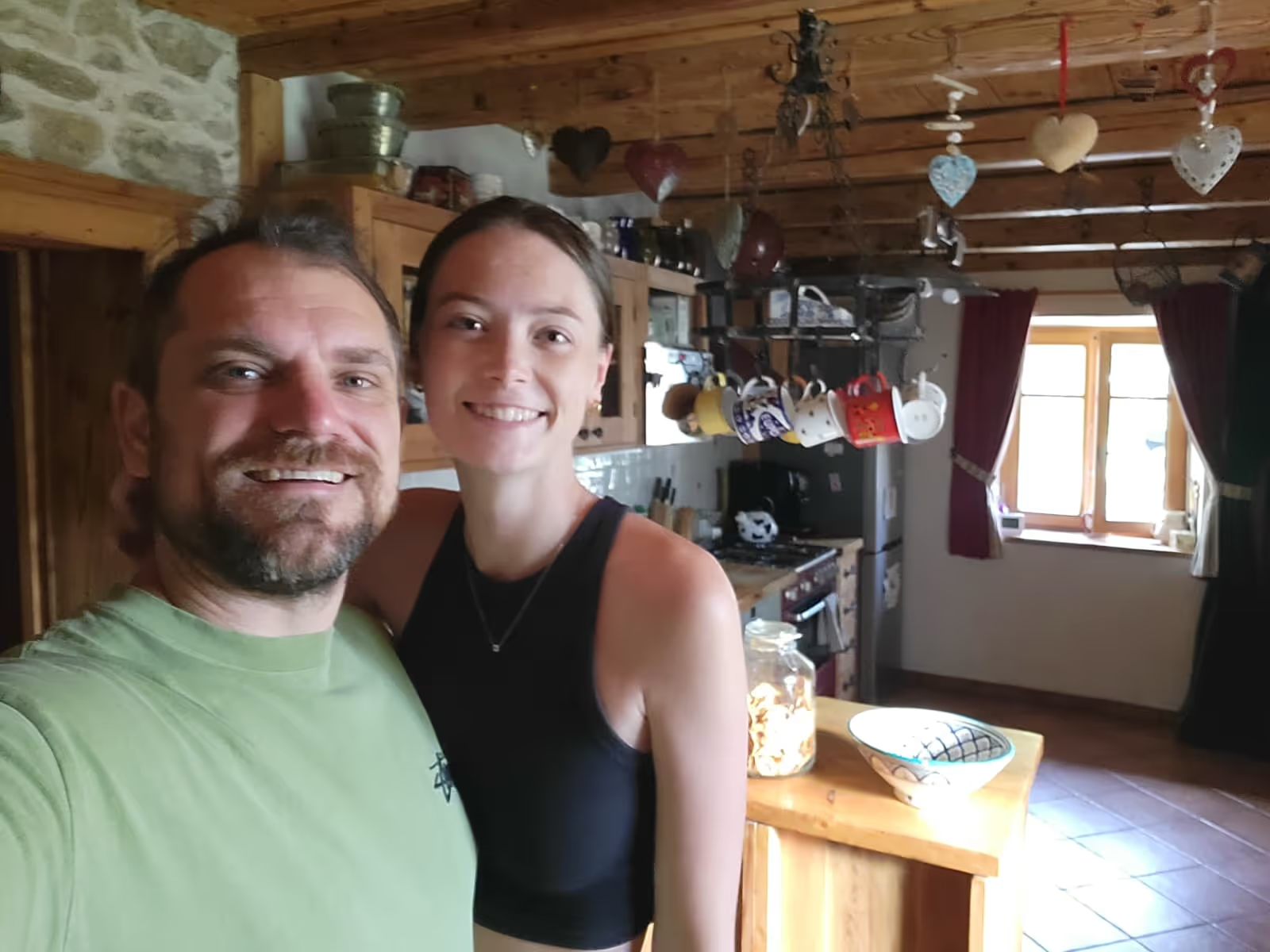
Konrad and Caro
DM us @housesittersguide if you have questions, we answer everyone.
FAQ
Why are retirees considered ideal house sitters?
Retirees offer the two things homeowners value most: time and reliability. A retired sitter with a long home-owning background, animal experience, and a flexible schedule gives homeowners confidence the sit will be fulfilled exactly as agreed. There are no work emergencies, no competing commitments, and no uncertainty about whether they have actually managed a home before. That combination is difficult to replicate at any other life stage.
Is house sitting physically demanding for seniors?
It depends entirely on the animals involved. Cats, small dogs, and low-energy breeds are genuinely low-impact and well-suited to sitters with mobility considerations. Large energetic dogs that need long daily runs are a different proposition. The critical step is matching your physical capability to the sit before you apply, not after you arrive. One sit that is a poor physical match can produce a difficult review. Many sits that are a good match build a consistent record homeowners trust.
Do I need prior experience to start house sitting as a retiree?
No, but you need to build trust before applying for competitive listings. Start with a local short sit, earn a real verified review, and use that as the foundation for everything that follows. Decades of home ownership and pet experience counts as relevant background even without formal sitting experience. Write it into your profile specifically rather than leaving homeowners to assume it.
How much does house sitting cost to get started?
The main cost is the platform membership, typically between €100 and €260 per year. Beyond that, your expenses are personal travel, food, and activities. Caro and I have spent roughly €400 on accommodation across three years and 20 sits in 12 countries. A single two-week sit in a destination where hotels cost €100 per night returns the membership cost before the sit ends.
What is the best type of sit for retirees?
Long-term sits of one to six months are the strongest match for most retired sitters. They give you a proper routine, a genuine bond with the animals, and a slow travel experience that short sits cannot replicate. Rural properties with gardens and manageable animals are the natural starting point for building a profile.
How do I find long-term house sitting opportunities?
Most major platforms allow you to filter by sit duration. Sits of one to three months and longer are common, particularly for homeowners going on extended trips. Our long-term house sitting guide covers how to find and apply for these specifically.
Are there age limits for house sitting?
No platform sets an upper age limit. What matters is what you can honestly deliver for the homeowner and their pets. Transparency about your physical capabilities and preferences in your profile is what earns trust, not a particular age.
Is international house sitting safe for seniors?
Yes, when using reputable platforms with verification processes and transparent review systems. Always do a thorough video call with every homeowner before confirming. Ensure comprehensive travel and health insurance is in place before any international trip and research visa requirements well in advance for longer stays. The community of homeowners on established platforms is generally very reliable.
Related Guides


Responses
What are your thoughts on this post?