Breadcrumbs: Home > House Sitting Guide > How to Handle a Negative Review on a House Sitting Site
Article updated on: February 2026
Some links in this article are affiliate links. If you sign up through them, we earn a small commission at no extra cost to you. This helps us keep the site running and create more free content for the house sitting community. We only recommend platforms we have personally used.
📊 Quick Facts
Have we personally received a negative review across 15+ sits? No. All have been 5-star
Have we left a negative review for a homeowner? Yes, once. Kefalonia. We documented flea bites and took a star off for cleanliness
What the THS double-blind review system does: Prevents either party gaming their response based on what the other wrote. Neither review is visible until both are submitted or the window closes
The single most effective response strategy: No emotion. Acknowledge, explain briefly if needed, thank them, wish them well. Let the reader decide who was reasonable
Prevention beats response: Most negative reviews are the result of a mismatch in expectations that could have been caught earlier
This guide was written by Konrad based on three years managing hospitality reviews for a hostel in Iceland and completing 15+ house sits across 9 countries with Caro. The advice comes from real experience, not generic research.
Before I ran the House Sitters Guide, I ran a hotel in Iceland. At peak we had over 2,000 five-star reviews, which sounds impressive until you remember that means there were also one-star reviews in the mix. Running a hospitality business in a remote location with demanding guests teaches you something that no amount of reading about reviews will: the response matters more than the review itself.
A one-star review with a gracious, calm, forward-looking reply often reads better to a prospective guest than a perfect score with no reviews at all. It shows a real person behind the business, someone who has faced difficulty and handled it well. That lesson has stayed with me and it applies directly to house sitting, for sitters and homeowners both.
This article covers both sides because a below-expectation review affects both parties differently but equally. For sitters on TrustedHouseSitters, a string of poor reviews can reduce the sits available to you. For homeowners, a poor review from a sitter can affect the quality of applicants willing to take your listing. A good response protects both.
Why Reviews Carry More Weight in House Sitting Than Most Platforms
On most review platforms, a three-star review sits among hundreds of others and loses significance quickly. House sitting profiles are different. Most sitters have completed between five and thirty sits in their lifetime on a platform. A single below-average review at sit number four is not buried. It is visible, proportionally significant, and will be read carefully by every homeowner considering you for the next twelve months.
TrustedHouseSitters introduced a five-application cap on listings. Homeowners now receive a maximum of five applicants per sit before the listing closes to new applications. That smaller pool means each applicant's review history is scrutinised far more carefully than it was when homeowners could compare twenty or thirty profiles at once. A single critical review on a five-sit profile is now harder to overlook than it was before the cap existed. Combined with the per-sit booking fees now charged to Basic and Standard members, the stakes around each individual sit have increased on both sides.
The same applies in reverse. A homeowner with one critical review from a sitter, where the sitter describes undisclosed pets, an uncleaned home, or conditions that were misrepresented, will notice a drop in the quality of applicants. Experienced sitters read homeowner reviews before applying. If something looks off, they move on.
This is why understanding how to respond, and more importantly how to prevent, matters more in house sitting than in almost any other review context. For a full picture of what sitters look at when assessing a listing, see our guide on what are red flags in a pet sitter, which covers the same assessment from both directions.
How the THS Double-Blind Review System Works in 2026
What is the TrustedHouseSitters double-blind review system? It is a process where neither the sitter nor the homeowner can see each other's feedback until both have submitted their review or the 14-day window closes. This prevents retaliatory reviews and stops either party from holding a five-star review hostage in exchange for a favour or silence about a problem.
The practical effect is that neither party can read the other's review and then craft a retaliatory or defensive response disguised as a review. You write your honest account of the sit before you know what the other person said. This was a deliberate design update introduced to combat review extortion, where one party implies they will leave a damaging review unless the other writes a glowing one first. The double-blind window removes the mechanism entirely.
What it means practically: if you sense tension at the end of a sit, write your review honestly and promptly. Do not wait, hoping the other party will go first so you can calibrate your response. The system is designed so that waiting gains you nothing. Write what you experienced, clearly and without hostility, and submit it.
The review and any public reply are then what future sitters and homeowners read. That public reply is where your real opportunity lies.

The First Thing to Do When a Negative Review Appears: Nothing
The 24-Hour Review Rule: If you receive a negative review, wait at least 24 hours before replying. Use this time to move from an emotional reaction to a professional response. In house sitting, your public reply is not an argument with the previous homeowner. It is a marketing pitch to your next one.
The instinct when you see a below-expectation review is to respond immediately. Do not.
Close the browser. Put your phone down. Go for a walk. Give it at least a few hours, or a full day if the review stings. The reply you write in the first thirty minutes of seeing a bad review is almost always the wrong one. It will contain emotion, even if you try to disguise it, and experienced readers will spot it.
Come back to it the next morning. Read the review again, this time trying to separate the complaint from the feeling. What is the actual claim being made? Is it about cleanliness, communication, pet care, a specific incident, or something more vague? Identifying the core of the complaint is the first step toward a reply that addresses it rather than reacts to it.
"Struggling to write your reply? Jump to our Interactive Response Scorecard to verify your draft is professional."
How to Write a Response That Works: For Sitters
The goal of a public reply is not to win an argument. Nobody reading it will have been there. They cannot verify what actually happened. What they can assess, and what they will assess, is how you handled it.
| Defensive Response | Professional Response |
|---|---|
| Disputes facts point by point | Acknowledges the concern briefly |
| Matches the emotional register of the review | Calm and neutral throughout |
| Focuses on what the reviewer got wrong | Focuses on what you will do differently |
| Long, detailed, reads as wounded | Four to six sentences maximum |
| Makes the reader uncomfortable | Makes the reader trust you more |
| Ends with a parting shot | Ends with a warm, clean close |
A response that blames, deflects, or matches the emotional register of a critical review tells the reader exactly what they need to know, and not in your favour. A response that is calm, brief, and forward-looking tells a different story entirely.
The structure that works:
Thank them briefly. Not effusively, just a single sentence. "Thank you for taking the time to leave feedback from our sit."
Acknowledge the concern without fully conceding. If there was a misunderstanding, say so clearly. "There appears to have been a miscommunication around the garden watering schedule, and I am sorry it fell short of your expectations."
State one factual point if genuinely necessary. Keep it to one sentence and keep it neutral. This is not the place for a detailed counter-argument.
Show what you have taken from it. This is the most important line. "This has been a useful reminder to agree a written checklist with homeowners before the sit begins, which I will do going forward."
End warmly. "I genuinely enjoyed my time with your animals and wish you well."
The entire response should be four to six sentences. No more. Length reads as defensiveness. Brevity reads as confidence.
Fill-in-the-blanks response templates by complaint type:
Cleanliness Complaint
"Thank you for the feedback, [Name]. I am sorry to hear the cleaning did not meet your standard. I followed the checklist provided at handover, but I have since added a final walk-through to my end-of-sit routine to make sure this does not happen again. I genuinely enjoyed caring for [Pet Name] and wish you well."
Communication Complaint
"Thank you for sharing this. I understand the update frequency was not what you were hoping for. I have taken this on board and will agree a specific communication schedule with homeowners before every sit going forward. It was a pleasure to spend time with [Pet Name]."
Pet Care Complaint
"Thank you for the feedback. I followed the routine as it was explained at handover, but I can see there was a gap in how we communicated expectations around [specific issue]. That is something I will address more thoroughly in future pre-sit conversations. I hope [Pet Name] is doing well."
General or Vague Complaint
"Thank you for taking the time to leave a review. I am sorry the sit did not fully meet your expectations. I have reflected on your feedback and will carry it into future sits. I enjoyed the experience and wish you all the best."
Keep the response to the length of the template. Longer is not more thorough. It is more defensive.
Using an AI tool to help draft and review your response is worth doing. Paste your draft and ask it to remove emotional language and flag anything that reads as defensive. It is a useful filter between what you want to say and what will actually serve you.
If you are new to the platform and have limited reviews, consider whether you have external references you can point to in your profile: past experience with animals, a character reference from a previous homeowner outside the platform, or other relevant background. These do not replace reviews but they give homeowners more to read and assess while your review history is still thin.

How to Write a Response That Works: For Homeowners
A sitter's review of a homeowner listing carries real weight with the experienced sitters you most want to attract. A critical review that goes unanswered, or worse, that receives a combative reply, will quietly filter out the best applicants.
The same principles apply. Thank them, acknowledge the concern, offer brief context if genuinely needed, and close warmly. If a sitter noted that the house was less clean than described, or that a pet's behaviour was more challenging than the listing indicated, a response that says "we have taken this on board and updated our listing to reflect it" is far more reassuring to the next applicant than a response that disputes the claim.
Homeowners who respond well to critical reviews signal something important: that they are reasonable people to deal with, that they take the arrangement seriously, and that a sitter who raises a concern will be heard rather than punished. That is exactly the kind of homeowner experienced sitters look for. See our guide on how to prepare for a house sitter for the practical steps that prevent most of the issues that generate critical reviews in the first place.
The Kefalonia Sit: Why We Left an Honest Review
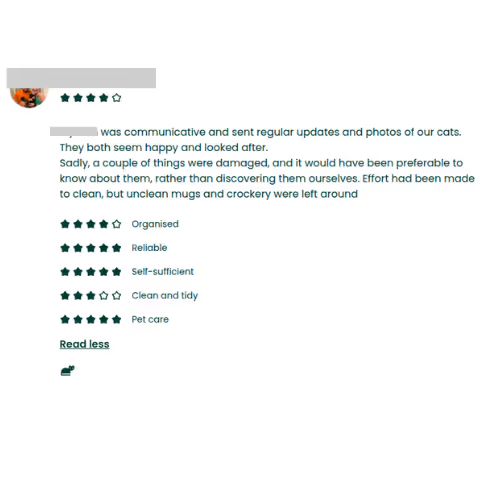
We arrived at our Kefalonia sit to find the property needed some cleaning. Over the course of the stay we discovered we had flea bites. We documented everything with photos.

At the end of the sit, we left a review. We were honest about the flea situation and we took a star off for cleanliness. We did not exaggerate and we did not write it in anger. We also wrote clearly that it was a fantastic experience overall and one we would genuinely do again.
The reason we wrote it that way is that a review is not primarily a message to the homeowner. It is information for the next sitter. If fleas appeared once, they might appear again. A future sitter who reads our review and finds it happening to them will not be surprised, and will be prepared. If it never happens again, our review ages into irrelevance. But if it becomes a pattern, other sitters can see it and make an informed decision. That is what an honest review system is for.
We did not write it to punish anyone. We wrote it because it was true, because future sitters deserved to know, and because the homeowner deserved the opportunity to address it before it became a repeated complaint.
When a Review Feels Malicious or Retaliatory
Occasionally a review crosses from critical into something that feels deliberately harmful, inaccurate, or retaliatory. This is relatively rare on platforms with double-blind systems, but it does happen.
If you believe a review violates the platform's terms, specifically if it contains false factual claims, personal information that should not be public, or language that crosses into harassment, contact support with documentation. Keep all your communications from the sit, any message threads, photos, and written agreements, as these form the evidence base for any dispute.
Platforms are generally reluctant to remove reviews unless they clearly breach terms, and even then the process takes time. Do not wait for a removal that may not come. Write your public reply as if the review will remain permanently, because it probably will. Your reply is the part you control. For a full breakdown of how platform disputes work and what THS support will and will not do, see our conflict resolution guide.
Prevention Is More Valuable Than Any Response
The most effective strategy for managing negative reviews is not having them to manage in the first place. This sounds obvious but the specific steps that prevent them are worth stating directly.
For sitters: communicate proactively throughout the sit, leave the home in at least the condition you found it (ideally better), follow the animal routine as closely as possible, and send photos of the pets unprompted. Most negative sitter reviews trace back to one of these four things being absent.
For homeowners: be honest in your listing about the property, the animals, and the workload involved. A sitter who arrives prepared for what the sit actually requires will perform better and review better than one who arrives expecting something different. The house sitting video call is the single best opportunity to align expectations before anyone commits.
The review exchange in house sitting is meant to be an equal one. Sitters are helping homeowners just as much as homeowners are helping sitters. It is a genuine exchange, not a transaction where one party has power over the other. When both sides approach it that way, the reviews tend to reflect that.
Conflict Resolution Checklist: Before You Hit Reply
Whether you are a sitter or a homeowner, run through this before posting any response to a negative review:
At least 24 hours have passed since you first read the review
You have re-read the review once more with fresh eyes
You have identified the single core complaint rather than every grievance
Your draft response is four to six sentences, no longer
You have removed any phrase that could be read as accusatory or defensive
You have not mentioned anything that disputes facts point by point
You have included one forward-looking sentence about what you will do differently
You have ended warmly and without a parting shot
You have run the draft through an AI tool or shown it to someone you trust before posting
You are posting because the response will serve future readers, not because you want the last word
Use our Review Response Scorecard to help you with completing the response
Konrad and Caro 🐾🚐
DM us @housesittersguide if you have questions — we answer everyone!
FAQ
How long should I wait before responding to a negative house sitting review
At least a few hours, ideally overnight. The response you write immediately after reading a bad review almost always contains emotion that will read poorly to anyone who sees it. Come back to it with a clear head, read it again as if you are a stranger seeing both the review and the reply for the first time, and write from that position.
Should I respond to every negative review or only some?
Always respond. Ignoring a negative review reads as indifference or as an admission that the complaint was valid. A calm, brief, professional reply shows that you take the arrangement seriously. Even a single sentence that thanks the reviewer and closes warmly is better than silence.
Can I get a false review removed from TrustedHouseSitters?
Possibly, but it is difficult and not guaranteed. Platforms will consider removal if a review contains false factual claims that can be disproved, personal information that should not be public, or content that violates their terms. Contact support with any documentation you have from the sit. In most cases your best outcome is a strong public reply that gives future readers the full picture. See our conflict resolution guide for how to approach the support process.
How does the THS double-blind review system protect against retaliation?
Neither party can see the other's review until both have been submitted or the review window closes. This means you cannot read a critical review and then write a retaliatory one in response. Both parties write what they actually experienced before seeing what the other said. It does not prevent someone from writing a dishonest review, but it removes the most common mechanism for review extortion, where one party implies they will leave a bad review unless the other writes a good one first.
As a homeowner, will a critical review from a sitter affect my future applications?
Yes, in practice it will. Experienced sitters read homeowner reviews carefully before applying. A critical review that is not responded to, or that receives a defensive reply, can quietly filter out the most capable applicants. A response that acknowledges the concern, explains any context, and describes what has been improved signals to future sitters that you are a reasonable and self-aware homeowner to work with.
Is it worth leaving an honest negative review for a homeowner even if the sit was otherwise good?
In our view, yes. We left an honest review for our Kefalonia sit that noted flea bites and took a star off for cleanliness, while also being clear that it was a sit we would do again. Reviews are information for the next sitter, not punishments for the homeowner. If something significant happened and you document it clearly and fairly, you are doing the community a service. If the issue was a one-off, your review ages into irrelevance. If it becomes a pattern, future sitters will be glad you wrote it.
What is the best way to prevent negative reviews in the first place?
For sitters: communicate well, follow the animal routine, leave the home in good condition, and send photos of the pets unprompted during the sit. For homeowners: be honest in your listing, prepare properly for the handover, and treat the sitter as an equal partner in the arrangement. Most negative reviews trace back to a mismatch in expectations that a better video call or a more honest listing would have prevented. See our guide on what to ask a homeowner before a house sit for how to close those gaps early.