Breadcrumbs: Home > House Sitting Guide > Should You Lend Your Car to a House Sitter
Article updated on: February 2026
Some links in this article are affiliate links. If you sign up through them, we earn a small commission at no extra cost to you. This helps us keep the site running and create more free content for the house sitting community. We only recommend platforms we have personally used.
📊 Quick Facts
Is a car expected by sitters? No. Most experienced sitters make their own transport arrangements and treat a car as a bonus
When a car genuinely matters: Remote or rural sits with limited public transport, particularly for month-long stays
The insurance rule: Call your insurer before anything else. Do not assume coverage exists
If you do lend it: Get the agreement in writing, confirm insurance in writing, document the car's condition beforehand
If you do not: A clear listing with transport alternatives is a perfectly good sit
The first and only time I was offered use of a car during a house sit, it did not go the way either of us expected.
I was in Montanel, France, on a solo sit. The homeowner had offered the car as part of the arrangement. It was included in the listing, mentioned on the call, and I had planned around having it available. Then, a few days before I flew from Australia to France, the owner contacted me asking for payment for both the car and the accommodation during the sit.
That was not what was agreed. And it was a significant lesson, not just about cars, but about the whole structure of international house sitting from the other side of the world. When you fly to a sit from Australia, you are genuinely at the mercy of the homeowner. The costs are sunk, the flights are booked, and saying no becomes very expensive. Now that Caro and I travel Europe continuously in our converted VW T4, we can always drive on to the next sit if something feels wrong. That flexibility changes everything. But that Montanel experience is why I think clearly about the car question, from both sides.
This guide is written for homeowners. But the sitter's perspective shapes the advice throughout, because the whole point is to create an arrangement that works well for both of you. If you are new to TrustedHouseSitters and still setting up your listing, understanding how sitters think about cars will help you write a more accurate and attractive profile.

A Car Is a Bonus, Not a Requirement
Summary: Most house sitters do not require a car and plan around not having one. A car becomes a practical necessity for rural or remote sits, particularly those lasting more than a week. Homeowners should only offer a vehicle if their insurance explicitly covers third-party drivers. Always confirm coverage in writing before including a car in your listing.
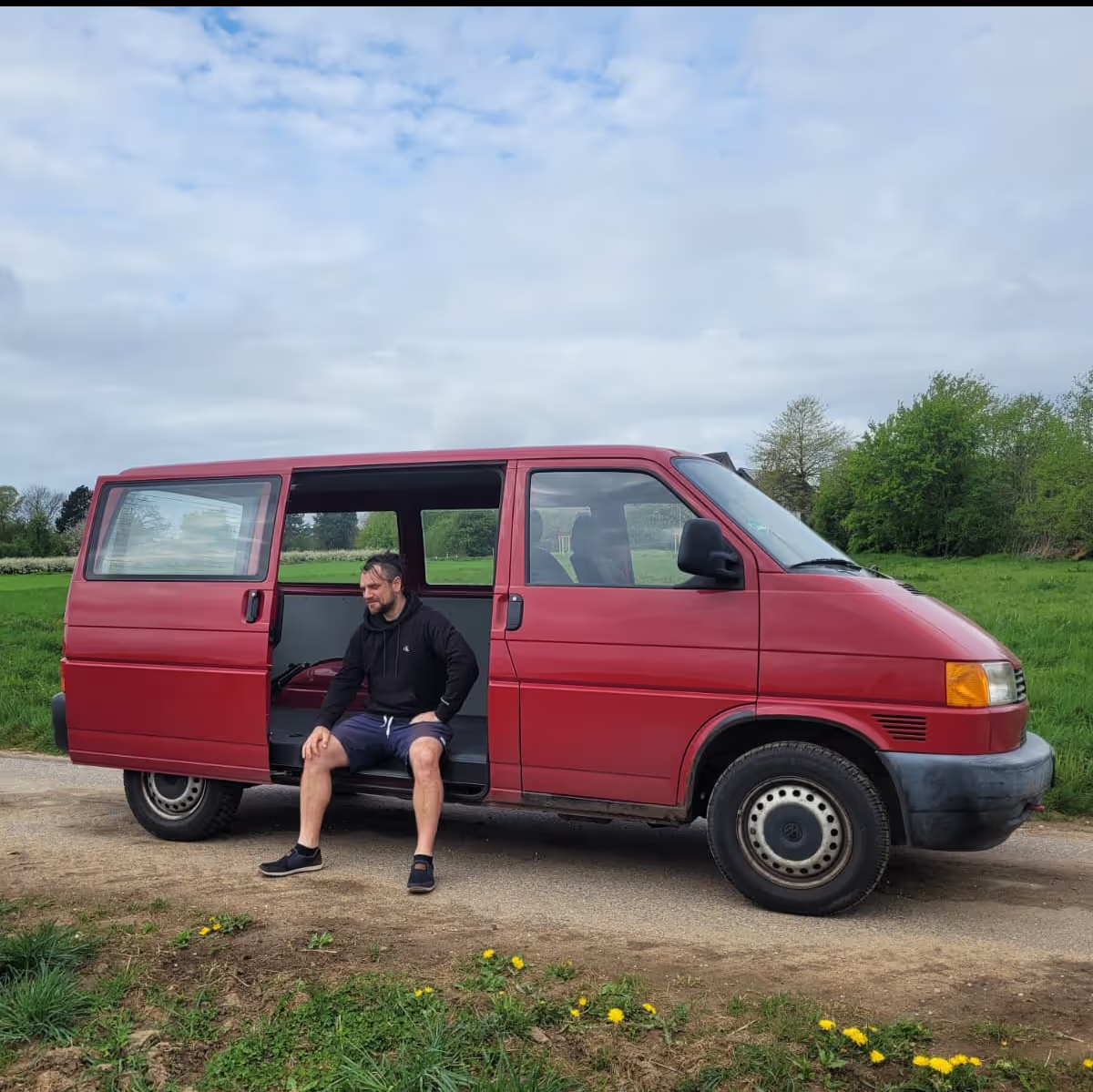
Most experienced sitters do not expect a car and do not need one to take a sit. Caro and I travel full-time in a converted VW T4, a compact vehicle that parks in narrow city streets, fits on most residential properties, and gives us complete transport independence wherever we go. We have parked directly outside the property in Athens, tucked into a side street in France, and used the van as our daily transport throughout sits across Europe.
For sitters like us, a car in the listing is a nice detail, not a deciding factor. We would not let the presence or absence of a homeowner's car determine whether we apply, unless we were flying into an unfamiliar country with no other options. In that case, and this is worth homeowners knowing, a car offer does meaningfully shift the appeal of a remote or rural listing.
From the sitter's perspective, the honest position is this: if a car is offered, it is the cherry on top. If it is not offered, that is fine too, provided the listing is honest about what transport options exist nearby. What is not fine is a car being implied in a listing and then the conversation changing after the sit is confirmed, or after flights are booked.
If you offer a car, mean it. If you do not want to lend it, do not include it in the listing. Clarity on this point before confirmation protects both sides.
When a Car Actually Matters: Rural vs Urban Sits
The transport question is almost entirely determined by location. For most urban and suburban sits, a sitter with a phone and a transit app can get wherever they need to go. For rural and remote sits, the calculation is completely different.
Our sit in Lullin, France was a month long and set in the countryside. Without a car, we would have been effectively stuck at the property for the duration. Public transport existed in theory, but the distances to the nearest town, the nearest supermarket, and any meaningful point of interest made daily life without a vehicle genuinely difficult. Having the car was not a perk. It was what made the sit workable as a month-long experience rather than a month spent looking at the same four walls.
In Athens, by contrast, the homeowners offered us their scooter. It was a generous gesture and we appreciated it. We declined, because the city was walkable, Uber was very affordable, and we had no need to add the complexity and risk of riding an unfamiliar scooter in heavy city traffic. The sit was excellent without it.
This distinction is worth thinking about as a homeowner. If your property is remote and you are considering listing it on TrustedHouseSitters, being honest about whether a car is necessary, rather than just available, helps attract sitters who are actually suited to that sit. A sitter who arrives at a rural property expecting to manage without a car, and then realises there is no realistic way to get supplies or explore the area, is a sitter who will find the sit more difficult than they expected.
| Location Type | Car Recommended? | Best Alternative | Risk Level if Offered |
|---|---|---|---|
| Major city (London, Athens, Paris) | Not recommended | Transit pass, Uber, walking | Low need, higher insurance complexity |
| Suburban area | Optional | Electric bike, local bus | Moderate, confirm policy first |
| Small town, walkable centre | Rarely needed | Cycling, occasional taxi | Low need |
| Rural or remote property | Usually essential | Sitter's own vehicle or hire car | High need, verify insurance carefully |
| Remote, month-long sit | Essential | Limited. Be honest in the listing | High need, written agreement recommended |
| International sit (sitter flying in) | Significant factor | Pre-booked airport shuttle, hire car | Use caution, confirm licence validity |
The Insurance Question: Call Before You Do Anything Else
This is a YMYL (Your Money, Your Life) topic — it involves real financial and legal liability — so we will be direct about the limits of what we can tell you here. We are not insurance advisors, policies vary significantly by country and provider, and the only person who can tell you whether your car is covered when a sitter drives it is your own insurer.
For general guidance on how car insurance works in your region, the Insurance Information Institute (US) and the Association of British Insurers (UK) both publish clear, free resources on permissive use and named driver policies. These are worth reading before you call your insurer so you know what questions to ask.
Call your insurer before you offer the car to anyone. The question to ask is simple: "Is my car covered if a friend borrows it for a few weeks while I am away?" Their answer will determine everything else.
Five-point insurance verification checklist before lending your car:
Does your policy cover a driver who is not named on it, and under what conditions?
Is that coverage limited compared to your standard policy limits?
Do you need to add the sitter as a named driver, and what does that cost?
Are there restrictions based on the sitter's age, nationality, or licence type?
Can the insurer confirm your coverage in writing, by email or letter?
Two additional questions worth raising that most people overlook in 2026:
Permissive use limits. Many UK and US policies allow a non-named friend to drive the car a limited number of times per year, often around 12 days. For a weekend sit this is rarely an issue. For a month-long sit, the sitter may exceed that limit mid-stay, at which point coverage lapses. If your sit is longer than a week or two, ask your insurer specifically how many permissive use days your policy allows and whether the sitter needs to be added as a named driver for the full duration.
Telematics and black box policies. In 2026, a significant number of car insurance policies are usage-based or pay-as-you-drive, with a telematics device recording speed, location, and driving hours. If your policy has a curfew, driving between midnight and 6am may void coverage entirely, regardless of whether the sitter had your permission. If your car has a black box, check whether the policy has time or speed restrictions and include this in what you tell the sitter before they drive.
International Driving Permits. If your sitter is flying in from abroad, verify whether they need an International Driving Permit (IDP) before they can legally drive your car. In 2026, many insurers in the EU and UK require an IDP to validate permissive use coverage for non-resident licence holders. A sitter driving on a foreign licence without a valid IDP may not be covered at all, even if you have explicitly given permission.
Do not assume the answer. Do not rely on a general reading of your policy documents. Call and ask directly. If your insurer confirms coverage exists for a non-named driver, ask them to confirm the limits in writing before you hand over the keys.
The reason this matters: if an accident occurs and your sitter is not properly covered, you may be liable for costs, your claim could be disputed, and your future premiums will almost certainly be affected regardless of who was at fault.
If You Decide to Lend the Car: What to Agree in Writing
If your insurance is confirmed and you want to offer the car, the arrangement works best when it is clear from the start. Raising new conditions after the sit is confirmed, or after the sitter has booked flights, is the situation most likely to cause genuine friction. The Montanel experience is a real example of what that looks like from the sitter's side.
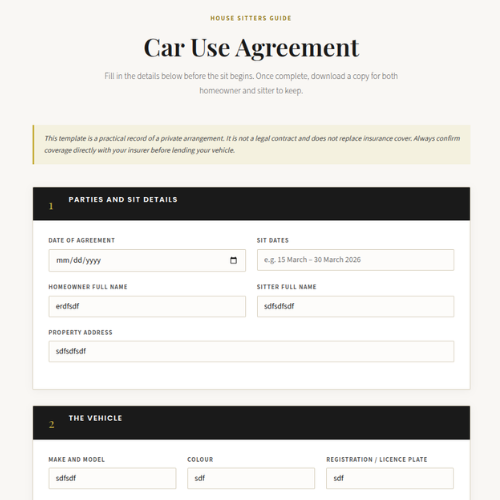
We have created a simple car use agreement template that covers everything worth documenting before handover. It is not a legal contract, but it gives both parties a shared written record of what was agreed, the vehicle's condition at the start, insurance details, and what to do in the event of an incident. Fill it out online together at the handover, and keep a download it on your phone.
Don't rely on a handshake. Use our interactive Car Use Agreement tool below to document your insurance and vehicle condition in under 5 minutes.
Car Use Agreement Template
Before the sitter arrives, agree and document the following:
Insurance confirmed: who is covered, to what extent, and how
Whether the sitter will cover any cost of being added to the policy
The condition of the car at handover, documented with photos
Any restrictions on use: distance limits, specific areas, motorway driving
Fuel arrangement: return it full, return it as found, or split costs
What to do in the event of a minor incident or damage
Where the car documents are kept and how to access them in an emergency
Put this in writing on the platform or in a message thread before the sit begins. Not because sitters cannot be trusted, but because clarity at the start prevents any ambiguity if something minor does happen. A small scratch is a much easier conversation when everyone already knows what was agreed.
If You Decide Not to Lend the Car: How to Make the Listing Work
Not lending your car is a completely reasonable position and, for many homeowners, the right one. The key is being honest about it in the listing and proactively telling sitters what their options are.
A listing that says "no car available" and nothing else leaves the sitter to guess whether the location is walkable, whether there is a bus, or whether they will need to hire something. A listing that says "no car available, 10 minutes walk to the town centre with a supermarket, bus to the city every 30 minutes from the corner" gives the sitter exactly what they need to make a good decision.
As part of your Welcome Guide preparation, a short transport section goes a long way: the nearest bus or train stop and its frequency, the best local transport app, a reliable taxi or Uber option, and any cycling or walking routes worth knowing about. This is the kind of preparation that turns a "no car" listing into a well-organised one.
The Homeowner's Car Decision Checklist
Before deciding whether to offer the car:
Called insurer and confirmed coverage for a non-named driver
Understood the limits of that coverage compared to standard policy
Considered whether the location genuinely requires a car for the sit to work well
Decided whether the sitter being added as a named driver is necessary and at whose cost
If offering the car:
Insurance confirmed in writing
Car condition documented with photos before handover
Fuel, distance, and usage terms agreed in writing before the sit starts
Emergency procedure agreed: who the sitter calls, where the documents are
Any restrictions communicated clearly before confirmation
If not offering the car:
Listing states clearly that no car is available
Transport alternatives listed in the listing and in the Welcome Guide
Welcome Guide includes nearest public transport, taxi options, and local apps
Konrad and Caro 🐾🚐
DM us @housesittersguide if you have questions — we answer everyone!

FAQ
Is it normal for homeowners to offer a car to house sitters?
It happens, but it is not standard or expected. Most experienced sitters make their own transport arrangements and plan around not having a car. A car offer is a genuine perk, particularly for rural or remote sits where public transport is limited. For urban sits, most sitters can manage well without one. See our article on what house sitters usually do for a broader picture of how sitters plan their day-to-day.
What happens if the sitter has an accident in my car?
This depends entirely on your insurance policy and whether the sitter was properly covered at the time. If they were not, you may be liable for the costs and your premiums are likely to be affected. This is why confirming coverage with your insurer before offering the car is the only sensible starting point. Do not assume a standard policy covers any driver with permission. Call and confirm.
Can I ask the sitter to pay for being added to my insurance?
Yes, this is a reasonable request if you are adding them as a named driver and there is a fee involved. Raise it before the sit is confirmed so there are no surprises. Like any financial arrangement within a sit, agreeing it in writing beforehand is cleaner than discussing it after the fact.
What if the homeowner offers a car and then tries to charge for it after I have already booked travel?
This happened to us and it is one of the more stressful situations a sitter can face, particularly on an international sit where costs are already committed. The best protection is having the original offer documented on the platform before travel is booked. If the terms change after confirmation, raise it with THS support and keep all communications in writing. For guidance on how to handle situations where agreed terms shift, see our conflict resolution guide.
Does offering a car make a listing more attractive to sitters?
It depends on the location. For a remote or rural sit, a car can be the difference between an appealing listing and an impractical one. For an urban sit with good public transport, most experienced sitters will not weight it heavily. Being honest about what transport options exist, with or without a car, is more valuable than a vague offer that creates ambiguity.
Should I disclose the car situation in the listing before sitters apply?
Yes, always. If a car is available, say so and note any conditions. If it is not available, say so and describe what transport options exist nearby. Ambiguity on this point causes problems later, especially if a sitter has planned around an assumption that turned out to be wrong.
What is the safest approach if I want to offer a car but am uncertain about insurance?
Verify your coverage first. If you cannot confirm that the sitter is properly covered under your existing policy, the options are to add them as a named driver, or to not offer the car. A car offered without confirmed insurance is a risk that sits entirely with you as the homeowner, not with the platform and not with the sitter.