

Home > Blog > What to Tell Customs When House Sitting Abroad
Quick Facts
| Simplest border answer | "I am travelling as a tourist and staying with friends" |
| The real strategy | Travel first, house sit second, never the other way around, with a genuine Plan B if it falls through |
| US visa risk | Real and documented. CBP has enforced deportations over unpaid house sitting, treating it as unauthorized work regardless of how it's described. Does not apply to US citizens or permanent residents |
| UK, Australia, Canada | All take a stricter interpretation than most other countries. Extra care and accurate framing genuinely matter here |
| EU citizens within Schengen | No border checks, no visa concerns, no customs between member states |
| Non-EU visitors to Schengen | 90 days maximum, house sitting within that creates no complications |
| UK ETA (current) | £20 as of 8 April 2026, apply online at gov.uk before travel |
| EU ETIAS | €20 (raised from €7 in July 2025), under-18s and over-70s exempt from the fee. Targeting Q4 2026 launch, not yet operational as of writing, always check the official ETIAS page for the current status |
| What to carry | Return or onward travel booking, proof of liquid funds (not just a credit limit), travel insurance, homeowner contact, and ideally a hotel or hostel booking for your first night or two |
| Who is responsible for compliance | You are. Not the platform, not this article, not anyone else |
Say you are a tourist staying with friends, never the phrase house sitting. That is accurate and works at almost every border. Two exceptions: US Customs and Border Protection treats unpaid house sitting as work, with documented deportations, and the UK agrees. Arrive a day or two early.
This is not immigration or legal advice. We are not immigration lawyers or licensed advisors. The information in this article is based on our own research and experience, and immigration and visa rules change frequently and vary by nationality, country, and individual circumstances. Always confirm current requirements directly with the relevant embassy, consulate, or a qualified immigration professional before you travel. A platform's own invitation letter or welcome documentation is not a legal guarantee of entry and may carry little weight with a skeptical immigration officer, treat it as helpful context, not proof of anything.
You are not trying to get away with something, and this is not simply a phrasing trick. For most countries, describing yourself accurately as a tourist staying with people you know is genuinely low-risk. For the US specifically, that framing reduces risk but does not eliminate it: US Customs and Border Protection has taken and enforced the explicit position that unpaid house sitting constitutes work, with real, documented deportation cases on record. The responsibility for getting this right, in every country, is entirely yours.
Most advice on this topic treats it as a simple problem of word choice, say the right thing at the border and you'll be fine. For the majority of countries and situations, that's a reasonable summary. But we don't think it's honest to leave it there, because for at least one major destination, the US, the actual documented reality is more serious than a phrasing issue, and pretending otherwise does readers a disservice.
This guide covers both things properly: the general approach that works well almost everywhere, built from our own experience crossing dozens of borders, and the specific, sourced detail on where that general approach genuinely isn't enough, most notably in the US, where real enforcement action has already happened to real sitters. Read the whole thing before you travel, not just the part that tells you what you want to hear.
Why "House Sitting" Creates Problems at the Border
Most countries draw a legal line at receiving compensation for services while on a tourist visa. Free accommodation in exchange for pet care occupies a grey area in some jurisdictions because the accommodation is a form of in-kind compensation. An immigration officer who hears "house sitting" may hear "working without a visa" and the conversation deteriorates from there.
This is not because house sitting is illegal. It is because the phrase triggers a category that border agents are trained to investigate. The same arrangement, described accurately but differently, raises no concerns at all.
The countries where this matters most are the UK, the USA, and Australia, where visa conditions are specific and enforced carefully. The Schengen zone is significantly more simple, and within it European citizens face no border checks at all.
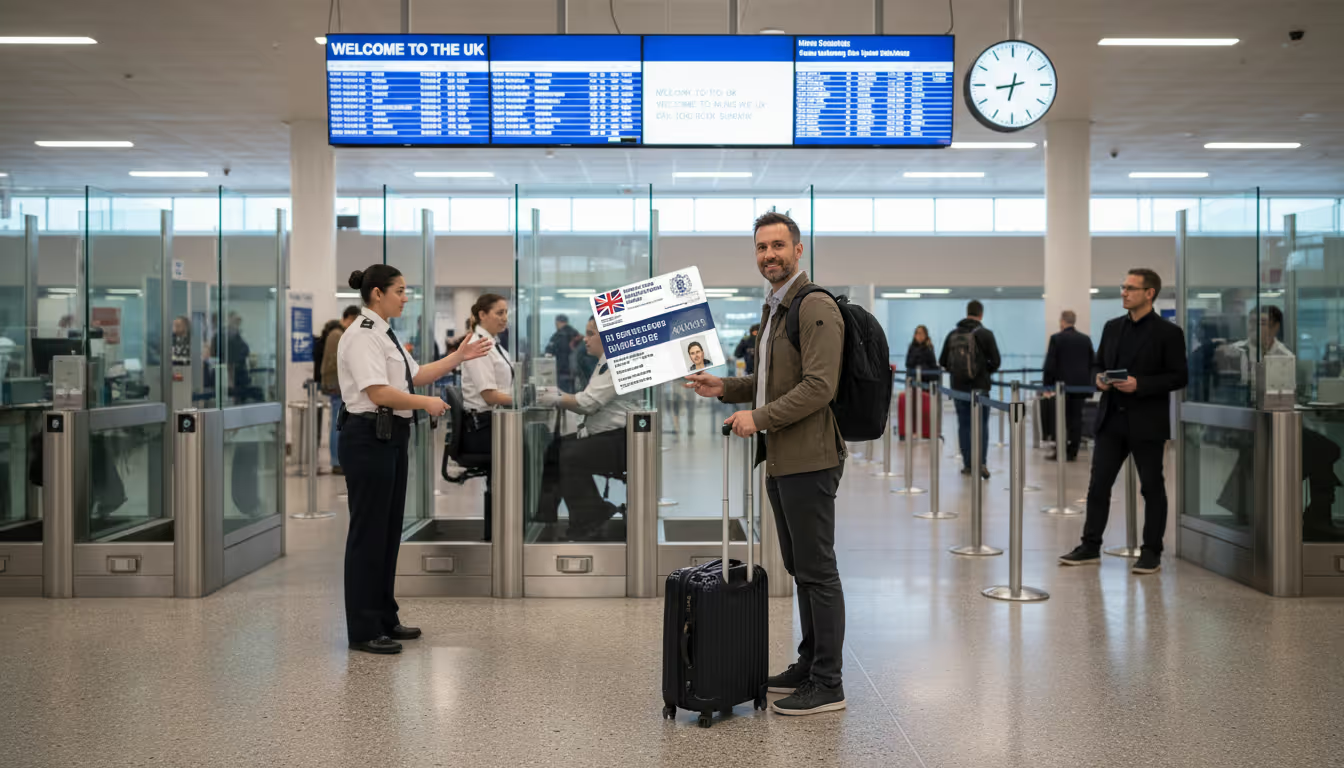
The Mindset That Makes Border Crossings Simple
When Caro and I travelled to Australia, Caro applied for a tourist visa and wrote that she was travelling as a tourist. At the border, there were no complications. That is because she was telling the truth. We had not gone to Australia because of house sits. We went because we wanted to explore it. The sits happened organically while we were already there.
That sequence is the key. We were not in Australia because of a sit. The sits happened because we were in Australia.
If you travel specifically because of a sit you found online, you are carrying risk that has nothing to do with customs. What happens if the sit cancels a week before you fly? What happens if the homeowner has a family emergency? What happens if you miss the handover? You have organised your entire trip around a single arrangement that could collapse at any point.
The practical and honest approach: decide where you want to go, travel there as a tourist, and treat any house sit that appears as a bonus on top of an already-planned trip. When you cross the border you are not constructing a story. You are a tourist who is also going to stay with some people you know for part of the trip. That is the complete truth.
For European Citizens: The Schengen Advantage
Caro is German. Konrad holds Polish and Australian citizenship. Within the Schengen zone, there are no passport checks at internal borders, no customs declarations between member states, and no visa requirements.
Travelling from Germany to Switzerland to Italy to Greece to France (all sits we have done) involved no border formalities whatsoever. We simply drove or took a ferry and arrived. The customs question that concerns many house sitters does not exist within this area.
For non-European visitors, the Schengen zone allows most nationalities a 90-day tourist stay. Across those 90 days you can house sit freely across dozens of countries without any border complications, as long as you stay within the time limit. Three months sitting across Spain, Portugal, France, Italy, and Greece is entirely possible without a single customs conversation. Our Europe guide covers the Schengen 90/180 rule, ETIAS, and long-stay visa requirements for sits beyond 90 days.
When Borders Do Come Up
We had one crossing that involved documents and questions: driving from Italy into Albania on the way to take a ferry. Albanian customs asked for our documents, asked us to declare alcohol, cigarettes, and cash, and asked where we were going. We said we were travelling. That was the end of it.
The reason it was that simple is because we were travelling. There was no complicated story to maintain. We said what was true.
What to Say If You Are Heading Directly to a Sit
If a customs officer asks where you are staying and you are heading directly to a sit, the accurate answer is that you are staying with friends. This is not a workaround. It is a genuine description of the relationship.
When you do a video call with homeowners before a sit, you spend 30 minutes learning their names, hearing about their animals, seeing their home, and talking about your lives. By the time you arrive, these are people you know. Describing them as friends is accurate.
If pressed further, the honest answer is: "I'm travelling, and I'm staying with some people I met through a travel platform while I'm here." That is true. You are not working. You are not receiving a salary. You are a tourist staying with people you know.
What you avoid saying: "I'm house sitting." The phrase triggers questions that do not serve you regardless of how simple your actual situation is.
What to Have on Your Phone
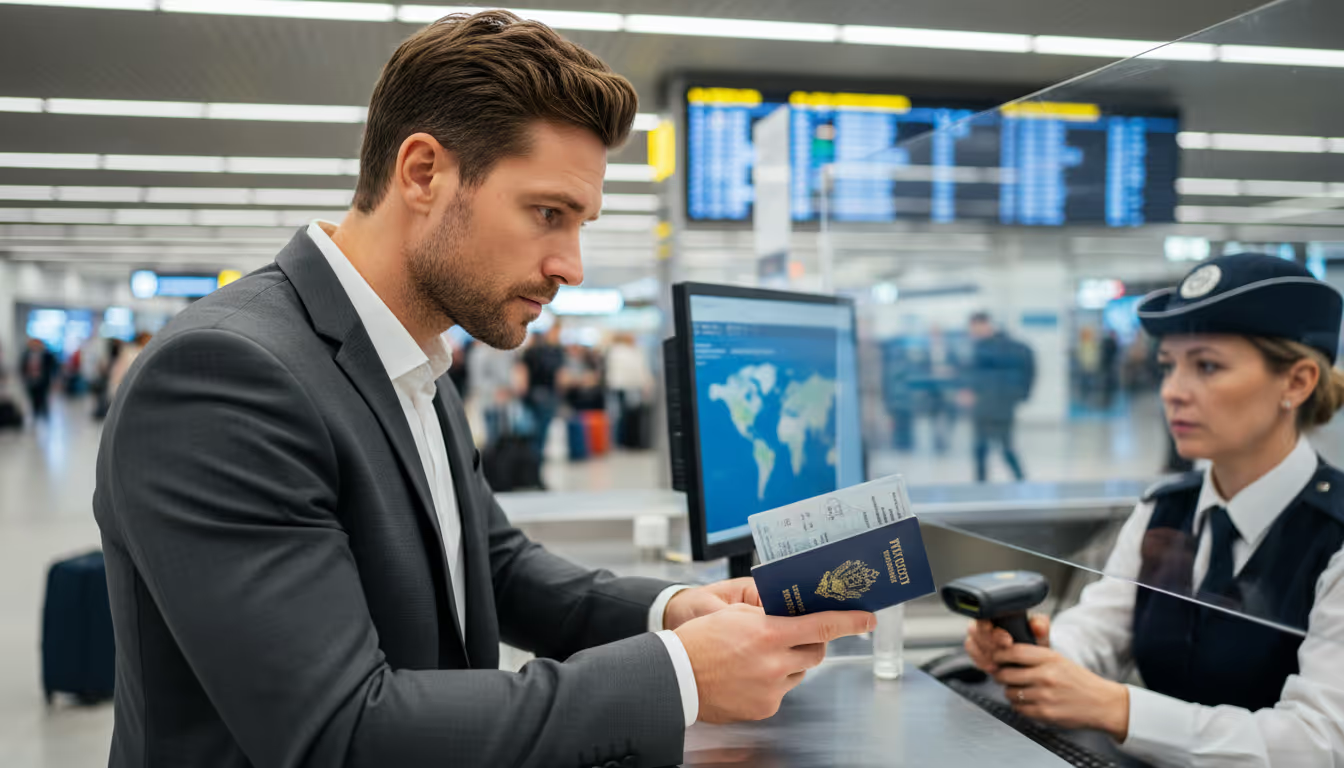
Customs officers can ask for evidence of onward travel, proof of funds, and confirmation of where you are staying. Having these accessible before you arrive at any border is sensible preparation:
A screenshot or PDF of your return or onward travel booking shows you have a plan to leave. This is one of the most common requests at UK and US borders.
A screenshot of a WhatsApp conversation or email with the homeowner, showing a name and an address, demonstrates you have a confirmed place to stay. You do not need to explain the arrangement beyond "I'm staying with friends."
Evidence of sufficient funds. A bank balance or credit card with a reasonable limit covers most borders, but in 2026 some UK border officers are asking to see liquid funds in a banking app rather than just a credit card limit. The reasoning is that a credit card could indicate someone planning to work to cover daily expenses. Having your banking app open with a visible balance showing you can cover food and accommodation without needing to earn anything is a stronger answer than showing a card. Some officers specifically distinguish a credit limit from money you actually have, having your banking app open with a visible, spendable balance is the stronger answer of the two.
Your travel insurance details. All major platforms require sitters to have travel insurance in place before a sit begins. Having the document on your phone is good practice for any border crossing.
Offline Google Maps for the destination country, downloaded before you travel. Also offline Google Translate with the relevant language pack. Not for customs specifically, but for everything that follows once you are through.
UK and US Sits: Extra Care Required
These are the two countries where sitters report the most complications when house sitting comes up at the border. Both have strict tourist visa conditions and border agents who apply them carefully.
UK: Most non-visa visitors including Australians, Americans, and Canadians now require an Electronic Travel Authorisation (ETA) before arrival. The UK ETA currently costs £20. Apply through the official GOV.UK page or the UK ETA app. Avoid third-party sites that charge inflated fees. Most applications are approved within minutes. At the border, describe your trip as visiting and travelling. The word "house sitting" is unnecessary.
US: This requires more caution than the guidance above suggests. US Customs and Border Protection has taken and enforced the explicit position that unpaid house sitting constitutes work, because free accommodation received in exchange for pet and home care counts as compensation, a direct violation of Visa Waiver Program and B-1/B-2 terms. This isn't a theoretical risk, documented deportation cases exist. The full detail, including exactly what CBP has said and what actually happened in real cases, is covered in depth below. Carry proof of onward travel and proof of funds regardless.

The Actual Visa Requirements for House Sitting in the US
This is a real, documented issue, not a theoretical grey area. US Customs and Border Protection has taken the explicit position that unpaid house sitting constitutes work, because the free accommodation received counts as compensation for services rendered, and this directly conflicts with the terms of the Visa Waiver Program (ESTA), which prohibit entrants from receiving any compensation for services performed during their stay. A documented case exists of a house sitter being deported from Los Angeles International Airport on exactly this basis, with the case also covered by The Guardian/Observer. A separate case involving an Australian sitter deported on the same grounds was reported directly by a CBP spokesperson to Business Insider, who confirmed: "working as a house-and-animal sitter in exchange for room and board" breaches Visa Waiver Program guidelines.
TrustedHouseSitters' own stated position is that international house sitting is fine for genuine tourists, since the purpose of the trip is a holiday, not employment. But that's the platform's interpretation, not CBP's, and the deportation cases show the two don't agree. The UK takes an equally strict position, the Home Office has told Reuters directly that house sitting is considered work there too and isn't permitted under a UK tourist visa. This isn't unique to America, and our full house sitting legal issues guide covers this same tension across other jurisdictions.
Separately, the general entry framework worth knowing: most visitors enter either via ESTA (90 days maximum, no extensions, available to citizens of 42 countries including the UK, Germany, France, Australia, and New Zealand) or a B-1/B-2 visitor visa for citizens of other countries, generally valid up to six months with the possibility of an extension. Both categories are legally defined to exclude "skilled or unskilled labor" and "local employment or labor for hire", the exact language CBP has used to justify treating unpaid house sitting as a violation.
Worth noting for balance: enforcement appears inconsistent rather than universal. One full-time house sitter with 12 years of experience reports always traveling on a standard visitor visa without incident, describing the arrangement as equivalent to volunteering. That inconsistency isn't the same as safety, it simply means the risk is real but not evenly applied.
The practical reality, based on what's documented, is that this remains a genuine, unresolved conflict between how the industry describes itself and how at least two governments have actually enforced entry rules. If you're planning to house sit in the US, we'd strongly recommend researching your specific situation directly with an immigration professional rather than relying on platform guidance or general community wisdom, given that CBP has already demonstrated it's willing to act on this position at the border. Our best platforms for international house sitting guide covers other countries worth considering if this changes your plans.
This risk applies specifically to non-citizens and non-permanent-residents. US citizens and lawful permanent residents face none of this, house sitting within your own country carries no visa complication whatsoever, this entire section concerns international sitters only.
It's also worth being precise about what actually creates the risk: CBP's stated position focuses on the underlying activity, an exchange of services for lodging, not merely the specific words used to describe it at the border. Framing your trip accurately as tourism reduces the chance the topic comes up at all, but it does not change the underlying legal classification if it does.

You Are Responsible for Your Own Visa Compliance
This is the one thing that matters more than anything else in this article: whatever you decide, the legal responsibility for entering a country under the correct visa classification is entirely yours. Not the platform's, not ours, and not anyone else's. TrustedHouseSitters' own stated position that international house sitting is acceptable for tourists has already proven, in at least one documented case, to carry no weight at the actual border. If you're refused entry or deported, the platform bears no consequence. You do.
Before committing to any international house sit in a country that requires a visa, the responsible step is researching your specific situation directly with your destination country's official immigration resources, or consulting an immigration attorney, not relying on this article, a forum thread, or general community practice.
Our Own Approach, and Why We Frame It as Risk, Not a Solution
We want to be direct about something: we've personally never been questioned about house sitting at any border. But we think it's important to explain exactly why, because it isn't because we've found a safe workaround, it's because of how we structure our own travel.
We never travel to a visa-required country with house sitting as our stated or actual purpose for entry. We go as tourists first, with genuine tourist intentions and a real plan for the trip regardless of whether a sit comes through. Only once we're already in the country do we look at whether a house sit makes sense to fold into that trip. If nothing comes up, we simply continue with the plans we already had. That sequencing matters to us specifically because our declared purpose for entering the country was never house sitting in the first place, it was tourism, genuinely.
If we were ever directly questioned by an immigration officer about accommodation arrangements, our honest answer would be that we're visiting friends. We want to be completely clear about what that actually is: a real risk we would be choosing to take, not a verified safe strategy, and not something we're recommending you do.
Given everything documented in the section above, real deportation cases, an explicit CBP position that unpaid house sitting constitutes work, that kind of answer carries genuine legal exposure if it doesn't hold up to scrutiny. It's simply the level of risk we've personally decided we're comfortable with, based on our own read of our own situation.

This Is Not Advice
Everything in this section describes our own thought process and our own risk tolerance, nothing more. It is not a recommendation, and it should not be treated as a safe or verified approach for anyone else.
Visa enforcement, individual circumstances, nationality, and destination all vary enormously, and what carries low risk for us in one context could carry real, serious consequences for someone else.
If you're planning international house sitting anywhere visa requirements apply, do your own research directly with official sources, and strongly consider speaking with an immigration professional before you travel, rather than basing your own decision on how anyone else, including us, has chosen to handle it. Our house sitting scams and red flags guide is a good companion piece for approaching the whole process with the same level of caution.
2026 Entry Requirements: What Has Changed
UK ETA: Currently £20, raised from £16 on 8 April 2026. Required for most non-visa visitors before arrival, including Australians, Americans, and Canadians. Apply through the official GOV.UK page or the UK ETA app, avoid third-party sites charging inflated fees. Most applications are approved within minutes.
This applies even if you're only transiting through the UK and never actually leaving the airport. I found this out directly on a recent flight from Portugal to Cyprus that connected through the UK, I wasn't planning to leave the airport at all, but was still advised I needed the ETA. The process itself was genuinely fast: I downloaded the official app, scanned my passport, did a face scan, and had approval back within about 20 minutes. The fee was £20, confirming the current rate. Worth knowing in advance if any part of your route touches the UK, even briefly, since it's easy to assume a pure transit doesn't require it.
EU ETIAS: Currently priced at €20, not the €7 figure originally set in 2018, the European Commission formally raised it in July 2025, citing inflation, higher operational and cybersecurity costs, and alignment with comparable systems abroad (the US ESTA itself was raised from $21 to $40 in September 2025). Travelers under 18 or over 70 remain exempt from the fee, though they still need an approved authorization once the system is live. ETIAS is still targeting a Q4 2026 launch with a six-month grace period before it becomes strictly mandatory in April 2027, though the timeline has already slipped once and could move again. As of writing, it is not yet operational, no action is required, check the official ETIAS page directly for the current status before you travel.
Both are entry authorisations, not visas. They do not change what you are permitted to do during your stay. They are administrative requirements before arrival, and the consequence of not having them is being denied boarding.
The Handover Timing Mistake
One practical mistake sitters make is arriving in the country on the exact day the sit starts. If you fly in two hours before a handover and arrive at the border with multiple bags and a specific address ready, it can look like you are arriving for a work arrangement rather than a holiday.
The simple fix: arrive one to two days before the sit begins. Spend a night in a hostel or budget hotel, visit something in the city, and settle in as a tourist before heading to the homeowner's property. When you are at the border, you are not heading directly to a sit. You are starting a trip. The sit is something happening in a couple of days, once you have oriented yourself. That distinction in timing changes how the arrival reads entirely, both to a customs officer and to yourself.
Arriving with no fallback plan, no hotel booked, nowhere to go if the sit falls through or is delayed, quietly undermines the "genuine tourist" framing even if you never say a word about it. A booked first night or two somewhere independent of the sit is a small cost that makes your actual story more consistent, not just what you say, but what you've genuinely planned for.
Conclusion
You are a tourist. You are travelling somewhere you want to explore. While you are there, you are staying with people you know for part of the trip. That is the complete, accurate description of house sitting as a travel model, and for most borders, in most countries, it's genuinely all you need.
The framing is not a trick. It is an accurate description of what house sitting is when done well: travel first, sit second. When you approach it that way, the customs conversation is simple because you are telling the truth.
For the US specifically, this framing reduces risk but does not eliminate it. Read the dedicated section above before assuming any approach, ours included, is fully safe, and treat this article as a starting point for your own research rather than a substitute for it.
For the full legal context of what house sitting is and is not under platform terms and immigration law, and for Europe-specific rules including Schengen and ETIAS, our Europe guide has everything you need.
Use our 25% discount on TrustedHouseSitters to get started and find sits in the regions you want to explore.
DM us @housesittersguide on Instagram if you have questions about border crossings and house sitting. We answer everyone.

Frequently Asked Questions
What should I say at customs when house sitting abroad?
"I am travelling as a tourist and staying with friends." This is accurate. Do not use the phrase "house sitting" at any border. It triggers a category of questioning that does not serve you regardless of how clear your situation actually is.
Is house sitting legal on a tourist visa?
This varies significantly by country, and the US specifically has documented, enforced cases treating it as employment. In most countries it operates as an unofficial grey area with low practical risk. The US is a clear exception, US Customs and Border Protection has taken and enforced the position that unpaid house sitting is work, with real deportation cases on record. The UK has taken a similarly strict position. Don't assume this is universally low-risk, research your specific destination directly.
Do I need special documentation to house sit internationally?
No special documentation beyond what any tourist requires. However, having your return or onward travel booking, evidence of funds, travel insurance details, and a contact address accessible on your phone is sensible preparation for any border crossing.
What is ETIAS and do I need it for house sitting in Europe?
ETIAS is the EU's Electronic Travel Information and Authorisation System, expected to launch in Q4 2026. As of April 2026 it is not yet active and no action is required. The official ETIAS page will confirm the launch date when known. When it launches, it will cost €20 and cover multiple Schengen entries for three years. Our Europe guide covers ETIAS and the Schengen 90/180 rule.
What is the UK ETA and who needs it?
The UK Electronic Travel Authorisation is required for most non-visa visitors before arrival, including Australians, Americans, and Canadians. The UK ETA currently costs £20, is applied for online, and typically approved within minutes. It came into force in late 2025. Apply before you travel.


Responses
What are your thoughts on this post?