

Home > Blog > House Sitting Packing List 2026: Must-Have Supplies for Every Sit
Quick Facts
| Quick Facts | |
|---|---|
| Clothing | 3-4 days rotation, you have a washing machine |
| Single most useful tech item | GaN charger, charges all devices from one block |
| Pet supplies to bring | Poop bags only, homes have everything else |
| Pet treats | Leave them at home, many pets are on strict diets |
| Cleaning supplies | Not needed, homes are fully equipped |
| Water | Bring a Brita filter if you are sensitive to water changes and you are arriving with a car to the house sit |
| Welcome gift | A bottle of Bio white wine, always appreciated |
| Extras worth considering | Earplugs, a basic first aid kit, a door wedge for peace of mind |
| Sit count this guide is based on | 20 sits across 12 countries |
The most common packing mistake new house sitters make is treating the sit like a hotel stay. You are not going to a resort. You are moving into a fully functional home with a kitchen, a washing machine, cleaning supplies, and usually more than enough of everything you need. Pack for the life you already live, not for a trip. The list is shorter than you think.
Caro and I have done 20 house sits across 12 countries over three years of travel. My entire life fits inside a 24-litre carry-on backpack.
That is not a flex. It is the result of stripping everything back to what actually gets used and leaving the rest behind. This guide is built from what we have genuinely needed across sits in Portugal, Germany, Greece, Australia, and beyond, not from a theoretical checklist.
If you are interested in getting into house sitting, our book Travel More for Less puts the whole process in one place: clear, step by step guidance from your first questions to your first confirmed sit, and the reviews that open the door to the next one.
Packing is one stage of five. For the rest, from reading the listing to the last morning, our house sitting checklist puts the whole sequence in one place.
The One Packing Rule That Changes Everything
You have a washing machine.
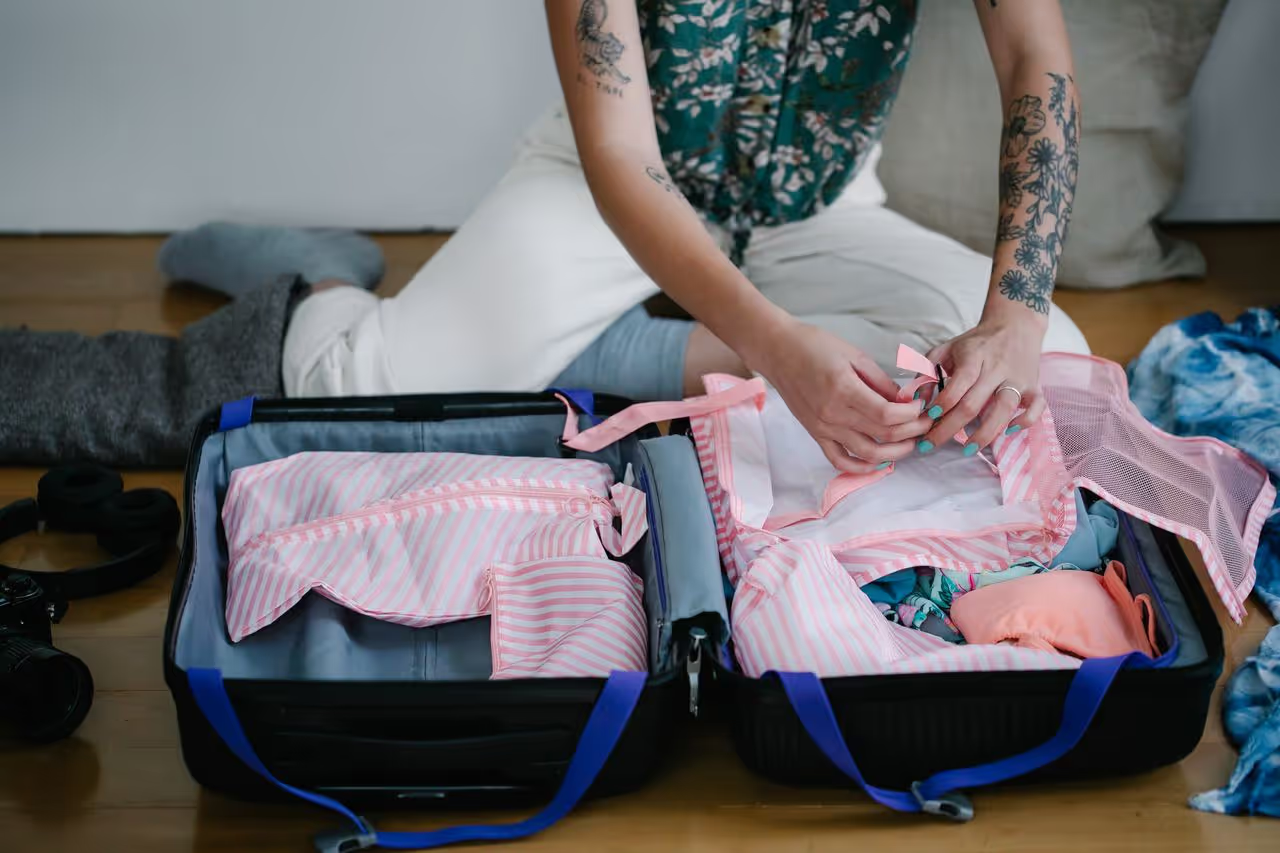
That single fact cuts your required clothing in half. For a week-long sit, you do not need seven outfits. Three or four days of rotation is enough. Run a load mid-sit and you are covered.
Caro and I have done month-long sits from a single carry-on each. The sit was comfortable. We never ran out of anything.
Think of it like staying at a friend's house for a week. You pack comfortably and lightly because you know you have all the amenities of home. That mindset is what makes house sitting as a lifestyle actually sustainable rather than exhausting, and it's also what makes the real savings add up the way they do.
House Sitter Supplies: What You Actually Need to Bring
This is the section most packing guides skip. The question people actually search for is not just what clothes to pack. It is what supplies to bring as a house sitter.
The answer is shorter than you might expect.
What the home already has. Do not pack these.
Cleaning supplies, washing powder, kitchen tools, cooking oil and pantry staples, pet food, pet toys, towels and bedding, and pet leads. Every sit we have done has had all of this ready.
Bringing your own duplicates adds weight for no reason.
One exception on pet supplies: do not bring your own pet treats. This feels like a kind instinct, but many animals are on strict diets and homeowners have specific approved treats already.
Arriving with your own and giving them to the animal without checking can cause digestive issues. Leave the treats at home and ask the homeowner what is appropriate, ideally as part of the same conversation covered in our what to ask a homeowner before you house sit guide.
If a pet has a specific medication routine, that's worth its own preparation beyond packing. Our guide to giving a pet medication during a house sit and our guide to caring for a senior pet during a house sit both cover what to actually confirm with a homeowner before you arrive, rather than anything you need to pack yourself.
Tech: The Two Items Worth Prioritising
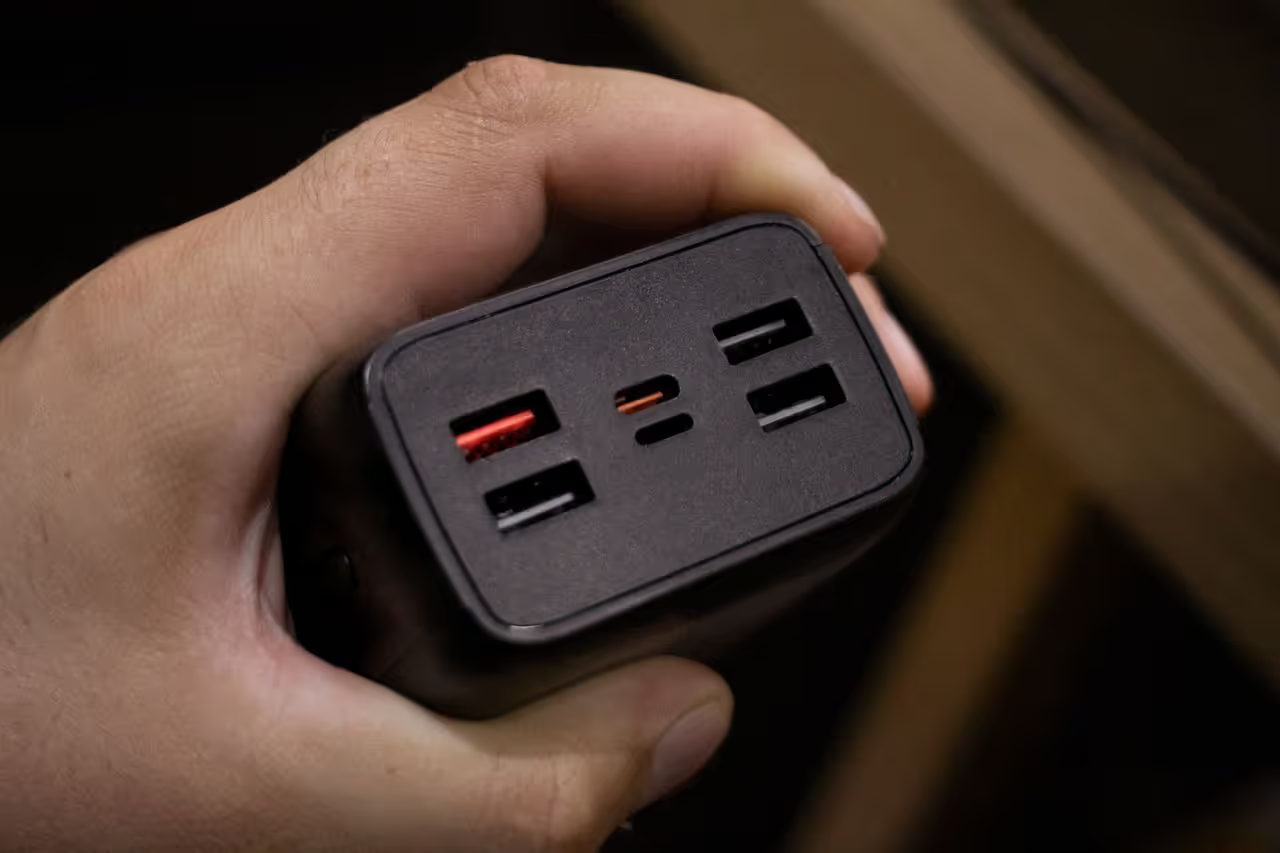
A GaN charger is the single most practical tech upgrade for house sitters.
A GaN (gallium nitride) charger can power your phone, laptop, and tablet simultaneously from one compact block. This means you travel with one item instead of three separate chargers, use one outlet instead of three, and keep your bag significantly lighter.
For long sits where you are working remotely, the difference is noticeable. Our guide to house sitting for remote workers covers how to set up a proper workspace in someone else's home.
A universal power adapter is non-negotiable for international sits. Even if the home has plenty of outlets, your devices need to be compatible. One good universal adapter covers most countries and lasts for years.
For domestic sits you can skip the adapter. The GaN charger is still worth having regardless.
Everything else tech-related, monitors, keyboards, desk lamps, the home usually has. Ask the homeowner in advance if you have specific remote work needs, and confirm it on the video call rather than assuming.
Documents: Keep It Simple
We do not carry physical documents related to the house sit itself. Our standard travel documents, passports, visas, any required travel permits, are what we carry. The same as any traveller.
For the sit itself, everything we need is digital: the THS confirmation, the welcome guide, the homeowner's contact details, and the vet information. A phone with good battery life covers it, which brings us back to the GaN charger.
On the broader question of documentation when crossing borders as a house sitter, our guide on what to tell customs when house sitting abroad covers the practical approach. Immigration rules vary by country and change regularly. Personal research based on your own situation always matters more than general guidance.
Clothing: The Minimalist Framework
The checklist that has worked across 20 sits:
Daily wear: 3-4 sets of comfortable clothes. For warmer climates, light trousers, shorts, and a few t-shirts. For cooler climates, add a thermal base layer and a fleece.
One smart-casual outfit: A decent pair of jeans and a button shirt for me, something equivalent for Caro. Homeowners sometimes invite you for a meal before they leave. Neighbours might stop by. You will not regret having one outfit that is not a t-shirt.
Footwear: One comfortable walking pair and one slightly nicer pair. That is enough.
Layers for longer sits: A packable rain jacket and a warm mid-layer cover most situations without adding much weight.
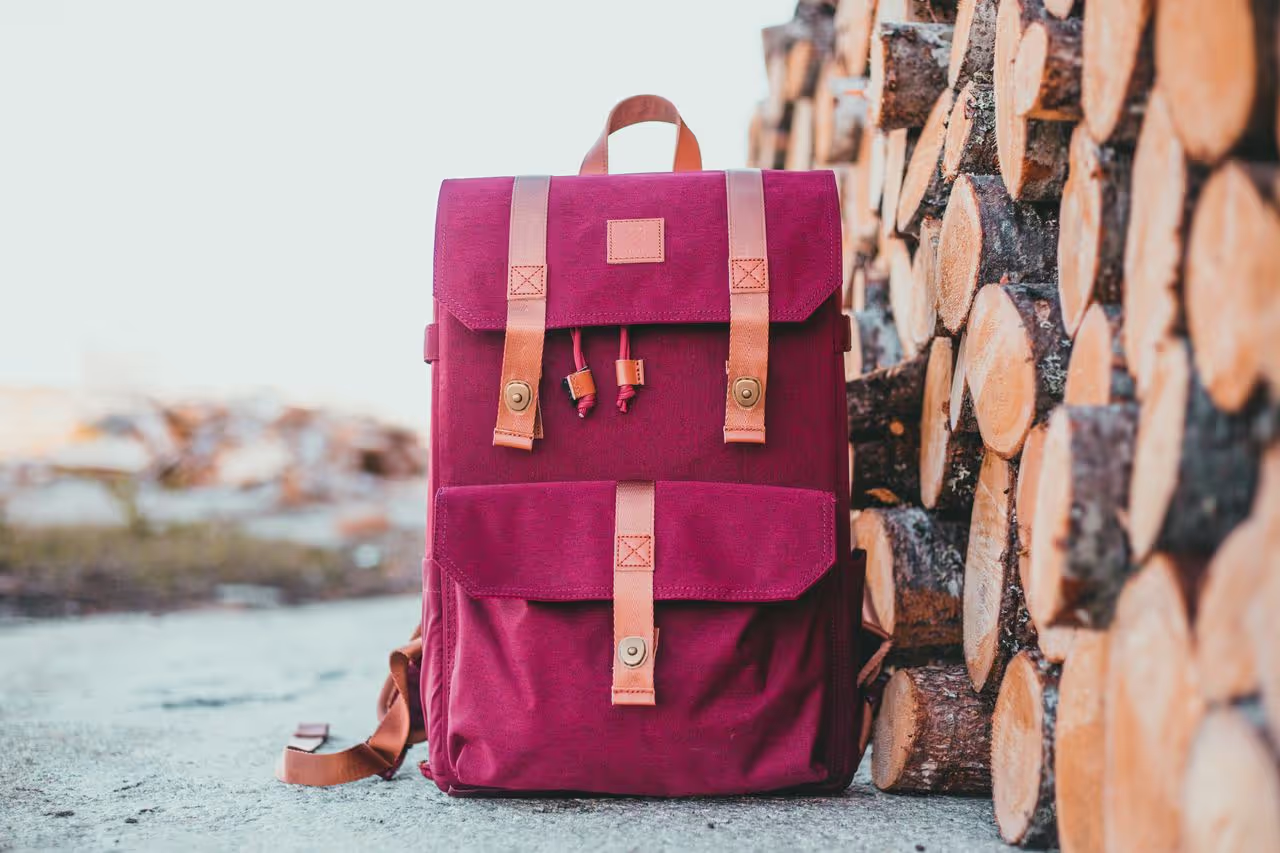
The bag itself matters too. I look for a carry-on sized backpack that keeps its shape, sits comfortably on the back, and packs a laptop first with everything else built around it. Caro is moving in the same direction. She has been selling possessions through Vinted, doing it entirely from Portugal with no fixed address, which is its own kind of impressive.
The future for us is more minimalistic, not less. We like experiences, memories, and the freedom to move. A small backpack makes that possible. Our article on no fixed address, mail, and banking as a house sitter covers the practical side of that lifestyle.
Packing for Different Climates
Caro and I have house sat across multiple seasons in Australia, Greece, Portugal, Germany, and the Netherlands. The climate varies enormously and the packing adjusts accordingly.
In summer: Shorts, a light shirt, flip-flops, swimwear and a hat are the core. Always add a jumper, long trousers, and a rain jacket regardless. Even hot countries have cold evenings.
In winter: Long trousers, a jumper, a jacket, and a beanie cover most situations. I run warm, so that is often enough for me. Caro needs an extra layer or two, which is worth knowing about your own body before you pack.
The key principle is the same regardless of season: you have a washing machine, so volume is never the answer. Pack fewer items of the right type rather than more items of everything.
For sits in New Zealand or the South Island specifically, four seasons in one day is a genuine reality rather than a cliché. A waterproof outer layer and a warm mid-layer are functional items there, not precautions. Our New Zealand house sitting guide covers what to expect climate-wise across the islands.

Water and Skin: The Thing Nobody Mentions
Here is something most packing guides do not cover.
When you move between countries, the water changes. Harshness, mineral content, chemical treatment, all of it varies significantly from one place to another. In the first week or two of a new sit, particularly an international one, you may find your skin becomes noticeably dry. This is a direct response to the change in water chemistry, not a health concern, but it is uncomfortable.
We carry a Brita filter. We pour the water in, it goes through the filter, and we get something that is standardised enough to drink comfortably regardless of where we are. It is not perfect for very harsh water but it brings most tap water to a usable level.
For the skin issue specifically, an exfoliating mitt and a good moisturiser in your toiletry bag will carry you through the adjustment period. Within two weeks your skin usually settles. It is a small thing that makes a real difference to how comfortable the first fortnight of a new sit feels.
Extra Items Other House Sitters and Travellers Pack
Beyond our own minimal kit, it's worth knowing what other experienced house sitters and long-term travellers commonly bring along, even if it's not all part of our own bag.
| Item | Why People Bring It |
|---|---|
| Earplugs and a sleep mask | Every home has different noises and light levels, and these help with the adjustment on the first few nights of a new sit |
| A small first aid kit | Covers minor cuts, headaches, or stomach upsets without needing to find a pharmacy on day one. We carry one in our campervan regardless, since it's a legal requirement for driving in most of Europe, and it doubles up nicely for any sit we drive to |
| A door wedge or portable travel lock | Some sitters like the extra peace of mind, particularly on a solo sit in an unfamiliar area. Worth knowing this exists even if you never end up using it |
| A reusable water bottle | Useful even with a home's own glasses and bottles on hand, especially for sits involving regular walks or hikes |
| A book, e-reader, or downloaded entertainment | Evenings in someone else's home, especially in a rural or quiet sit, can be quieter than you're used to |
| Comfortable indoor slippers | A small comfort item that makes an unfamiliar home feel more like your own from the first night |
| Travel-size laundry sheets | Handy for a quick wash of delicates between full machine loads |
None of these are essential the way a GaN charger or a universal adapter is. But if you're wondering what else experienced sitters tend to carry beyond the basics, this is the honest list.
Cleaning Supplies and Pet Safety
We do not bring our own cleaning supplies because every home has them. But there is something worth knowing if you are looking after dogs specifically.
Research from multiple institutions, including the University of Wisconsin and Duke University, has found that dogs exposed to common household cleaning products, particularly insecticides, herbicides, and spray cleaners, face a measurably higher risk of bladder cancer and lymphoma. Dogs spend their lives close to the floor, licking their paws and absorbing whatever has been sprayed on the surfaces around them. The exposure is cumulative and largely invisible.
My personal approach is to use white vinegar and water for cleaning wherever possible. It is effective, it is non-toxic, and most homes have vinegar in the kitchen already. I avoid bleach and strong chemical sprays around pets entirely.
This is not a rule I impose on anyone else. But if you are sitting with dogs and you have a choice between a harsh spray cleaner and something gentler, it is worth knowing the research exists. Our guide on what not to do when house sitting covers other aspects of responsible pet care that are easy to overlook, and our broader house sitting safety guide covers the wider picture beyond just cleaning products.
Packing for Cat Sits When You Have Allergies
I have been allergic to cats my whole life.
When Caro and I started house sitting, I managed with antihistamines on sits with multiple cats. I am not someone who likes taking medication, so I avoided them where possible and accepted some degree of eye irritation and a sniffly nose for the first week or two of cat sits.
The sit that changed things was Kefalonia, Greece. We arrived expecting one cat and one dog and found nine cats. The flat could not be ventilated properly, and I was in a constant low-level allergic state for the entire sit. It was manageable but not comfortable.
After that sit, something shifted. On subsequent cat sits my reaction was noticeably less severe. The eyes were puffy for a shorter window. The nose cleared faster. Exposure over time had reduced my sensitivity, which is a recognised pattern in allergy responses, though it is not guaranteed and varies person to person.
Now, on our six-month Portugal sit with one cat, I do not notice any allergic response at all.
The practical advice: if you are cat-allergic and considering cat sits, bring antihistamines for the first two weeks regardless. Have them with you, use them if you need them, and do not avoid cat sits because of the allergy. Your sensitivity may reduce with exposure over time.
If you are looking at a sit with multiple cats and you are cat-allergic, read our guide on house sitting with multiple cats before you apply. The number of cats in a confined space matters considerably more than the number in a ventilated home.

The Welcome Gift
Not a supply, but worth including: a small gift for the homeowner.
Caro and I always bring a bottle of Bio white wine. We choose Bio specifically because the label signals quality and care, even at a similar price point to a standard bottle. White wine tends to suit more people than red, which can feel heavy. The Bio label also means fewer additives, which in our experience means no groggy morning after.
It is never expected and it always lands well.
On our current Portugal sit, which is six months long, we arrived and spent two days with the homeowners before they left. That is unusual. In most sits the handover is a few hours. But with six months ahead of us it made sense to take the time properly.
On the first evening they cooked two types of pasta for us. On the second, I went to the shops and made a laksa soup with chicken. It was slightly spicy, the wine helped, and everyone enjoyed it. By the time they left, it did not feel like a transaction. It felt like saying goodbye to friends we had just made.
That is how Caro and I approach every sit. Not as a job, not as a business arrangement, but as meeting people. The welcome gift is the first signal of that intention. It costs almost nothing and changes the entire opening of a sit.
For a full picture of how to start a sit on the right footing, our guide on how to do a proper house sit checkout covers what a well-handled sit looks like from arrival to departure.
What a Well-Packed Bag Actually Looks Like
For a two-week sit, our combined kit fits into one carry-on and one personal bag each.
The carry-on holds the clothing rotation, one smart outfit, and the personal toiletries. The personal bag holds the laptop, GaN charger, universal adapter, medications, travel documents, and a few poop bags in a side pocket.
That is it.
We have arrived at a sit in Greece and a sit in France from the same bag. The weight of what you carry should not be a limiting factor in how freely you move. Packing light is not a compromise. It is the point.

If You Are Travelling to the Sit by Car or Van
Everything above describes what you need if you are flying or arriving by train. If you are driving to your sit, the calculation changes completely.
Caro and I travel to many of our sits in a 1998 VW T4 campervan. We arrive with our full kitchen setup, the Brita filter, spices, our first aid kit, and anything else we use day to day. There is no reason not to bring it all when you have the space.
The home will have what it needs. But if you have your own coffee setup, your preferred cooking oil, or a water filter you rely on, bring it.
This applies to anyone arriving by car, not just van travellers. A boot full of your own kitchen preferences, toiletries in full sizes, and a few home comforts costs you nothing extra and makes a longer sit feel genuinely like living somewhere rather than camping lightly in someone else's space.
If a sit ever falls through, the van means we are never stranded. We drive to the next one. That flexibility is one of the strongest arguments for any long-term house sitter having their own vehicle. Our guide on getting started in house sitting covers how to build that kind of setup from scratch, and our full TrustedHouseSitters review covers the platform we've built that setup around.
The supplies table above still holds as the minimum for anyone travelling light. If you have the vehicle space, treat it as a starting point rather than a ceiling.
A Word on Your Own Belongings
Packing light for a sit doesn't mean being careless with what you do bring, especially valuables like a laptop, passport, or jewellery of your own.
We keep anything genuinely valuable in our own bags rather than leaving it scattered around a home we're only in temporarily, partly out of habit and partly because it's just good practice regardless of how much you trust a homeowner or a neighbourhood. Our guide on house sitter theft and what to do about it goes into this from the other direction, covering the same principle: a little bit of low-effort care around belongings, on both sides of a sit, prevents almost every problem before it starts.
Conclusion
The supplies you actually need as a house sitter fit in a side pocket: poop bags, a GaN charger, a universal adapter, and your personal medications and toiletries.
Everything else is already in the home.
The rest of your bag is for your clothing rotation, one decent outfit, and a small gift for the homeowner. Pack once, pack well, and adjust after your first sit. You will almost certainly arrive home having used half of what you brought and already know what to leave out next time.
Minimalism is not about having less. It is about having exactly what you need and nothing that slows you down.
Caro and I have completed 20 house sits across 12 countries, driven 19,000km in Australia and 24,000km in our 1998 VW T4, and saved over $26,500 in accommodation costs over three years of house sitting.
If you have questions about what to pack for a house sit, drop them in the comments below or send us a message on Instagram, we read every DM. And if you're setting up Trusted House Sitters membership before your first sit, our 25% discount code and full pricing breakdown are worth checking out first.

Frequently Asked Questions
Do I need to bring my own towels and bedding to a house sit?
Almost never. The home is fully equipped. Towels, bedding, and kitchen essentials are provided. Pack as if you are staying at a friend's house, not a hostel.
Should I bring pet supplies for a house sit?
Only poop bags. Homes occasionally run out and they weigh nothing. Do not bring pet treats. Many animals are on strict diets and the homeowner will have their own approved options. Everything else, leads, food, toys, grooming tools, will be in the home.
What is the most useful tech item to pack for a house sit?
A GaN charger. It charges your phone, laptop, and tablet from one compact block, saves bag space, and means you only need one outlet for all your devices. Add a universal power adapter for international sits.
Should I pack food for my first few days?
Buy groceries on arrival. It helps you settle in and get a feel for the local area. Most homeowners leave kitchen staples like salt, pepper, and oil. Some leave a welcome gift of their own.
How much luggage is too much for a house sit?
If you cannot carry it all yourself in one go, you have packed too much. A carry-on and a personal bag are ideal for sits up to a few weeks. You have a washing machine. Use it.
Is it safe to drink tap water at a house sit in another country?
In most developed countries yes, but water hardness and chemical composition vary significantly between regions. We carry a Brita filter for exactly this reason. It standardises water quality enough to drink comfortably and reduces the skin dryness that comes from moving between countries with different water chemistry.
What should I do about cleaning supplies if I prefer not to use harsh chemicals around pets?
Most homes have white vinegar in the kitchen. A solution of white vinegar and water is effective for most household cleaning tasks and is safe around pets. Research from the University of Wisconsin and Duke University has found links between common household chemical sprays and higher rates of bladder cancer and lymphoma in dogs. It is worth being mindful of what you use around the animals in your care.
Should I bring anything specific for a cat sit if I am allergic to cats?
Yes. Bring antihistamines for the first two weeks regardless of how mild your allergy is. The first fortnight of a cat sit tends to be the worst window. After that, symptoms often reduce. My own cat allergy has subsided significantly over years of cat sits to the point where it no longer affects me day to day. But that process takes time, and you need to be comfortable while it does. Read our guide on house sitting with multiple cats if your sit involves more than two.
What extra items do experienced house sitters pack beyond the basics?
Earplugs and a sleep mask for adjusting to a new home's noise and light, a small first aid kit, and sometimes a door wedge or travel lock for extra peace of mind. None of these are essential, but they're common additions among long-term travellers and sitters.


Responses
What are your thoughts on this post?