

Home > Blog > VW T4 Campervan: The Ultimate House Sitter's Companion
Quick Facts
| Total setup cost | Under €6,500: €3,500 van, €1,500 build, €1,500 mechanical work. |
| How long to build? | Four days, in a trades store carpark with parts on site. |
| Best modification | 90% tinted rear windows: private inside, invisible outside. |
| Biggest risk when buying | Rust in wheel arches, sills, step and windscreen surround. |
| Which engine? | The 2.5 TDI diesel, routinely reaching 250,000 to 400,000 kilometres. |
| Buy on mileage or condition? | Condition: a maintained 150,000km van beats a neglected 80,000km one. |
The VW T4 is one of the best entry points for house sitters who want a van. It is affordable, truly reliable, easy to repair without specialist knowledge, and critically invisible in European streets. Ours cost €3,500, the build cost another €1,500, and across 24,000km through more than twenty countries it has never had a single mechanical failure. The slogan should be "it just keeps driving."
Caro found the van on her first search. She was on the phone with her dad when he suggested a campervan for the Europe trip. She typed the search, one of the first listings was a red VW T4, nobody had bid on it yet. By the time I was home from work she had already messaged the seller. We drove two hours to see it, had a mechanic check it over, made an offer, signed the papers, and drove it home.
That was 24,000km, more than twenty countries, and nine house sits ago. The van has not skipped a beat.
This article is about why the T4 specifically, what we built inside it, and why the combination of a VW T4 and house sitting produces a travel model that neither can achieve alone.
If you are interested in getting into house sitting, our book Travel More for Less puts the whole process in one place: clear, step by step guidance from your first questions to your first confirmed sit, and the reviews that open the door to the next one.
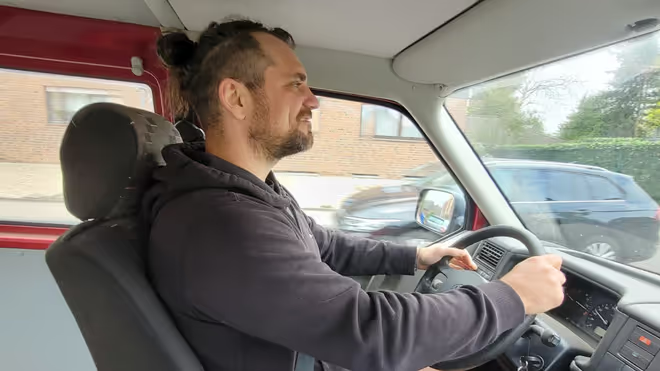
Why the T4: The Honest Assessment
Our T4 has a 2.0 AAC petrol engine. When we bought it, the odometer read 73,000km. Which for a van this age makes it practically new. A VW T4 at 73,000km is a van with most of its life ahead of it, provided the previous owners maintained it correctly. Ours was maintained correctly.
The first thing we did after purchase was replace the sensors, fit a new drive belt, and sort the muffler. The plastic interior parts were brittle from years of sitting unused, which made it look worse than it was mechanically. Plastic cracking and fading is cosmetic, not structural. Underneath all of that the engine was in superb condition and it has remained that way.
The research describes the 2.5 TDI as the legendary engine of the T4 range. That reputation is deserved. Diesel T4s can run to 300,000km with proper maintenance and are the first choice for serious long-haul van life. Our petrol 2.0 has proven equally reliable in practice, with simpler electronics that mean fewer points of failure and more things we can fix ourselves without a specialist.
The community around T4 ownership was something we did not expect. Every time we meet other T4 owners on the road, there is an immediate sense of familiarity. They know the van. They love the van. They make fun of T5 and T6 owners, who know their own vehicles are more complicated and less reliable. Even the T5 and T6 owners admit it. The T4 crowd has a specific pride in driving something uncomplicated that just works. We have sat in the van crossing mountain passes and coastal roads thinking about how fortunate we are to be doing it in something this unproblematic.
The Stealth Advantage
Driving across Europe, the thing that truly surprised us was how many VW T4s are out there. This is a workers' van. It is everywhere. Plumbers, electricians, delivery drivers, small businesses. The T4 is the default working van of a generation in most European countries, and there are enormous numbers of them on every road and in every carpark.
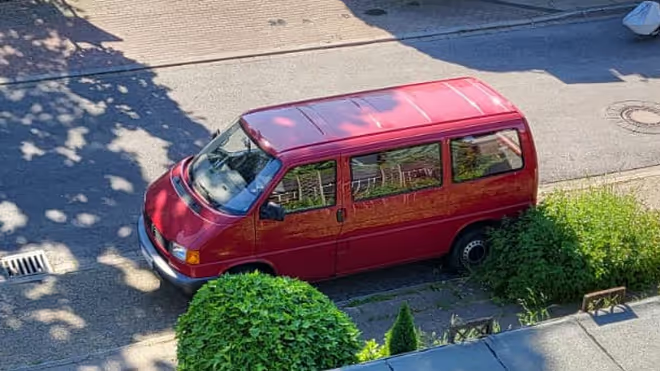
Our van is red. We were slightly worried the colour would draw attention. The opposite turned out to be true. A red T4 looks like a cheap working van that a sole trader drives to jobs. Nobody looks twice. We park in residential streets without any issue. We wild camp in designated areas and nobody has ever approached us or questioned our right to be there.
We installed 90% tinted windows on the rear of the van. This is the single modification we would recommend to anyone building a camper before anything else. People cannot see inside, but we can see out perfectly clearly. We have watched people walk up to the van, look at their reflection in the glass, and walk away entirely unaware we were sitting inside watching them. The tinted windows transform the van from a personal vehicle into what looks like a private works vehicle, and that invisibility is worth more on the road than almost any other modification.
The research describes modern, expensive campervan conversions as a liability. They attract attention, signal that there is valuable equipment inside, and make discreet urban parking impossible. A T4 that looks like a working van has none of these problems. Our campervan travel between house sits guide covers the parking and wild camping approach we use.
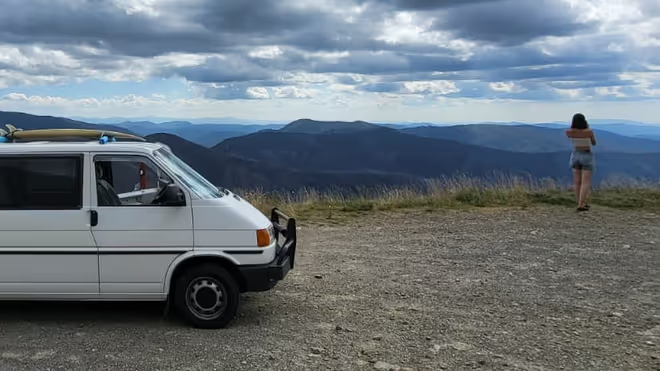
The Build: Four Days in a Carpark
We built the van in four days. The method came from the experience of building our Australian T4, where the biggest time loss was the repeated drives back to the hardware store for parts we had forgotten. This time we parked in the carpark of a trades store and built from there. When something was missing, we walked inside and bought it. No wasted drives, no momentum lost.
The build in order of priority:
Power station and fridge first. The power station and a 12V compressor fridge were the most important pieces of equipment, so we sized everything else around them. We have a foldable Solar panel which we pull out when it is sunny and need power (don't ever buy solar play solar panels, they are terrible)
The bed. A 140x200cm sleeping platform. 55x79 inches for those unfamiliar with metric. Built from four hinged panels that fold up to create floor space during the day. With a 9cm mattress this is a truly comfortable sleeping arrangement that matches a reasonable hotel bed.
The bench and kitchen. A compact workbench with storage beneath, a portable induction cooker, and enough counter space to cook actual meals. Simple, robust, no plumbing beyond a 20L water container. Four days of that build taught us how little space a workable home really needs, and a tiny home sit is the same lesson inside a fixed building.
We skipped insulation. The van has enough windows that insulation would have made minimal difference to the temperature, and the weight and complexity were not worth it. The tinted windows do significant work in managing summer heat.
The total build cost including the power system, fridge, solar, bed, bench, and materials came to approximately €1,500. Combined with the €3,500 purchase price and €1,500 in initial mechanical work, the entire setup. Van, conversion, and roadworthy. Was under €6,500. Our campervan setup for house sitting guide covers the full equipment list and what we would change.
The Rule for Building
The one lesson from both builds. Australia and Europe. Is this: do not over-complicate it. Every system added is a future fault to diagnose. The van's strength is its mechanical simplicity. A conversion that respects that principle. A good bed, a functional kitchen, a reliable power system, and nothing more. Will outlast and outperform a complex build that looks impressive on Instagram and breaks in rural Portugal.
We have met people on the road with €50,000 Sprinter conversions who spend their travel time managing inverter failures and water system leaks. We cook dinner, sleep comfortably, and drive. The T4 philosophy is keep it simple. The conversion philosophy should be the same.
The Burnout Reality. And Why House Sitting Fixes It
I want to be direct about something that the van life social media world tends to understate: sustained van life leads to burnout. Of all the people we have met on the road who live in their vans full-time, almost everyone describes a point where the romance fades and the constraints become dominant. The lack of standing room, the limited water, the absence of a proper bathroom. These are minor inconveniences for a week and real quality-of-life issues after months.
I have met exactly one couple who loves the T4 life without reservation, all the time. Everyone else describes the same arc: exciting at first, sustainable with management, eventually tiring in its limitations.
House sitting solves this. A house sit gives you a toilet, a proper shower with unlimited hot water, a full kitchen with counter space, separate rooms, a garden. After weeks in the van, arriving at a good house sit feels like a genuine luxury even when the house is ordinary. The contrast makes both experiences better. The van becomes freedom and the house sit becomes comfort, and each one refreshes your appreciation for the other.
This is the model that works long-term: the van as the travel and exploration vehicle, house sitting as the settlement and recovery period. Neither alone produces the same quality of experience. Together they cover everything. Our campervan vs house sitting comparison and van life upgrade guide cover the financial and practical case for combining both.
Before You Buy: What to Check
The T4's main enemy is rust. Everything else is manageable. Mechanical parts are widely available, engines are simple, and the T4 community can talk you through almost any repair. Rust is the one problem that gets expensive and structural if ignored.
At the viewing, check the wheel arches, the sills, the step below the sliding door, the windscreen surround, and the front panel beneath the headlights. Bring a magnet and run it over areas that look freshly painted. Filler does not stick to magnets. A van that has had significant rust repairs is not necessarily a bad purchase, but you need to know what you are buying.
Our van had some surface rust which we treated with rust converter and painted over. That has been sufficient. No progression, no structural concern. Surface rust on a well-treated T4 body is normal and manageable. Structural rust in the load floor, the jacking points, or the chassis is a different conversation.
Buy on condition, not mileage. A well-maintained T4 at 150,000km is a better purchase than a neglected one at 80,000km. Look for service history, ask about cambelt replacement history, and have a mechanic inspect it before committing. The €100 spent on an independent inspection will tell you more than any listing description.
The T4 in Numbers
| Our T4 | What to aim for | |
|---|---|---|
| Purchase price | €3,500 | €3,000-€10,000 for a solid base |
| Initial mechanical work | €1,500 | Budget €1,000-€2,000 for a full service |
| Build cost | €1,500 | €1,000-€5,000 depending on spec |
| Total on-road cost | ~€6,500 | €5,000-€16,000 |
| Monthly running cost (on road) | ~€800 | Fuel, oil, minor repairs, insurance |
| Monthly running cost (on a sit) | ~€100 | Minimal movement, basic maintenance |
| Kilometres covered | 19,000+ | T4 engines routinely reach 200,000-300,000km |
| Breakdowns | 0 | — |
Join TrustedHouseSitters with 25% off. DM us @housesittersguide on Instagram. We answer everyone.

Frequently Asked Questions
Is a VW T4 reliable enough for full-time travel across Europe?
Yes, if it has been well maintained. Our 2.0 petrol T4 has covered 24,000km across more than twenty countries without a single mechanical failure. The key is buying on condition rather than mileage. A well-maintained T4 with 150,000km is a better vehicle than a neglected one at 80,000km. Budget for a full service on purchase including cambelt, oil, filters, and sensors.
What is the best engine in the VW T4 for house sitting travel?
The 2.5 TDI diesel is the community favourite for long-distance reliability and fuel economy, routinely reaching 250,000-400,000km on original internals. Our 2.0 petrol AAC engine has proven equally reliable in practice with simpler electronics. Avoid the earlier naturally aspirated 2.4 diesel if you need to cover ground quickly. It is reliable but slow.
How much does it cost to build a VW T4 for van life?
Our total build. Power station, fridge, solar, bed, bench, and all materials. Came to approximately €1,500. Add €3,500 for the van and €1,500 for initial mechanical work and the whole setup is under €6,500. A more complex build with plumbing, heating, and insulation adds cost. Our recommendation: start simple. Every additional system is a future fault.
What is the most important modification for a T4 campervan?
90% tinted rear windows. People cannot see inside from outside, but you can see out clearly. The van becomes completely private, looks like a working vehicle rather than a camper, and wild camping becomes significantly easier. This single modification has a bigger impact on day-to-day van life than almost anything else.


Responses
What are your thoughts on this post?