

Home > Blog > Dealing with Van Breakdowns on a House Sitting Tour
Quick Facts
| Breakdown record | 19,000 kilometres across over twenty countries, no major breakdowns. |
| Prevention rule | Change oil and filter every 10,000 to 12,000 kilometres. |
| Is cover worth it? | Yes: one Australian tow callout without it cost $3,000. |
| Best European cover | ADAC offers the best campervan roadside assistance across Europe. |
| When to tell the owner? | Within 30 minutes of the breakdown, before repairs begin. |
| Cheapest repairs | Albania: €50 for an oil and filter change, Italy €180. |
The best breakdown strategy is prevention. Change the oil and filter every 10,000 kilometres. Check the fluids regularly. Replace brakes at the right time so you do not have to replace the discs. Ask a mechanic what the next things to address are before they become emergencies. A well-maintained older van driven this way will cover enormous distances without drama. And if something does happen, roadside assistance can save you thousands compared to calling a tow truck without it.
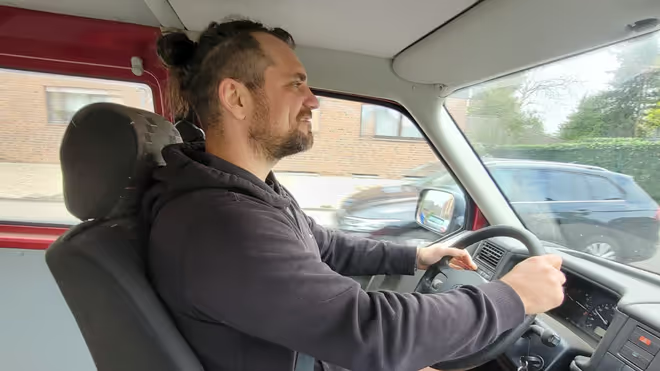
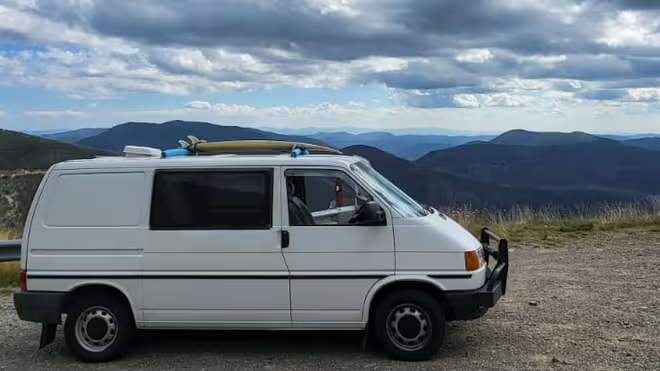
We have covered 19,000 kilometres across more than twenty countries in our 1998 VW T4. No major breakdowns. The van has not skipped a beat.
This is not luck. It is the result of changing the oil and filter every 10,000 to 12,000 kilometres, replacing the front brakes before they became an emergency, and treating the van as something worth maintaining rather than hoping it holds together. The difference in reliability between a well-maintained older vehicle and a neglected one is not theoretical. You can see it in how the engine sounds, how the car handles, and whether small issues are caught before they become expensive ones.
This article covers what to do if a breakdown does happen. How to communicate with the homeowner, how to find a mechanic in a country where you do not speak the language, and what the actual costs look like across different regions. Based on the trip and backed by community knowledge from sitters and vandwellers across Europe, Australia, and beyond.
If you are interested in getting into house sitting, our book Travel More for Less puts the whole process in one place: clear, step by step guidance from your first questions to your first confirmed sit, and the reviews that open the door to the next one.
Prevention: The Only Breakdown Strategy That Actually Counts
Every mechanic who looked at our T4 confirmed the same principle: change the oil and filter more often than the manufacturer recommends. Many European vehicles have an official recommendation of 20,000 kilometres. The oil reservoir is often small. With a small reservoir and heavy use, 10,000 kilometres is the number that keeps the engine running well.
We follow this religiously. Oil and filter change every 10,000 to 12,000 kilometres, confirmed and refined across conversations with mechanics in multiple countries. The result is an engine that runs smoothly and a vehicle we trust on mountain passes and long motorway stretches.
The brakes are the second most important item. Replace the brake pads at the right time and you protect the discs. Ignore them until they are worn down and you replace both pads and discs at significantly higher cost. Ask a mechanic during any service what the next items to address are. Not what is critical today, but what is coming. This converts potential emergencies into planned maintenance.
The same logic applies to coolant, timing belts, tyres, and any other consumable with a predictable lifespan. A one-day car maintenance course before a long trip is worth more than most of the equipment people buy for van life. Knowing how to check your oil, identify a failing component by sound, and assess whether a noise is urgent or manageable removes a significant amount of anxiety from the road.
For sitters who are not mechanically inclined: have the vehicle checked by a trusted mechanic before any major trip. Ask explicitly what the next 10,000 kilometres might require. Address those things before you leave, not after.
The Emergency Kit
In most European countries the following items are a legal requirement. In Australia and the US they are strongly recommended regardless. In the T4 we carry:
A warning triangle. A high-visibility vest for each person in the vehicle. A spare tyre in serviceable condition. A first aid kit. Basic tools for minor repairs.
In Europe, failure to carry a warning triangle and high-vis vests can result in a fine if you are stopped or if there is an incident. These items also do something more important: they make you visible on the side of a road in a situation where being invisible is dangerous. Set up the triangle at a reasonable distance behind the vehicle. Put on the vest before you open the door. These are the first actions after safely getting off the road.
The first aid kit matters too. Not because vehicle breakdowns typically produce injuries, but because the same kit serves the sit. A six-month house sitting tour across multiple countries produces more situations where a first aid kit is useful than most people anticipate.
Roadside Assistance: The Investment That Pays for Itself
Caro and I have had roadside assistance coverage for the vans in both Europe and Australia. In Australia the only time we needed it was dirty battery terminals. The assistant pulled up, cleaned them, and the van started immediately. The cost of that callout alone would have been significant without coverage.
A fellow traveller in Australia had to call a tow truck without roadside assistance. The tow cost $3,000. A year of roadside assistance costs a fraction of that. The calculation is simple: one callout without coverage will almost always cost more than years of annual premiums.
For different regions:
Europe: ADAC (German automobile club) is arguably the best roadside assistance for campervans across Europe. It covers vehicles of almost any age, provides roadside repair, towing, and in some plans, accommodation if the vehicle cannot be repaired same-day. AA (UK) and RAC (UK) offer European coverage extensions. For non-German sitters, specialist campervan breakdown policies from providers like Camping and Caravanning Club or Brittany Ferries' insurance arm cover pan-European travel.
Australia: NRMA (New South Wales), RACQ (Queensland), RAA (South Australia), RAC (Western Australia), and RACV (Victoria) are the state-based clubs. Each offers roadside assistance that is reasonably priced and covers the full country through reciprocal agreements. For older vehicles, confirm coverage. Some policies exclude vehicles over a certain age or require a recent inspection.
United States: AAA (American Automobile Association) is the standard. Membership costs approximately $50-$100 per year depending on tier. For van-dwellers and RV users, Good Sam Roadside Assistance is specifically designed for larger vehicles. The US road network is well-served but rural breakdowns in states like Nevada, Wyoming, or Montana can involve significant distances to the nearest town. AAA Premier membership, which includes longer tow distances, is worth the premium in these cases.
New Zealand and rest of world: New Zealand AA provides coverage and has reciprocal agreements with equivalent clubs in other countries. For sits in less-covered regions, travel insurance with roadside assistance and vehicle repatriation clauses is the safest approach.
The key check before any international trip: confirm that your policy covers the specific country, the vehicle's age and weight, and what happens if the vehicle cannot be repaired locally (repatriation or rental car provision).
When It Actually Goes Wrong: The Four-Step Response
Step one: Safety first. Move off the road. Hazard lights on immediately, even before the vehicle has fully stopped. Once safely off the road, warning triangle behind the vehicle and high-vis vests on before anyone exits. If pets are in the vehicle in warm weather, this becomes a dual emergency. The priority is also preventing the vehicle from becoming a heat trap.
Step two: Contact the homeowner within 30 minutes. Not after the mechanic has been found, not after the recovery truck has arrived. Within 30 minutes of the breakdown. The homeowner's anxiety increases proportionally with every hour of silence. A calm, factual message that communicates the situation and immediately offers a solution is far better received than a message that arrives after three hours of silence.
The message that works: "Hi [name], I'm sorry to message with this. My van has broken down on [road] approximately [distance] from you. I am safe and the recovery service is being called. I wanted to let you know immediately rather than wait. Is there a neighbour or local contact who could check on the pets if you need to leave before I arrive? I will keep you updated every step of the way."
This message does three things. It demonstrates that the sitter's first thought was the homeowner's animals, not their own situation. It offers an immediate practical solution before being asked. It commits to ongoing communication. Homeowners who receive this message almost universally respond with concern for the sitter rather than frustration about the delay.
Ask the homeowner directly if they know a trustworthy local mechanic. A homeowner's personal recommendation is worth more than any review on Google Maps. They may know someone, they may be able to call ahead, and they may be able to ensure the sitter is treated fairly rather than as an unknown foreigner.
Step three: Finding a mechanic. Call roadside assistance first if you have it. If not:
Google Maps with translated search terms. Before any international trip, save the words for mechanic, garage, breakdown, and tow truck in the languages of the countries on your route. Pasting these into Google Maps finds nearby garages quickly. Image-based reviews reveal the quality of the workshop before you commit.
Google Translate conversation mode for the interaction itself. In Italy, when we needed brakes and a tyre replaced, we stopped at a roadside mechanic and used Google Translate to communicate everything. The problem, what we wanted done, the cost. It was not perfect but it worked. The mechanic diagnosed the issue, we agreed on a price, and we left with new brakes and a new tyre.
Local Facebook groups. Posting in a local expat or community group asking for a mechanic recommendation typically produces rapid, personal responses. House sitting and vanlife communities on Facebook are particularly helpful for this.
On regional pricing: The same work costs dramatically different amounts across Europe. In Italy, we were quoted €180 for an oil and filter change. In Albania, the same service cost €50 including a general check-up. The Balkans in general offer significantly lower labour costs than Western Europe without any compromise in quality. If you are travelling through Eastern or Southeast Europe and have maintenance due, the timing can save hundreds. The important caveat: do not delay safety-critical work (brakes, tyres, belts) to wait for a cheaper country.
Franchise garages. Norauto or Feu Vert in France, Midas across Europe, Kwik Fit in the UK, Bridgestone or Bob Jane in Australia. Provide standardised pricing, warranties, and often English-speaking staff. In an unfamiliar location without a personal recommendation, a franchise is generally more reliable than an unknown independent. In the US, Jiffy Lube, Firestone, Pep Boys, and Midas operate nationally with consistent service standards.
Step four: Managing the sit during the repair. If the repair takes time, arrange interim pet care immediately. The homeowner's neighbour is the first option. A local pet-sitting service booked at the sitter's expense is a goodwill gesture that preserves the relationship. Keep the homeowner updated with brief factual messages. The diagnosis, the expected completion time, the new arrival estimate. Not a running commentary of the anxiety, but the key facts as they become known.

The Buffer Day Approach
Caro and I almost always travel to within approximately one hour of the next sit on the day before it starts. This means the final drive on sit day is short, unhurried, and manageable. It means we arrive clean, rested, and composed rather than stressed from a long morning drive. It also means that if anything does go wrong in the last hour. A flat tyre, a mechanical noise that needs investigating. We have time to address it without the sit start time becoming a crisis.
For sitters who do not have a van, the principle applies to all travel: do not plan to arrive at a sit directly from a long journey on the same day. Build in a buffer. The buffer is also what allows you to arrive well-presented and engaged rather than exhausted.
Our campervan travel between house sits guide and campervan vs house sitting comparison cover the broader logistics of travel timing.
What the Mechanic Said About Old Vans
One observation worth sharing from multiple mechanics across the trip: old, well-maintained vehicles are often more reliable than newer ones with complex electronics and more failure points. The T4's simplicity. Fewer sensors, accessible components, a mechanical logic that a competent person can understand. Means that problems are diagnosable and fixable without specialist equipment.
When I see absolute lemons on the road. Vehicles with no maintenance, clearly run until something breaks. And they are still driving, I feel better about a van that is serviced regularly. A well-maintained older vehicle has a significantly lower probability of a serious breakdown than a neglected one at any age. The anxiety about the van breaking down is real, but it is disproportionate to the actual risk when the maintenance is done properly.
Do not stress about what might happen. Maintain the vehicle, carry the emergency kit, have roadside assistance, park close to the next sit the night before, and move on with the trip.
Join TrustedHouseSitters with 25% off. DM us @housesittersguide on Instagram. We answer everyone.
Emergency Vocabulary by Language
Save these in your phone notes before driving in each country:
| English | French | Spanish | Italian | German | Portuguese | Albanian | Greek |
|---|---|---|---|---|---|---|---|
| Mechanic | Mécanicien | Mecánico | Meccanico | Mechaniker | Mecânico | Mekanik | Μηχανικός |
| Garage | Garage | Taller | Officina | Werkstatt | Oficina | Garazh | Συνεργείο |
| Breakdown | Panne | Avería | Guasto | Panne | Avaria | Prishje | Βλάβη |
| Tow truck | Dépanneuse | Grúa | Carro attrezzi | Abschlepper | Reboque | Kamion tërheqës | Ρυμουλκό |
| How much? | C'est combien? | ¿Cuánto cuesta? | Quanto costa? | Was kostet das? | Quanto custa? | Sa kushton? | Πόσο κοστίζει; |
Frequently Asked Questions
What should I do first if my van breaks down between house sits?
Get safely off the road, then contact the homeowner within 30 minutes. Hazard lights on, warning triangle deployed, high-vis vests on before exiting. Then message the homeowner. Calmly, factually, with an immediate offer of a solution (a neighbour who can check the pets). The communication is more important than the speed of the repair.
Is roadside assistance worth it for a campervan?
Yes, without question. A single tow truck callout without coverage in Australia cost one traveller $3,000. Annual roadside assistance costs a fraction of that. For Europe, ADAC is the best option for van coverage. For Australia, the state-based clubs (NRMA, RACQ, RACV etc.) provide national coverage. For the US, AAA or Good Sam for larger vehicles. Confirm coverage for your vehicle's age and the specific countries on your route before departure.
How do I find a mechanic in a country where I do not speak the language?
Ask the homeowner first, then use Google Maps with translated search terms, then local Facebook groups. The homeowner's personal recommendation is worth more than any review. Google Translate's conversation mode handles the actual interaction. Franchise garages (Norauto, Midas, Feu Vert in Europe; Firestone, Pep Boys in the US; Bridgestone in Australia) offer standardised pricing and often English-speaking staff when personal recommendations are not available.
How much cheaper are mechanics in Eastern Europe compared to Western Europe?
Significantly cheaper. Often 60-70% less for the same work. We were quoted €180 for an oil and filter change in Italy and paid €50 for the same service plus a general check in Albania. Labour costs across the Balkans are consistently lower than Western Europe without any sacrifice in quality. Plan maintenance timing around route if possible, but never delay safety-critical work to wait for a cheaper country.


Responses
What are your thoughts on this post?