

Home > Blog > The Art of Slow Travel Through House Sitting
Quick Facts
| How long for slow travel? | A month is the minimum to move past tourist mode. |
| When does it click? | By week three routines feel natural and pressure dissolves. |
| What a slow day looks like | Feed animals, work six to eight hours, walk, read. |
| Is less travel a loss? | No. You see fewer places more deeply. |
| Do you need a van? | No. One good long sit is enough for slow travel. |
| Best sit length | Six months removes end-of-sit anxiety entirely. |
House sitting is the most effective slow travel model available. It removes the financial pressure to keep moving, replaces it with a routine that grounds you, and gives you the time to actually absorb a place rather than pass through it.
I have traveled by cruise ship, backpack, five-star hotel, Couchsurfing, campervan, camping, tent, train. Sleeping on trains, on overnight ferries, on night buses. I have run a hostel and stayed in one the week before. I have volunteered my way through multiple countries and house sat my way through twelve. I have traveled to collect experiences, to collect countries, to collect the feeling of motion itself.
What I have found, after all of that, is that the more you see in a short period of time, the more you need to stop. The brain has a processing limit. Push past it long enough and even the most extraordinary places start to feel like items being checked off a list rather than things being truly experienced. I got there. After six months of covering 19,000 kilometres through more than twenty countries and nine house sits, I arrived in Portugal and felt, for the first time in a long time, that I did not need to move again for a while.
That feeling is what slow travel actually is. And house sitting, more than any other form of travel I have tried, is what makes it accessible.
If you are interested in getting into house sitting, our book Travel More for Less puts the whole process in one place: clear, step by step guidance from your first questions to your first confirmed sit, and the reviews that open the door to the next one.
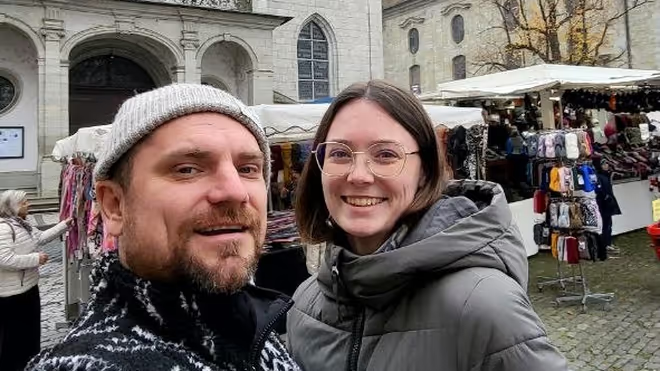
The Checklist Problem
The way most people travel, and the way I traveled for a long time, is structured around a list of things to do before leaving. The checklist is not always explicit, but it is always there. The famous viewpoint. The restaurant everyone recommends. The Instagram spot that is non-negotiable. The old town that you have to see at least once.
Moving through countries at speed means the checklist is always full. Driving from Bochum across Italy toward Greece then back to Portugal, Caro and I ticked things off. Beautiful things. Genuinely extraordinary places. But somewhere past the tenth stunning view and the fifteenth medieval town, something changes. The experience becomes about having had the experience rather than being in it. You are already thinking about the next stop while you are still at the current one.
This is what speed does to travel. It keeps you permanently in transition and never quite in arrival. The place you are in becomes the place you are passing through. Fast travel is extraordinary for generating memories. It is poor at generating the deeper understanding of a place that only comes with time.
What Slowing Down Actually Produces
We are now two and a half weeks into our six-month Portugal sit. Two weeks ago I was still in the headspace of the previous six months. The movement, the planning, the packing and unpacking. I was settled in the house but not settled in myself.
Now something has shifted. The mornings have a rhythm. The afternoon has a shape. I know which bakery Caro prefers, what time the chickens expect their midday lettuce, how the light changes in the garden across the day. This is knowledge you cannot buy with two weeks in a hotel. It only comes from staying long enough for a place to stop being unfamiliar.
Portugal, in these early weeks, has revealed something I would have missed on a standard trip. The people here are warm in a way that goes beyond service. At the checkout of a local shop, a cashier asked Caro what she was making for dinner. Not because it was a script, but because she was truly interested. That kind of warmth takes time to find. A two-week tourist usually only encounters the front-facing version of a place. The real character is further in.
Our best countries for van life and house sitting guide covers the regional picture for slow travel by country. Our benefits of house sitting for nomads guide covers what the model provides beyond accommodation.
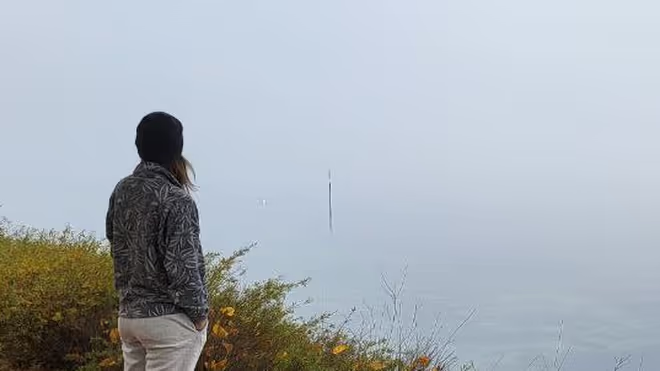
The Lullin Experiment: One Month and What It Taught Me
Before Portugal, the longest sit Caro and I did was a month in Lullin, France. It was a beautiful property, a quiet village, a good sit. But one month exposed something I had not fully understood about slow travel. The mental arc of a stay has its own stages, and one month is barely long enough to complete them.
The first two to three weeks in Lullin, we were tourists. We drove around the region, discovered things, made the most of the location. It was wonderful. But by the time we started truly relaxing. By the time the sit felt like a temporary home rather than a temporary holiday. We were already thinking about the return to Bochum. The end was close enough to create a low-level anxiety that shortened the experience.
Six months removes that. Two and a half weeks into Portugal I feel like we are just arriving. There is no end close enough to create pressure. That absence of pressure is the most valuable thing slow travel provides and it is the hardest thing to manufacture in a conventional travel model. Our van life and house sitting guide covers how combining the two creates this kind of rhythm.
What a Slow Day Actually Looks Like
People assume slow travel involves a lot of exploration. The reality of a good slow day on a house sit looks nothing like a holiday brochure.
Wake up. Feed the animals. Thirty minutes of meditation. Light exercise. Coffee. Work for six to eight hours. Lunch somewhere in the middle. Back to work. Feed the animals again in the evening. A walk. Dinner. Read. Sleep.
That is a normal Tuesday in Portugal. It sounds ordinary. It does not feel ordinary. After six months of being constantly in motion, having a day with no obligation to be somewhere specific, no checkout time, no transit to catch. A day that belongs entirely to the things I choose to do in it. Is extraordinary in its own way.
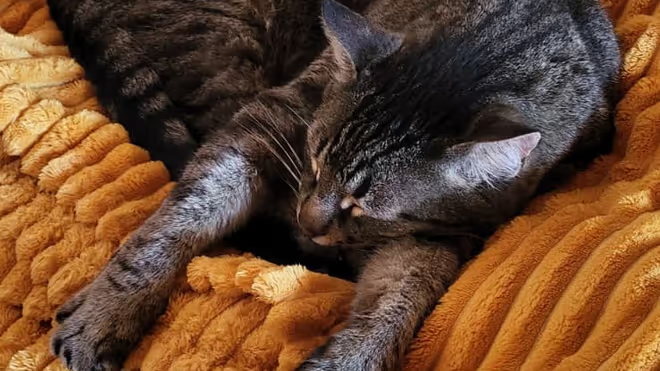
The pets provide the structure that makes this work. The chickens at eight, the midday vegetables, the cat's evening feeding. These anchors give the day shape without filling it with obligation. I think this is one of the most underappreciated benefits of house sitting specifically. The routine of caring for animals is not a burden. It is the architecture of a slow day. Our house sitting for remote workers guide covers how this daily rhythm translates into productive remote work.
The Van Changes the Equation
The campervan is what makes the slow travel model complete for us. Without it, we would have needed to book accommodation between sits, which means planning ahead, which means committing to a timeline, which means losing the flexibility that slow travel requires.
With the van, the gap between sits is not a logistical problem. It is a continuation of the journey. We drive toward the next sit at whatever pace makes sense, stop wherever interests us, and arrive ready to settle. The van is not luxury travel. We sleep in a 6m² space, manage our power from a 200Ah system, and navigate rough roads in a 30-year-old vehicle. But it provides something five-star hotels cannot: total freedom from anyone else's schedule.
Financially, the combination is what sustains the model. Accommodation is the biggest cost in travel. House sitting eliminates it entirely on sits. The van eliminates it between sits. The result is that Caro and I are not burning through savings. We are building. The time that house sitting provides is going into the projects that will sustain more travel in the future. HouseSittersGuide is one. Caro's teaching resource website is another. Slow travel gave us the time to build them. Our save $10,000 house sitting guide covers the financial model.
What Slow Travel Unlocks That Speed Cannot
I described it to someone recently as the travel equivalent of Vipassana. The ten-day silent meditation retreat I recommend to anyone who wants to understand their own mind. Vipassana works because it gives you ten uninterrupted days with yourself and nothing else. The insights that come from that do not come from a busy weekend retreat. They require the depth that only extended, uninterrupted time creates.
A month-long house sit in a beautiful location with a pleasant pet is not a meditation retreat. But it offers something structurally similar: time. Time to work on the thing you have been putting off. Time to rest in a way that actually registers. Time to discover what you truly enjoy when there is no agenda to fulfil.
If you want to start something online. A business, a content project, a skill. Slow travel is one of the few models that gives you the sustained blocks of working time that those things require. If you want to recover from burnout, a month in someone's garden with a cat that needs feeding twice a day is more restorative than a fortnight at a beach resort where you feel the pressure to have a good time.
The Answer to the FOMO Question
People worry that slowing down means missing out. That staying somewhere longer means seeing fewer places. That trading variety for depth is a loss.
My answer is simple: you do not have to see everything.
Caro and I have been to dozens of Instagram-famous locations across Europe. The viewpoints, the old towns, the lakes and valleys that everyone queues to photograph. They are beautiful. They become a memory, a good photo, a moment. Then the next one arrives and the previous one recedes.
The month in Lullin, the chickens in Portugal, the Swiss Shepherd who was still limping when we left but got better. These do not recede. They are part of a life rather than a tour of someone else's highlights. The things that stay with you are almost never the things you rushed to see. They are the things you lived alongside long enough to care about.
House sitting does not limit your travel. It changes what your travel is for. And for Caro and me, that change has been the most significant single shift in how we experience the world.
Join TrustedHouseSitters with 25% off. Read our house sitting vs house swapping comparison for a different angle on alternative accommodation models.
DM us @housesittersguide on Instagram. We answer everyone.
Frequently Asked Questions
Does slow travel through house sitting mean seeing fewer places?
It means seeing fewer places more deeply. Which is a different kind of gain, not a loss. A month in one location produces knowledge, relationships, and understanding that a week in four places cannot. The question is what you want from travel. If the answer is a complete and varied set of experiences rather than an exhaustive list of locations, slow travel consistently delivers more.
How long does a house sit need to be to feel like slow travel?
A month is the minimum to move past tourist mode into genuine settlement. The first two weeks of any longer sit are still adjustment. By week three something shifts. The routines become natural, the place starts to feel familiar, and the mental pressure of transition dissolves. Six months, as we are experiencing now, removes the end-of-sit anxiety entirely and allows a completely different quality of presence.
Can you work productively while house sitting?
Yes. It is one of the best remote work environments available. Stable WiFi, a quiet home, a predictable routine anchored by animal care, and no daily accommodation cost removing pressure to move on. The Portuguese sit is producing some of our most productive working months. Our house sitting for remote workers guide covers the setup in detail.
Is house sitting only for full-time travellers?
No. A single long sit works as slow travel for anyone. A month-long sit in a place you have wanted to explore gives you everything slow travel produces: time, depth, routine, and the removal of the checklist pressure. You do not need a van or a nomadic lifestyle to experience it. You need one good sit and the willingness to stop rushing.


Responses
What are your thoughts on this post?