

Home > Blog > The Permission to Stay Still During a House Sit
Quick Facts
| Quick Facts | |
|---|---|
| Who this matters most for | Full-time slow travellers combining van life with house sitting |
| The underlying guilt | Feeling you should be exploring when you actually need rest |
| What staying still actually produces | Focus, recovery, genuine presence, and often — unexpected growth |
| Monday rule | Caro and I take one full day off every week with no agenda |
| For occasional house sitters | Different calculus — if you are on holiday, explore |
You do not have to sightsee every day of a house sit. You do not have to justify staying in. You do not have to fill every free hour with a local experience worth photographing. The permission to stay still is one of the most underrated skills in slow travel, and it takes longer to develop than most people expect.
When Caro and I arrived in Manosque in the south of France after several weeks on the road, we did almost nothing. We ate takeaway pizza. We cooked a roast. We played games, worked on our websites, and spent time with the Icelandic Sheepdog and the cat. We did not visit the lavender fields. We did not drive to the Gorges du Verdon. We sat still, and by the end of those ten days, we had recovered something that all the driving and exploring had slowly depleted.
If you are interested in getting into house sitting, our book Travel More for Less puts the whole process in one place: clear, step by step guidance from your first questions to your first confirmed sit, and the reviews that open the door to the next one.
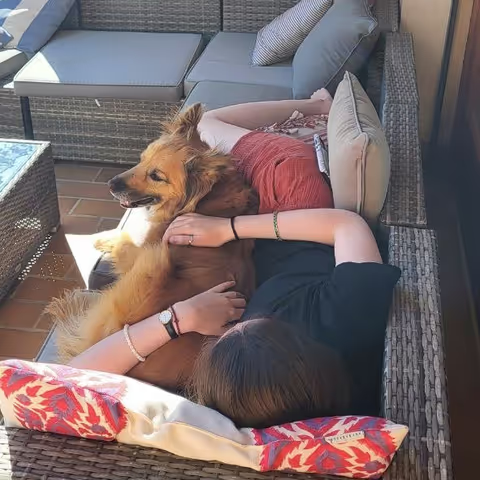
The Guilt Nobody Talks About
The most honest thing I can say about staying still is that the guilt arrives before the rest does.
When you are traveling with someone you love and you have the privilege of being in a beautiful place, there is a persistent internal voice asking whether you should be doing something with it. For me, that voice often speaks on Caro's behalf before she has said anything at all. I find myself wondering whether she wants to explore, whether staying in means she is missing something, whether my tiredness is limiting her experience. I bring it up directly rather than letting it sit — I tell her where I am, that I am tired, that I would be happy to go but would genuinely prefer to rest. She has the car, she has her own energy, and she is entirely free to go out on her own. That communication removes most of the guilt because it replaces assumption with honesty.
This dynamic is worth naming because it affects how a lot of couples experience house sitting. One person's need to stop is quietly managed around the other person's perceived desire to explore. The sit becomes a negotiation nobody is having out loud. The fix is to have it out loud, early, and without drama. Most of the time, both people are tireder than they have admitted.
What Five Months of Constant Movement Actually Feels Like
By the time we arrived at the Manosque sit, we had been traveling for around five months. Montenegro, Bosnia, Serbia, Hungary, Slovenia, Italy, the Dolomites, Greece. Each place had been genuinely incredible. Each place had also taken something from the mental reserve.
There is a ceiling to how much new information the mind can absorb before it simply stops processing it properly. New landscapes, new road systems, new languages on signs, new supermarket layouts, new beds, new pets, new homeowners, new welcome guides. Every transition requires cognitive effort that does not feel like effort in the moment because it is wrapped in excitement. It accumulates anyway.
Scrolling back through six or seven months of photos now, from the current Portugal sit, Caro and I are regularly surprised by how much we did. The volume of experience is genuinely difficult to hold in the mind at once. At the time, some of it was passing through us faster than we could absorb it. Manosque was the first time we actually stopped and let some of it settle.
This is what the slow travel approach to house sitting makes possible that conventional tourism does not. You are not on a two-week holiday with a departure date creating urgency. You have time — real time — to stop doing and simply be somewhere for a while. Using that time to tick off every local attraction is a choice, not an obligation.
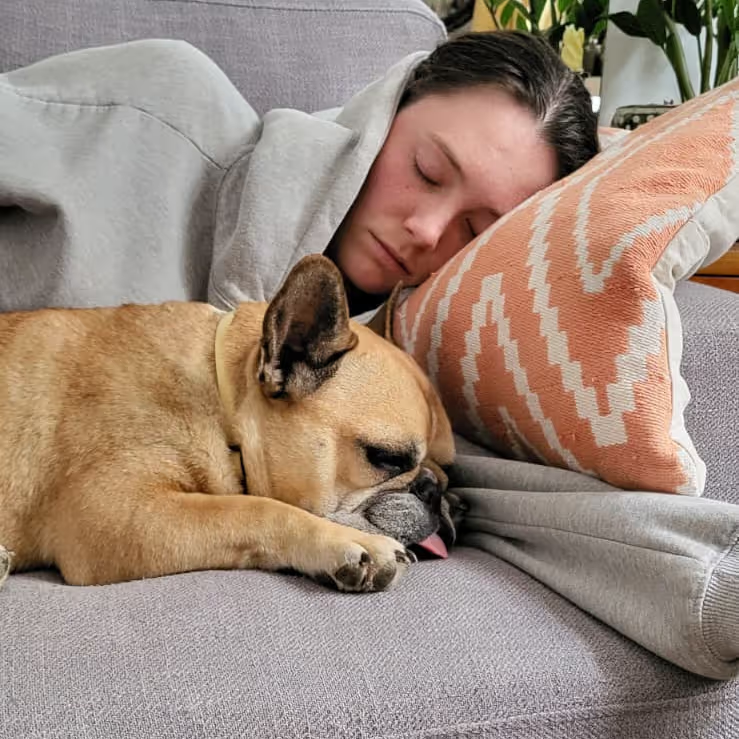
What a Day of Staying Still Actually Looks Like
The current Portugal sit is six months long. A month in, the shape of a typical day has settled into something that feels genuinely sustainable.
Caro works on her teaching resource site and goes for a swim in the pool each afternoon. I work on housesittersguide.com, study German, do some exercise with the macebell, and usually cook in the evening. The cat wakes us at 6am. The chickens get fed. The garden gets watered. Work starts at 8am. By early afternoon the productive window is closing and we ease into something slower.
We introduced a Monday rule early in the Portugal sit: one full day each week with no work agenda, no obligations, just switching off entirely. It started as an experiment and became a fixture within two weeks. The quality of the following Tuesday is noticeably different from the Tuesdays that came before we introduced it. Rest that is scheduled and protected works better than rest that is squeezed into whatever space the week leaves over.
None of this involves sightseeing. Some of it is deeply productive in ways that have nothing to do with exploring Portugal. The websites are growing. The engagement is increasing. There is a version of the conversation about slow travel that focuses entirely on place — what to see, where to eat, what to photograph. The version we are living is more interested in what becomes possible when you stop moving long enough to actually build something.
The Van Life and House Sitting Combination Changes the Calculus
For anyone combining campervan travel with house sitting, the relationship between movement and rest works differently than it does for someone flying in from home for a single annual sit.
When you are living in the van between sits, you are almost always exploring. New towns, new viewpoints, new roads. The van life phase is high-stimulation almost by definition — you are moving, discovering, navigating, making decisions about where to park and what to eat and how long to stay. By the time the sit starts, the exploring has largely already happened. You have driven through the region. You have seen the things you wanted to see. The house sit is the exhale after the inhale of the road.
This means that for us, a sit is often a natural resting point rather than a new sightseeing opportunity. The house gives us a desk, a kitchen, a proper bed, a settled routine. The animals give the days structure. The absence of navigation decisions gives the mind space to think about something other than logistics. That combination is what makes long sits feel restorative in a way that short sits sometimes do not.
For people doing one or two sits a year as a holiday, the calculus is different. If you have traveled specifically to be somewhere and the sit is the mechanism that gets you there, exploring that place is entirely appropriate and is exactly what you should do. The month in Lullin in France is a good example — Caro and I explored the lakes and the surrounding area thoroughly, and that felt right. We also had time to settle into the house, and the two things coexisted without tension.
The question is not whether to explore or to rest. It is whether you are making a genuine choice or responding to an unexamined pressure.
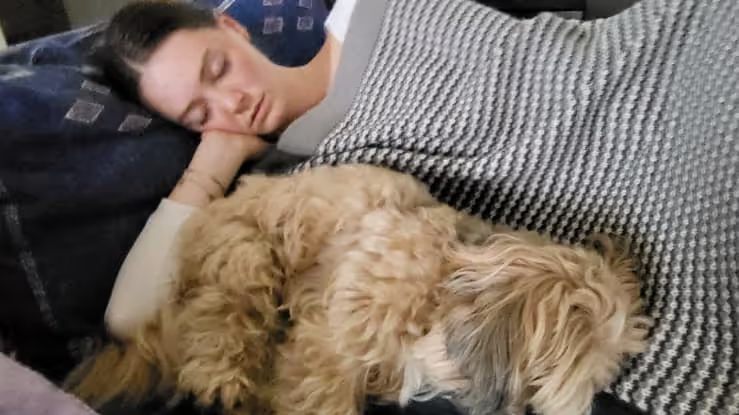
The Productivity That Comes From Stillness
One thing that has surprised us about extended house sitting is how much focused work becomes possible when the background noise of constant movement disappears.
Since Caro and I started the Portugal sit in May 2026, both of our projects have grown more in a single month than they did in several months of traveling. Not because we are working harder, but because we are working with more consistency and less disruption. There is no travel day coming up in three days that requires packing and driving and a new orientation. There is no welcome guide to read through or new set of pet routines to memorise. The same desk, the same morning, the same chickens. Routine creates cognitive surplus. Cognitive surplus goes into the work.
This is something the slow travel literature rarely acknowledges directly. The benefit of staying still is not just psychological recovery from the fatigue of movement. It is the accumulation of focused time that movement constantly interrupts. House sitting, particularly long-term house sitting, provides something most remote workers are actively trying to manufacture — a stable, comfortable, low-distraction environment that changes often enough to stay interesting but not so often that it prevents depth.
The slow morning routine article covers what the structure of a productive but unhurried house sitting day can look like in practice.
Gratitude as a Practice, Not a Platitude
There is something that happens when you stop moving long enough to actually notice where you are.
Scrolling through six months of photos at the start of a six-month sit in Portugal, genuinely surprised by how much has happened, is a specific kind of perspective that constant movement does not produce. It takes stillness to see the accumulation. It takes a quiet afternoon in a garden in the Alentejo, with a cat sleeping nearby and chickens scratching in the corner, to feel the weight and the luck of the life being lived.
Caro and I talk about gratitude not as a morning journaling exercise but as a natural response to actually paying attention. The more present you are — the less you are mentally preparing for the next destination or reviewing what you just left — the more what is directly in front of you registers as genuinely remarkable. A good meal cooked in someone else's kitchen. A dog who has started choosing to sleep at the foot of your bed. A garden that is visibly better for being watered every morning.
None of these things appear in a travel highlight reel. All of them are part of why this lifestyle, at its best, is worth living.
A Note for Occasional House Sitters
Everything above applies most directly to people for whom house sitting is a continuous lifestyle rather than an annual event.
If you are doing one or two sits a year and the sit is your holiday, the advice changes. You have limited time in a specific place and exploring that place is entirely reasonable. The obligation you owe is to the pets — never leave them alone for longer than is fair, always honour the feeding and care routine — but within those boundaries, your time is yours to use as you choose. Going out every day, visiting the local markets and the nearby towns and the things you traveled for, is not a failure to slow down. It is a completely appropriate use of a house sit as a travel base.
The message of this article is not that everyone should stay in. It is that the pressure to go out, which most sitters feel to varying degrees, is worth examining. If you want to explore, explore. If you want to rest, rest. The permission to choose the latter without guilt is what most sitters are not given and what this lifestyle, uniquely, makes available.
Conclusion
Staying still is a skill. It takes practice to override the guilt of not making the most of a place, the social pressure to produce content worth sharing, the internal voice asking whether you should be doing something. The sits where Caro and I have done the least have often given us the most — the most recovery, the most focused work, the most genuine presence in the life we are living.
The house sit that looked quiet from the outside, the one with the takeaway pizza and the roast and the games and the garden watering, was not a wasted opportunity. It was the point.
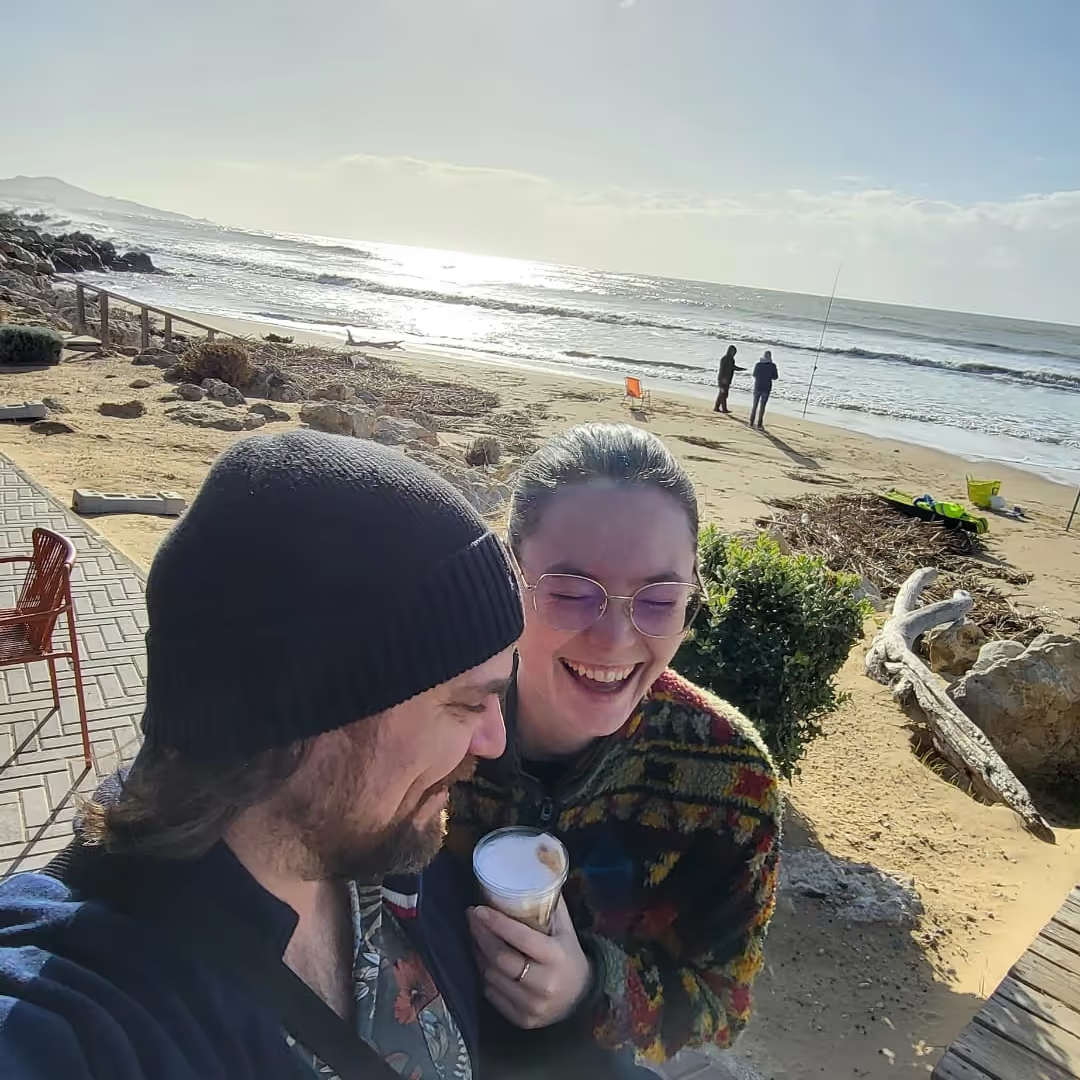
Caro and I have completed 20 house sits across 12 countries, driven 19,000km in Australia and 24,000km in our 1998 VW T4, and saved over $26,500 in accommodation costs. If you have a question about the slower side of this lifestyle, send us a message on Instagram — we read every DM.
Frequently Asked Questions
Do I have to go sightseeing during a house sit?
No — and the pressure to do so is worth examining before you act on it. If you traveled specifically to see a place and the sit is your base for doing that, explore. If you are a full-time slow traveller who has been moving constantly and needs to recover, staying in is not laziness. It is appropriate use of what the sit is actually offering you. The obligation you have is to the pets and the home, not to the local tourist board.
Is it normal to feel guilty for resting during a house sit?
Yes, and it is particularly common when traveling with a partner. One person's need to rest often gets managed quietly around the other person's assumed desire to explore. The most effective fix is to say it out loud early — where you are, what you need, and what you are happy to do. Most of the time, both people are tireder than they have admitted and the conversation resolves itself quickly.
How do you balance rest and exploration during a long house sit?
By making genuine choices rather than responding to unexamined pressure. Explore when you genuinely want to. Rest when you genuinely need to. Protect at least one full day each week with no agenda. Caro and I use Monday as a complete switch-off day and find the week that follows it is consistently better than the weeks before we introduced that rule.
Does staying still during a house sit make you less productive?
In our experience, the opposite. The stability of a long sit — the same desk, the same morning routine, the same pets — creates conditions for focused work that constant movement interrupts. Both of our projects grew more in the first month of the Portugal sit than in several months of traveling. Routine generates cognitive surplus. That surplus goes into the work.
What is the difference between slow travel and just being lazy?
Intention and awareness. Slow travel involves making a deliberate choice to be present in a place rather than moving through it quickly. Staying in because you need to recover is an intentional act. Staying in because you cannot be bothered and feel vaguely dissatisfied about it is something different. The distinction matters because one produces genuine rest and the other produces guilt that undermines the rest. If staying still feels genuinely restorative, it is slow travel. If it feels like avoidance, it might be worth asking what you are avoiding.
Should first-time house sitters try to sightsee or rest?
Both, in proportion to what the sit is for you. If it is your annual holiday and you traveled to a specific place, explore it. If it is part of a longer travel life and you are already saturated with new experiences, give yourself permission to stop. The sits where nothing happened are often the ones people remember most clearly, because presence — genuine, unhurried presence in a place — is rarer and more valuable than another item ticked off a list.


Responses
What are your thoughts on this post?