
Home > Blog > Mail, Banking, and No Fixed Address
Quick Facts
| Quick Facts | |
|---|---|
| Do you need a permanent address? | For some official purposes, yes. But daily life without one is simpler than you expect. |
| How we handle mail | Family addresses in Australia and Germany, plus post office collection and postal boxes |
| Banking without a fixed address | Online banks like N26 and Revolut make this straightforward |
| Receiving packages on the road | Post office collection (poste restante), postal locker boxes, or delivered to the current sit with homeowner permission |
| Important disclaimer | Everyone's situation is different. Research the requirements for your nationality, tax residency, and personal circumstances. We are not lawyers or tax advisors. |
In eleven years of traveling, across multiple countries and continents, the number of physical letters I have actually needed to receive is remarkably small. Most important communication arrives by email. Banking is entirely online. Government documents, when they arrive at all, go to my mum's address in Australia. The reality of living without a fixed address in 2026 is far simpler than most people assume, not because the systems have been designed for nomads, but because the systems have moved online to the point where a physical mailbox is needed far less often than it used to be.
That said, there are moments where a physical address matters. A new bank card. A government notice. A package you ordered because the battery charger for the van's power station is not going to appear in your email inbox. This article covers how Caro and I handle all of it while traveling full-time in the T4 and house sitting across Europe, and what options exist for sitters in different situations.
A note before we start: everyone's legal, tax, and residency situation is different. What works for us as EU citizens may not apply to someone with a different nationality, tax residency, or personal circumstances. We are not lawyers, tax advisors, or immigration specialists. Our house sitting legal issues guide covers some of the broader legal questions, and our customs and border guide covers travel documentation. If anything in this article touches on your specific situation, research the requirements for your country thoroughly before making decisions. This article covers what we do in practice, not what you should do without checking your own obligations first.
If you are interested in getting into house sitting, our book Travel More for Less puts the whole process in one place: clear, step by step guidance from your first questions to your first confirmed sit, and the reviews that open the door to the next one.
The Family Address Solution
The simplest and most common solution for full-time travellers is the one most people start with: a family member's address.
My mum's address in Australia is my registered address for anything that requires one. She is also the person who introduced me to house sitting in the first place, when she found the Sydney sit that started everything. Any physical mail that needs to reach me, which is genuinely rare, goes there. She holds it, lets me know if anything arrives, and in the few cases where something has been time-sensitive, she has forwarded it or sent a photo of the document.
Caro is registered at her family's address in Germany. Any personal documents, official correspondence, or anything that needs a German address goes there. Her family holds it and lets her know when something arrives. The same address she has had since before we started house sitting together in Bochum.
This is not a complicated system. It is the system most people already have before they start traveling. The difference is that instead of it being a backup, it becomes the primary arrangement. For most full-time house sitters, this is enough. The volume of physical mail that genuinely requires a physical address has decreased so significantly over the past decade that a family member checking a mailbox once a week covers the vast majority of situations.
The obvious limitation is that it requires a willing family member in a country where you maintain some form of registration or residency. Not everyone has that. If you do not, the alternatives below cover other options.
Receiving Packages on the Road
This is the practical problem that comes up more often than official mail: you need to buy something physical while traveling and you need somewhere to send it.
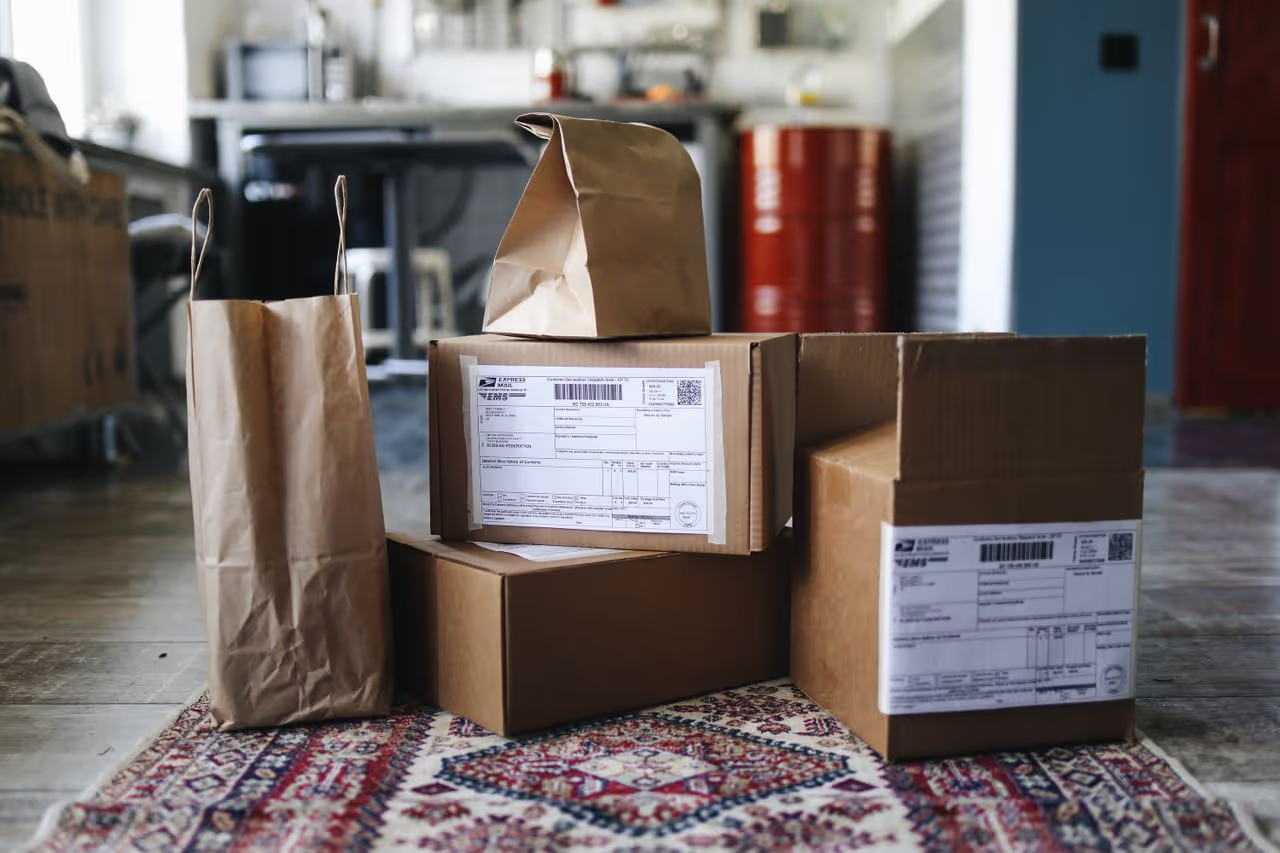
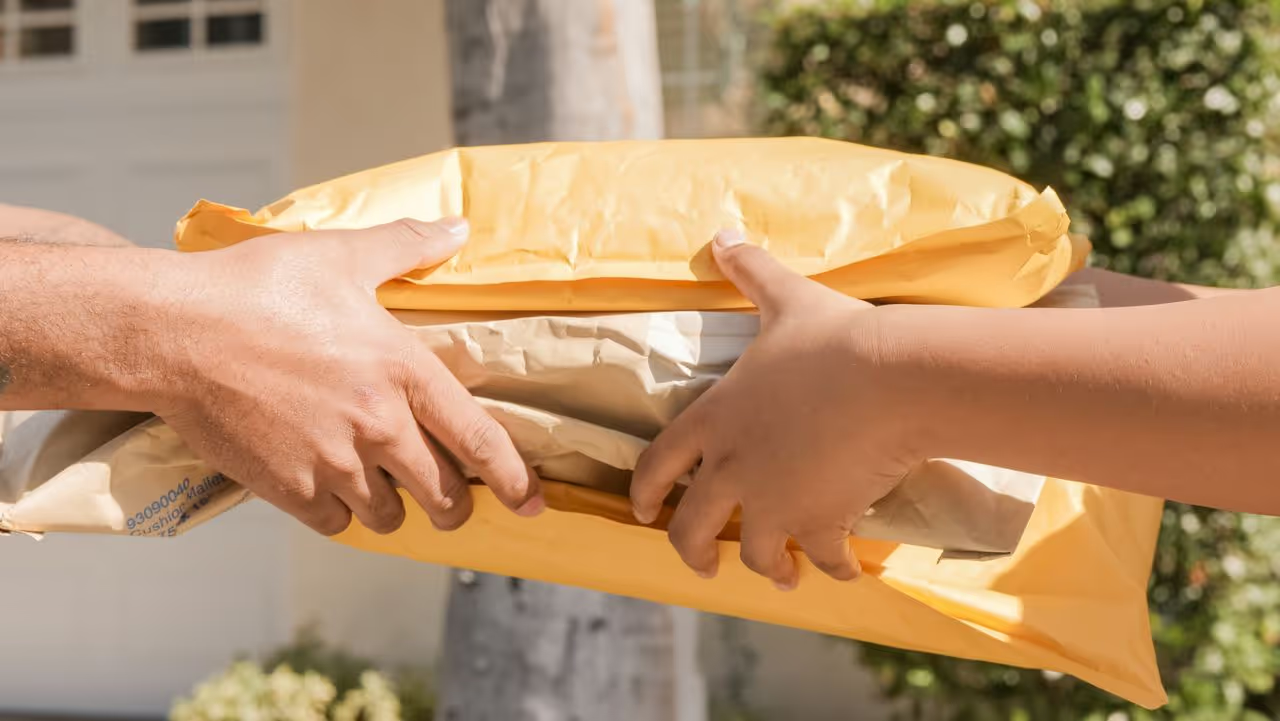
When we were in Italy, driving the T4 through on our way toward Portugal, I needed to buy a battery charger for our power station. I did not have an Italian address. While researching delivery options, I discovered something I had not known before: in most European countries, you can send packages directly to a post office for collection. You address the package with your name and the post office's address, and when it arrives, you show your ID and pick it up. This system is called poste restante in some countries, or fermo posta in Italy, and it exists specifically for people without a fixed local address.
The other option, which Caro uses regularly for her Vinted sales alongside running carosclass.com, is postal locker boxes. In Portugal, these are everywhere and the system is one of the simplest I have ever used. You pay for postage, receive a code, type it into the locker screen, the door opens, you place the package inside, and it gets picked up, labelled, and delivered without you ever needing to write an address on the box yourself. For receiving, the same system works in reverse: the package arrives at a locker near you, you get a code, and you collect it whenever it suits you.
To give a sense of how robust these systems are: I recently ordered a 12kg (26lb) macebell on eBay for my fitness routine and had it delivered to a postal locker box in Portugal. A 26lb steel training tool, shipped from a seller on eBay to a locker I picked up from at my convenience, with no home address required at any point. If the postal system can handle that, it can handle whatever you need to order.
Each country handles this slightly differently. The locker systems, the post office collection policies, and the costs vary. But the principle is the same everywhere: there are always options for sending and receiving packages without a permanent address. It is worth researching the specific system in whatever country your current sit is in when you arrive, because the local solution is usually simpler than you expect. In Portugal, where we are currently on a six-month sit, the postal locker system has been effortless.
Selling Online Without a Fixed Address
Caro runs carosclass.com and sells through Eduki and Vinted. She manages all of this from her portable monitor setup at the sit, with one screen for creating content and the other for research and admin. Selling through platforms like Vinted while traveling full-time raises the practical question of return addresses.
So far, Caro has not had any returns, so we have not been tested on this. What we have done as a precaution is ask the homeowners at our current sit whether we could use their address as a return address on packages during the sit. They agreed, which covers us for the duration. This is the kind of conversation worth having during the first day of a sit if you plan to sell or receive packages during your stay. If a return were requested, we could also route it to a postal locker box, which is more than sufficient for receiving a returned item.
For sitters who sell online regularly, the key is having a plan before you need it rather than scrambling when a return request arrives. The options are: the homeowner's address with their permission, a postal locker at a nearby collection point, or a family address in your home country if the return timeline allows for it.
If you are running any kind of online business while house sitting, whether selling physical products or receiving business correspondence, make sure you understand the legal requirements around business registration addresses in your home country. Some countries require a business to have a registered address that may need to be more formal than a family home. This is something to check with an accountant or business advisor before you leave, not after. Our house sitting careers article covers the broader picture of running a remote income alongside the house sitting lifestyle.
Banking Without a Physical Address
This has been one of the easiest parts of full-time travel, and it comes down to choosing the right bank before you leave.
I use N26 for all my spending. It is an entirely online bank with no physical branches, which means I do not receive any documents by post. Everything, statements, notifications, tax certificates, arrives by email or through the app. If I need a new card, it gets sent to a family address in Poland, though I have not needed a new physical card in years because I pay with my phone and can create virtual cards through the app instantly.
Caro uses a similar setup. The combination of an online bank and mobile payments means that physical banking correspondence has been eliminated from our lives almost entirely. We mentioned N26 in our Portugal guide as our recommendation for spending abroad, and after using it across 12 countries, that recommendation has only gotten stronger.
For house sitters in Europe, N26 is the option I would recommend looking into. For sitters outside Europe, Revolut offers similar functionality globally. Both provide real exchange rates, no foreign transaction fees, and travel insurance benefits that are genuinely useful for full-time travellers. The key feature for nomads is that neither bank requires you to visit a branch or receive physical mail to manage your account. Our house sitting costs guide covers how we track and manage our spending across different countries.
One thing to be aware of: some banks, including traditional ones, will close accounts if they detect address discrepancies or if mail is returned as undeliverable. If you still have accounts with traditional banks, make sure your registered address is somewhere that mail can actually be received and does not bounce back. A family address that is actively checked works. A former rental address where you no longer live does not.
Government and Official Correspondence
In eleven years of traveling, the volume of government mail I have needed to deal with physically has been close to zero. Tax documents, government notifications, and official correspondence in most countries now arrive by email or through online government portals. Australia, Iceland, and Poland all have digital systems for most official communication.
When something does arrive by physical post, which is rare, it goes to the relevant family address. My mum in Australia handles anything from Australian government bodies. Caro's family in Germany handles anything from German authorities. In both cases, the family member lets us know it has arrived, and if action is needed, we handle it online or over the phone.
The honest truth is that it is surprising how rarely physical government mail arrives. If your government accounts, tax registration, and official profiles all have your email address as the primary contact, the postal system becomes a backup rather than the main channel.
This is heavily dependent on your country of citizenship and tax residency. Some countries are further along in digital government than others. Some still require physical signatures on documents that need to be posted back. Research what your specific country requires before assuming that email will cover everything. If you know you will need to receive and return physical government documents while traveling, setting up a postal forwarding service or a postal box in your home country before you leave is worth the small monthly cost for the peace of mind it provides. Our insurance guide covers some of the official documentation questions that arise around coverage and liability during sits.
Medical Records and Healthcare
This is the area where full-time travel creates the most fragmentation, and I will be honest about it: my medical records are scattered across multiple countries from years of living in different places.
My personal approach is prevention focused. I have not needed to visit a doctor in close to five years. I eat well, exercise regularly, take supplements, and prioritise my health in a way that, so far, has kept me out of medical situations. As European citizens, Caro and I have access to healthcare across EU countries, and we both carry travel insurance. Our article on getting sick during a house sit covers what to do when illness hits during a sit and how to access healthcare in a foreign country.
If I did need to see a doctor during a sit, I would go in with a clean slate because I do not have pre-existing conditions that require ongoing management. For someone with pre-existing conditions, chronic medication, or ongoing treatment, the calculation is very different. Regular prescriptions, specialist referrals, and continuity of care all require a more structured approach to medical records and a more deliberate relationship with a healthcare system.
If you have ongoing medical needs, consider registering with a GP or healthcare provider in your home country or a country where you spend significant time. Having one central point where medical records are held and prescriptions can be managed makes the logistics of healthcare while traveling significantly more manageable. A postal box or family address in that country ensures medical correspondence reaches you. The physical toll of constant travel article covers the broader health considerations of the nomadic lifestyle, and the burnout article covers why pacing matters for long-term wellbeing.
We are not medical professionals. This section describes what works for us personally. If you have specific health needs, consult with a doctor before committing to full-time travel without a fixed healthcare base.
Postal Solutions: A Quick Comparison
| Solution | Best for | Limitations |
|---|---|---|
| Family address | Official documents, government mail, bank cards, general correspondence | Requires a willing family member in a relevant country |
| Poste restante (post office collection) | One-off package deliveries while traveling | Available in most countries but policies and holding periods vary. Requires ID for collection. |
| Postal locker boxes | Sending and receiving packages, Vinted and marketplace sales | Widely available in Portugal, increasingly common across Europe. Not available everywhere. |
| Homeowner's address (with permission) | Packages during a longer sit | Must ask the homeowner first. Only works for the duration of the sit. |
| Virtual mailbox service | Business registration, ongoing professional correspondence | Costs money monthly. Primarily aimed at US digital nomads. May not be accepted for all official purposes depending on country. |
| PO Box in home country | Ongoing mail collection with a permanent address | Requires periodic access or someone to forward. Costs vary by country. |
The Digital-First Setup
The reason all of this works as smoothly as it does is that Caro and I made the switch to digital-first before we started traveling full-time. Almost everything that used to arrive by post now arrives by email or through an app. Here is what the practical setup looks like.
Banking is entirely through N26 with no physical correspondence. Tax filing in Australia is done online through the ATO portal. Government notifications arrive by email. Platform correspondence from TrustedHouseSitters, Nomador, Aussie House Sitters, and every other platform we use is entirely digital. House sitting profiles, applications, video calls, and reviews are all managed through the platforms' apps and websites. Even the German learning app I built runs entirely on a laptop.
The only physical items that still require a postal address are: the occasional bank card replacement, rare government documents that cannot be delivered digitally, and packages ordered while traveling. Those three categories cover everything, and each one has a solution that does not require a permanent home address.
For sitters starting out, the best time to set this up is before your first sit, while you still have a fixed address. Switching banks, updating government contact preferences, and confirming your family is willing to receive mail are all easier to do from a stable base than from a sit in a country where you do not speak the language.
What We Wish We Had Known
The main thing we would tell someone about to start full-time travel and house sitting: set up your systems before you leave, not after.
Make sure your banks are online-only or at minimum have your email as the primary contact for all correspondence. Confirm that government accounts have your email registered. Tell your family members that they may receive occasional mail for you and check whether they are comfortable with that arrangement. If you plan to sell online, figure out the return address situation before your first sale. If you have prescriptions or ongoing medical needs, arrange continuity before your departure.
Most of these things take an afternoon to sort out while you still have a fixed address. Doing them from a house sit in a country where you do not speak the language and do not have a local postal address is significantly harder. Our getting started guide covers the practical setup for the house sitting side of things, and the what to pack for illness article covers the health supplies worth having in your travel kit.
The other thing worth knowing: it is easier than you think. The anxiety about "how will I receive mail" is almost always bigger than the reality. In practice, almost everything arrives by email, packages can be sent to post offices or lockers in most countries, and the number of times you genuinely need a physical address is remarkably small. After three years and 20 sits across 12 countries, the postal system has been a minor footnote in the logistics of our life, not the obstacle we once imagined it would be.
Conclusion
Living without a fixed address while house sitting full-time is more practical in 2026 than it has ever been. Online banking, digital government services, email correspondence, postal locker systems, and post office collection cover the vast majority of situations that used to require a permanent mailbox.
The foundation is simple: a family or friend address for anything that genuinely needs one, an online bank that does not require physical mail, and knowledge of the local postal collection options in whatever country your current sit is in. Everything else is manageable with a phone and an internet connection.
Everyone's situation is different. Nationality, tax residency, business registration, medical needs, and personal obligations all affect what you need and what systems work for you. Research your own specific requirements thoroughly before making any decisions about addresses, residency, or official correspondence. What works for two EU citizens traveling in a campervan across Europe may not apply to your circumstances.
Caro and I have completed 20 house sits across 12 countries, driven 19,000km in Australia and 24,000km in our 1998 VW T4, and saved over $26,500 in accommodation costs over three years of house sitting. If you have questions about the logistics of full-time travel and house sitting, send us a message on Instagram, we read every DM.
Frequently Asked Questions
Do I need a permanent address to house sit full-time?
For daily life, no. Most correspondence arrives by email, banking can be entirely online, and packages can be sent to post offices or locker boxes. For some official purposes, such as tax residency, government registration, and certain legal or financial requirements, a registered address in your home country is usually necessary. A family member's address covers this for most people. Our house sitting legal issues guide covers some of the broader questions.
How do I receive packages while traveling?
Three main options: send packages to a local post office for collection using poste restante (available in most European countries, requires ID to collect), use postal locker boxes (widely available in Portugal and increasingly across Europe), or ask the homeowner's permission to use the sit address during a longer stay.
Which bank works best for full-time house sitters?
For Europe, N26 is entirely online with no physical mail, no foreign transaction fees, and virtual card creation through the app. Revolut offers similar functionality globally. Both eliminate the need for physical banking correspondence. Avoid traditional banks that send statements by post, as undeliverable mail can trigger account closures. Our house sitting costs guide covers how we manage spending across countries.
Can I sell on Vinted or marketplace platforms without a fixed address?
Yes. Caro sells through Vinted using postal locker boxes in Portugal for sending packages. For return addresses, we have asked the homeowner for permission to use the sit address during the current stay, or route returns to a postal locker. Research the specific postal system in whatever country you are in, as locker availability and processes vary.
What about tax obligations without a fixed address?
This is heavily dependent on your nationality and tax residency, and is something to research thoroughly or discuss with a tax advisor before departing. Most countries have digital tax filing systems that can be accessed from anywhere. Physical tax correspondence typically goes to your registered address, which for most full-time travellers is a family address in their home country. We are not tax advisors and this is not tax advice.
How do I handle medical records while traveling full-time?
Medical records can become fragmented across multiple countries. If you have ongoing medical needs, consider maintaining a relationship with a healthcare provider in one country where records are centralised and prescriptions can be managed. If you are healthy with no ongoing conditions, most routine medical care can be accessed locally during a sit using travel insurance or EU healthcare access. Our getting sick during a sit article covers the practical side of illness and healthcare during sits.
What should I set up before leaving for full-time travel?
Switch banks to an online provider like N26, register email as the primary contact for all government and financial accounts, confirm family members are willing to receive occasional mail, figure out your return address solution for any online selling, and arrange medical continuity if you have ongoing health needs. Do all of this while you still have a fixed address. Our getting started guide covers the house sitting setup side.


Responses
What are your thoughts on this post?