

Home > Blog > Does House Sitting Build a Healthier Gut Microbiome?
Quick Facts
| Quick Facts | |
|---|---|
| Does house sitting build a healthier gut microbiome overall? | The trend points that way, based on travel, pet, and diet research combined, though no study has tested this exact lifestyle directly |
| Does travel change your gut microbiome? | Yes, and quickly. Studies using daily sampling found measurable shifts within the first days of travel |
| Does living in someone else's home matter beyond travel itself? | Yes. People sharing a living environment can share up to 50% of gut microbiota taxa, regardless of relatedness, passively, without any active choice involved |
| Does pet exposure change your microbiome? | Genuinely likely, yes, through direct skin and gut microbiome transfer, though findings across individual studies are mixed |
| What role does diet play in all this? | The one lever a sitter actively controls. A new sit's psychological reset makes dietary change easier, and diet is one of the strongest known drivers of gut microbiome shift |
| The psychological side: why new homes make change easier | Every new sit strips away ingrained routine, functioning as a genuine "hard reset" that a settled home doesn't provide |
| Our own experiment | Cut alcohol, sugar, grains, and dairy for the full 6-month Portugal sit, using the fixed end date as motivation |
| Have either of us been sick recently? | Neither of us has needed a doctor since November, and Caro, who used to get sick often as a teacher, has been notably healthier |
| Is this medical advice? | No. We are not doctors or microbiologists. This is a summary of published research plus personal observation |
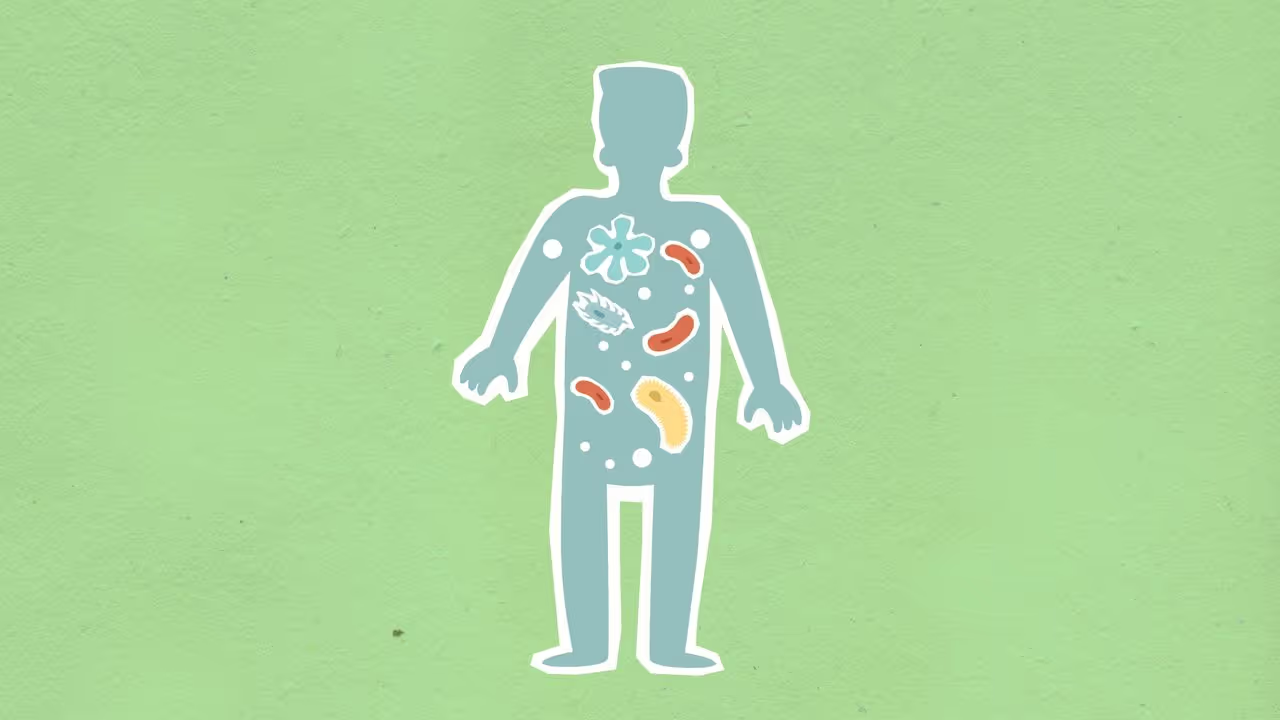
Constantly moving between homes doesn't just affect your sleep and your skin, both covered in our physical toll of constant travel guide, it likely affects the actual bacterial ecosystems living in and on your body. Research on international travel shows gut microbiome shifts happening within days, not weeks. Separately, people who share a living space can share up to half their gut bacteria, regardless of relatedness. And pet contact specifically, the thing that makes house sitting different from any hotel stay, is linked in multiple studies to greater microbial diversity through direct physical contact. There's also a psychological layer worth taking seriously: every new sit functions as a genuine reset, stripping away the routines that build up in a settled home, which may be exactly why house sitting turns out to be an unusually good environment for actually changing habits.
We stumbled into this topic almost by accident, thinking through why we've both felt noticeably healthier over the past few years of doing this, and realizing the obvious explanations (better food, more walking, less stress) didn't fully account for it. That sent us looking into what's actually known about how travel, shared living spaces, and pets affect the human microbiome, and what we found was more specific, and more directly relevant to house sitting, than we expected.
This isn't a topic anyone seems to have studied for a lifestyle quite like this one. So this article does two things: it lays out the real, published research on gut and skin microbiome science as it applies to travel and pet exposure, and it's honest about where that research stops and our own observation begins. We are not doctors, and none of what follows is personalized medical advice, and we're not claiming more certainty than the science actually supports. But we think this is a genuinely underexplored angle on why constantly changing homes might be doing more to the body than just disrupting sleep for a few days.
If you are interested in getting into house sitting, our book Travel More for Less puts the whole process in one place: clear, step by step guidance from your first questions to your first confirmed sit, and the reviews that open the door to the next one.
Why This Is Different From Just "Travel Affects Your Body"
We've already covered the experiential side of moving frequently, the sleep disruption, the skin reacting to new water, the allergen adjustment, in our guide to the physical toll of constant travel. This article goes a layer deeper, into the actual bacterial science behind some of what that article describes experientially, and into territory that piece doesn't touch at all: the gut and skin microbiome specifically, what pet exposure does to it, and the psychological mechanism that seems to make house sitting an unusually effective environment for changing your habits.
House sitting is a genuinely unusual case study here. A regular traveler moves through hotels, largely standardized environments with professional cleaning and no resident animals. A settled pet owner lives with the same one or two pets continuously, in the same home, for years. A house sitter does neither. We move through dozens of distinct homes, each with its own food, water, cleaning products, and, critically, its own animals, in a pattern that doesn't map neatly onto either kind of study that already exists.
What Travel Actually Does to Gut Bacteria
A study published in npj Biofilms and Microbiomes, using daily stool sampling and genetic sequencing during intercontinental travel, found rapid shifts in gut microbiota composition within the first days of a trip, far faster than most people would assume. The same body of research has found that travelers can pick up antimicrobial resistance genes during travel, a real, if generally low, risk worth being aware of, particularly on longer trips.
Separate research examining international travel and gut microbiota composition found that long stays, especially in destinations with different levels of industrialization than where a traveler normally lives, are associated with genuine increases in gut microbial diversity. Industrialized environments tend to correlate with lower microbial diversity overall, so travel to more varied environments can, somewhat counterintuitively, be a net positive for gut bacterial diversity, generally considered a marker of good gut health. That same research specifically recommended probiotics for long-term travelers, given the real risk of travelers' diarrhea associated with these shifts.
The Part That's Genuinely Surprising: Shared Homes, Shared Bacteria
Here's the finding that made us actually reconsider what house sitting does to the body, beyond travel alone. Research on shared living environments has found that people cohabiting the same space, even with no genetic relationship at all, can share up to 50% of their gut microbiota taxa, transmitted simply through close contact with the same environment.
That's a genuinely different mechanism from travel itself. It's not just about new food and new water in a new place. It's about actually living inside someone else's home, their surfaces, their air, their routines, in a way that a hotel room, cleaned and reset for every guest, simply doesn't replicate. A house sitter isn't visiting a location. They're temporarily becoming part of a specific home's microbial ecosystem, one that's been shaped by the people, and the pets, who normally live there.
Pets Specifically Change This Picture
This is where house sitting diverges most clearly from ordinary travel, and where the research gets genuinely interesting.
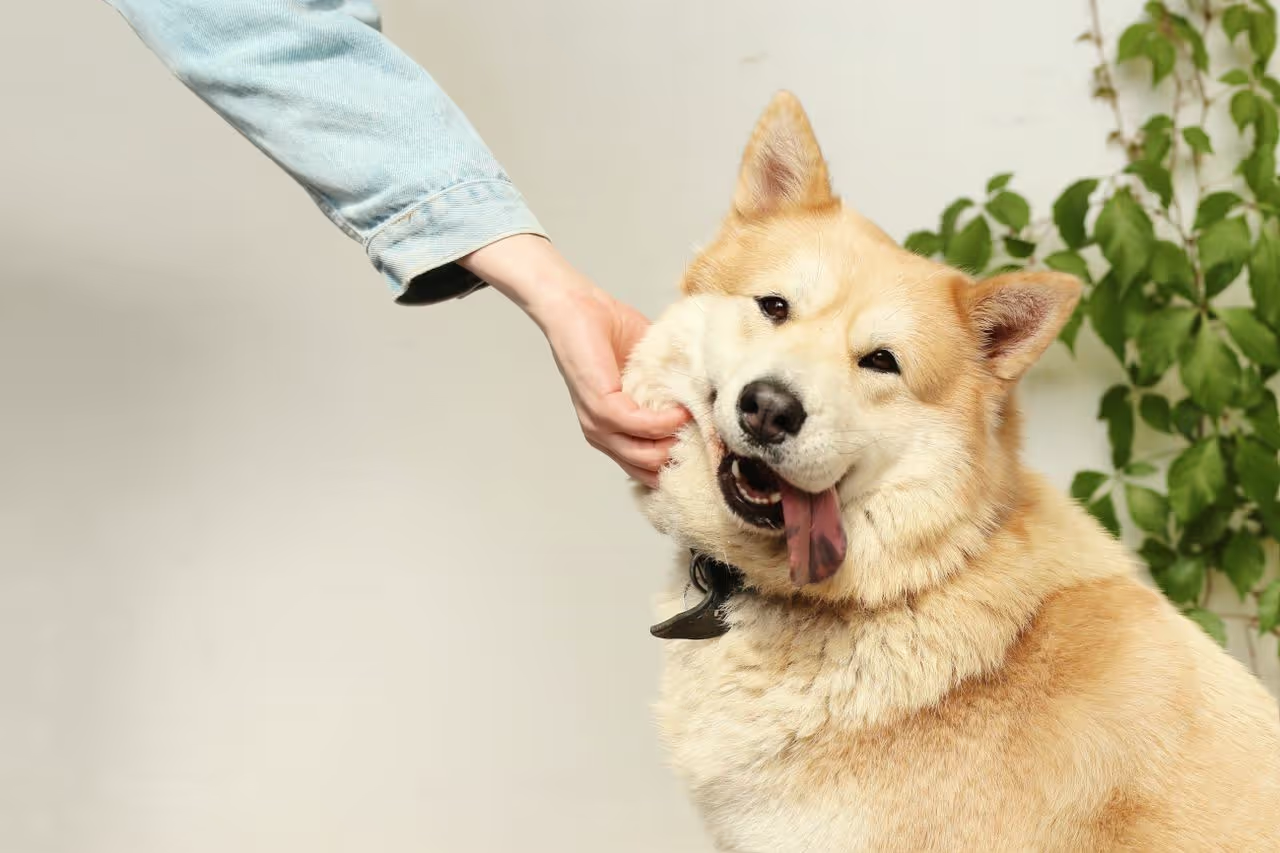
Direct physical contact with pets, being licked, petting them, sharing a bed, has been shown to transfer organisms between a pet's skin and oral microbiome and a human's skin microbiome. Research has found that cohabitating humans and dogs show gut and skin microbiomes that align more closely with each other than with non-cohabitating pairs. A widely cited 2013 NIH study found that the mere presence of a dog in a household significantly increased overall household microbial diversity. Twin studies comparing pet-raised versus non-pet-raised siblings found the pet-raised twins had richer, more complex gut microbiota, a pattern researchers associate with potential immune resilience.
It's worth being honest that the picture isn't entirely uniform. A Wisconsin-based case-control study using 16S rRNA sequencing found no overall difference in broad diversity measures between pet-owning and non-pet-owning households, though it did find specific bacterial types shifted in each direction.
A separate study on cat ownership specifically found measurable changes in gut microbial composition among cat owners compared to non-owners. A broader review of pet ownership and human microbiota concludes the overall effect is real but modest in scale, with homeostasis between pet and owner microbiota being the more important underlying pattern.
The honest summary: pet exposure clearly does something to human microbiota, the direction is generally toward greater diversity, but the science on exactly how much, and how consistently, is still developing rather than fully settled.
The Genuinely Unstudied Question: What Happens With 20 Different Pets?
As far as we can tell, nobody has actually studied what happens to a person who repeatedly cycles through dozens of different homes and different animals over a period of years, which is precisely what house sitting involves.
We can only reason from what the existing research suggests rather than cite a direct answer, since one doesn't appear to exist yet. If pet contact genuinely increases microbial diversity, and shared living environments genuinely transfer bacteria between cohabitants, then repeated exposure to many different pets and many different homes over time is a plausible route to unusually high cumulative microbial diversity, arguably more varied exposure than either a single long-term pet owner or a typical traveler moving through hotels would ever encounter.
One thing worth mentioning honestly rather than as proof: neither of us has needed to see a doctor since November. Caro in particular used to get sick with some regularity when she was teaching in Bochum, close contact with a classroom of children will do that, and while she's not immune now (her throat's a little sore as we write this), the overall pattern of illness has genuinely reduced.
We can't claim that's the microbiome specifically rather than diet, sleep, or simply a less germ-dense daily environment than a school. But it's a real, noticed pattern, not something we're claiming the research above has proven.
The Psychological Reset: Why New Homes Make Habit Change Easier
Here's the angle that surprised us most while researching this, and it's less about bacteria and more about behavior, though we think the two are connected.
Every time we arrive at a new sit, everything genuinely resets. New kitchen, new schedule, new surroundings, none of the ingrained routine that builds up in a home you've lived in for years. That absence of routine turns out to be a strange kind of freedom. It's far easier to try something new when literally everything else around you is already new too, there's no established pattern pulling you back into old habits.
The clearest example of this for me personally happened in Ostuni, over Christmas. Caro had gone to visit her family, and I was alone in the house with four cats for the holiday. It was the first time I'd genuinely had the space, and the specific window of time, to focus entirely on myself.
I did a fast, just water, sitting with my own thoughts, something I could technically have done at any point living in our old flat in Bochum, but never actually did. I think the difference was the timeframe. In a settled home, there's no natural end point pushing you to start something, everything gets pushed to "tomorrow." In Ostuni, I had a defined window, and that structure was enough to actually follow through.
Since then, fasting has become something I do regularly at different sits, the last three fasts specifically happened at three different sits, most recently here in Portugal. During this current six-month sit, I've cut alcohol, sugar, grains, and dairy entirely, using the fixed six-month window as motivation the same way the Ostuni fast worked: I know exactly when the experiment ends, which makes starting it, and sticking with it, far easier than an open-ended "I should probably cut back" ever was.
The same pattern shows up in how much we're actually working. Caro was recently asked by friends back in Bochum how many hours we put in each day, and the honest answer was eight to ten. That's not because we have nothing else to do, we could easily spend the time exploring instead.
It's because a new desk, a new view, a genuinely new environment is motivating in a way that's hard to manufacture in a home you've sat in for years. Our guide to staying productive working from someone else's home covers the practical side of this, and our slow morning routine guide covers how we structure the start of each day to actually make use of that motivation rather than burning out on it.
Does the Reset Effect Fade on a Longer Sit?
We're genuinely six months into testing this ourselves in Portugal, and if anything, the effect seems to be building rather than fading. Having a long, fixed window still creates the same structure the shorter Ostuni fast did, we know there's an endpoint, which makes the experiment feel contained and manageable rather than an indefinite lifestyle change we might abandon.
We think the specific home matters less than the psychology of the reset itself. This particular sit happens to have an incredible view, which genuinely helps, but we'd expect the same underlying mechanism, a defined timeframe in an unfamiliar space, to work even somewhere less scenic.
Everyone carries different ingrained habits built up over years, and some are harder to break than others, but the structure a house sit provides, a real start date and a real end date, seems to be the actual mechanism, not the specific location. Our guide to slow travel through house sitting and our long-term house sitting guide both touch on this same rhythm from different angles.
Have you noticed physical or behavioral changes, skin, digestion, energy, habits you've actually managed to change, tied to specific countries or specific sits? We'd genuinely like to hear what you've noticed, drop it in the comments below.

Where the Two Halves of This Actually Meet
The research above and the habit changes described in the previous section aren't really two separate topics, but the connection is more specific than "new environment, new microbiome." It's worth being precise about which part is automatic and which part is a choice.
Shared living space and pet contact do their work passively. Simply being in a new home, in close contact with a homeowner's furniture, surfaces, and animals, transfers bacteria whether or not you're paying attention to it, that's what the shared-environment and pet-exposure research above actually shows. You don't have to do anything for that mechanism to operate.
Diet is the other half, and it's the part that's actually under conscious control. A new sit creates the psychological space to change what we eat, cutting alcohol, sugar, grains, and dairy stuck this time specifically because the six-month window gave it a defined shape.
And diet happens to be a second, genuinely significant input into gut microbiome composition, the travel research above found diversity shifts tied specifically to new food in a new environment, separate from the passive exposure effect of simply being somewhere new.
So the honest picture is two mechanisms working at once, not one story doing all the work. Passive exposure, from the home and its animals, shifts the microbiome regardless of what a sitter decides to do. Active choice, enabled by the psychological reset each new sit provides, adds a second, deliberate layer on top of that. Neither replaces the other. Together, they're a more complete answer to why this lifestyle seems to affect the body as much as it does.
So, Does House Sitting Make You Healthier Through Your Gut Microbiome?
Here's the direct answer to the question this whole article has been circling.
The science doesn't study house sitting specifically, nobody has run this exact experiment. But it does show a consistent trend across three separate, related mechanisms: travel changes gut microbiome composition, often for the better; pet exposure is linked to greater microbial diversity; and dietary variety is one of the strongest known levers for shifting gut bacteria. House sitting happens to combine all three at once, repeatedly, in a way almost no other lifestyle does.
Traveling to new places exposes you to different environments, different water, different air, different surfaces, and the research shows that kind of exposure is generally associated with a positive shift in gut health rather than a negative one. Caring for a different animal at nearly every sit adds a second, separate layer of microbial exposure on top of that, one linked in multiple studies to greater diversity and, in some research, stronger immune resilience. And the psychological reset each new sit provides makes it genuinely easier to change what you eat, which is itself one of the most direct ways to influence gut bacteria composition.
None of these three things proves house sitting makes a person healthier on its own; that would need a study built specifically around this lifestyle, and none exists yet. But taken together, the honest, defensible answer is: the trend points in a positive direction. Travel, pet exposure, and dietary change are each independently linked to a more diverse, generally healthier gut microbiome, and house sitting combines all three more consistently than almost any other way of living. If there's a genuinely low-risk experiment worth running on yourself, this lifestyle already appears to be running it.
Caro and I have completed 20 house sits across 12 countries, driven 19,000km in Australia and 24,000km in our 1998 VW T4, and saved over $26,500 in accommodation costs over three years of house sitting. If you have thoughts or your own observations on this, DM us @housesittersguide, we answer everyone.

Frequently Asked Questions
Does moving between different homes actually affect your gut bacteria?
Yes, based on published research. Studies using daily sampling during travel found measurable shifts in gut microbiota composition within the first days of a trip. Separately, people sharing a living environment, not just a country, have been found to share a significant portion of their gut bacteria through close contact.
Does being around different pets change your microbiome?
Likely yes, though the science is still developing. Physical contact with pets has been shown to transfer organisms between pet and human skin microbiomes, and several studies link pet exposure to greater microbial diversity. Findings aren't entirely consistent across every study, but the general direction points toward a real effect.
Why does house sitting make it easier to change habits like diet or exercise?
Every new sit removes the ingrained routine that builds up in a settled home. A fixed, defined timeframe, whether it's a two-week sit or a six-month one, creates natural motivation and a clear endpoint, which seems to make following through on a new habit easier than an open-ended "I should probably start" ever is.
Should house sitters take probiotics while traveling?
Research on long-term international travelers has specifically recommended probiotic use given the real risk of travelers' diarrhea associated with gut microbiome shifts during travel. This is general published guidance, not personalized medical advice, and anyone with a specific health condition should consult a doctor.
Does house sitting actually make you healthier through your gut microbiome?
The trend points in a positive direction, though no study has been built around this specific lifestyle yet. Travel, pet exposure, and dietary change are each independently linked in research to a more diverse, generally healthier gut microbiome, and house sitting combines all three more consistently than almost any other way of living.


Responses
What are your thoughts on this post?