

Home > Blog > How to Keep Fit While House Sitting and Living in a Van
Quick Facts
| Best exercise on a sit | A dog sit: the walk happens whether you feel like it or not. |
| Does van life keep you fit? | It raises step count but brings sedentary driving days too. |
| Equipment worth buying? | No. The resistance bands stayed in storage most of the trip. |
| Cheapest workout | Bodyweight squats, push-ups, lunges and a plank in fifteen minutes. |
| How to build a routine? | Let an AI interview you first: twenty questions before it writes. |
| Best AI tool | DeepSeek, which is free and better at sourcing exercise research. |
The resistance bands are in a storage box. They have been there for most of the trip. The most consistently active periods have been the sits with dogs, where the walk was non-negotiable and happened whether we felt like it or not. If you are a digital nomad who struggles to exercise consistently at home, moving into a van or a house sit will not fix that. But a sit with a dog might.
I want to be honest about this article from the beginning: Caro and I do not have a disciplined fitness routine. We walk a lot when we are in cities. The van life naturally produces more incidental movement than a fixed home does, because the space is small and getting out is the default. We eat organic food where possible and we take care of what we put into our bodies. I meditate most mornings for thirty minutes, which I treat as looking after the mind rather than the body.
But structured exercise? The resistance bands have spent most of the trip in storage. The workout equipment we own exists in the same relationship to our lives that most people's home gym equipment has to theirs: bought with intention, rarely used.
If you are interested in getting into house sitting, our book Travel More for Less puts the whole process in one place: clear, step by step guidance from your first questions to your first confirmed sit, and the reviews that open the door to the next one.
Use our 25% discount when joining.
The Honest Problem With Fitness on the Road
The research is correct when it identifies disrupted routine as the enemy of exercise. Fitness habits depend on consistency in time and place. Move every few weeks and both disappear. But there is a deeper version of this that community discussions tend to avoid.
If you do not have a structured exercise routine at home and struggle to follow one consistently, moving to a van or a house sit will not change that. The environment changes, the underlying habit does not. Someone who consistently exercises will find ways to do it in a van. Someone who consistently avoids it will find reasons not to, regardless of how many trails are nearby or how many resistance bands are in the storage compartment.
This is not a criticism. It is an accurate description of how habits work, and acknowledging it is more useful than pretending the nomadic lifestyle inherently produces fitness. The nomadic lifestyle produces walking. That is not nothing. And in terms of general health and step count, it is probably more than most sedentary office workers achieve. But it is not a replacement for intentional exercise if intentional exercise is something you want.
The six-month Portugal sit is the first extended period where I have truly thought about building a routine. Months of settled time provide the conditions for that kind of consistency in a way that two-week sits and constant van travel do not. If you are planning a long sit and want to use that time to build something sustainable, the AI fitness plan approach in the Ostuni section below is the practical starting point I would recommend.
The Dog Walk: The Best Exercise Either of Us Got
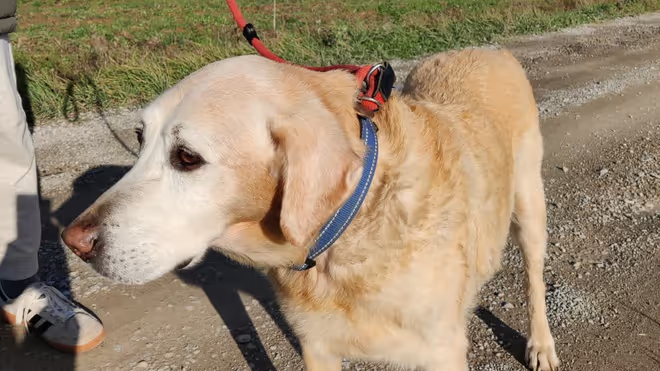
The Cortona Labradors needed walking every day. The Athens French Bulldog needed walking twice daily. These were the most consistently active periods of the trip. Not because Caro and I were particularly motivated to exercise, but because the dog required it and the dog was our responsibility.
This is the fitness argument for house sitting with dogs that the community does not make loudly enough. If you are a digital nomad who spends most of your day in front of a screen and struggles to build exercise into that pattern, a sit with a dog solves the problem structurally. The walk is non-negotiable. It happens in the morning because the dog needs to go out. It happens again in the afternoon for the same reason. It takes you outside, away from the screen, into the air and the surroundings.
In Cortona, the walks were truly beautiful. Two Labradors across the Tuscan countryside. In Athens, the French Bulldog's walk through the city provided two solid breaks from the laptop and genuine time to think, either alone or with Caro alongside. Neither of those walks felt like exercise. They felt like a pleasant part of the day. The result was more steps and more outdoor time than we would have produced without the obligation.
If you are choosing between a sit with a dog and a sit without one, and physical activity matters to you, the dog sit is the one that will move you. Small dog, manageable walks, twice daily. This is the best exercise anchor the house sitting lifestyle offers. Our looking after dogs during a sit guide covers what good dog care looks like.

What Van Life Actually Produces
Campervanning produces more movement than fixed living, but not in the dramatic way the social media version suggests. It is simply that a small van is uncomfortable to sit in all day. You get out. You walk around the place you have parked. You explore on foot because that is how you discover where you are.
When we drive into a new city, we walk. When we stop at a viewpoint, we walk. When we need groceries, we walk to wherever they are sold. This is incidental movement rather than exercise, but accumulated over weeks of travel it produces a meaningfully higher step count than sitting in a home office.
The challenge is that van life also produces genuine sedentary periods. Driving days where the only movement is getting in and out at petrol stations, rainy days where staying inside the van is the most comfortable option, evenings where the laptop and a blanket are the path of least resistance. These balance out the active periods in ways that are hard to account for.
The honest summary: van life keeps you more active than a fixed home, less through deliberate exercise and more through the logistical fact of being somewhere new that requires walking to discover.
What Works Without a Dog
Without a dog to enforce a walk, movement has to come from somewhere else. The approaches that have worked in practice across our sits:
Morning meditation as a daily anchor. I meditate for thirty minutes most mornings. It is not cardiovascular exercise, but it establishes a morning routine that has a higher chance of including a walk or a stretch afterwards than a morning with no structure at all.
Garden and property work. The Portugal sit involves daily garden watering on a hilly property. Walking up and down those hills with a hose every morning is not what anyone would call exercise, but it is physical activity that would not happen otherwise.
Exploring new locations on foot. Every time we park somewhere new or arrive at a sit location, the first exploration happens on foot. This is inherent to the curiosity that brings people to this lifestyle and it produces a natural spike in activity.
Desk breaks as minimum viable movement. Sitting for eight hours impairs both physical health and cognitive function. Every break from the laptop that involves standing up, doing a few squats or stretches, and walking to a different room is a small counter to the accumulated damage of screen work. This does not require equipment or motivation — just the acknowledgement that the body needs to move during the working day. Our remote work routine guide covers how desk breaks fit into the working day structure.
The Equipment Reality
We have resistance bands. We have other portable fitness equipment. Most of it is in a box.
The community research is enthusiastic about the "gym in a bag" concept. Resistance bands, a travel yoga mat, a jump rope, a suspension trainer. All of this is truly useful for people who exercise consistently. For people who struggle to exercise consistently, it produces a well-packed box of equipment that moves between sits without being used.
The honest recommendation: do not buy fitness equipment hoping that having it will create the habit. The habit creates the use of the equipment, not the reverse. If you already exercise consistently, a set of resistance bands and a travel mat are excellent companions for the road. If you do not, they will become storage objects.
What does work is the bodyweight minimum. Squats, push-ups, lunges, a plank. Which requires no equipment, fits in any space, and takes fifteen minutes. The barrier is entirely motivational rather than logistical. If you can solve the motivation problem, no equipment is needed.
The Ostuni Sit and the AI Fitness Plan
During a house sit in Ostuni, Italy, I asked an AI to create a workout plan for me. The method that produced a useful result was the same one I use for applications and articles: make the AI interview you before it writes anything.
A generic AI fitness prompt produces a generic fitness plan. Without knowing your injuries, your sleep quality, your actual food intake, your schedule, your goals, and your starting point, the AI produces the average of everything it has ever processed. Moderately useful for nobody in particular. An AI that has interviewed you first produces something calibrated to your actual situation.
This is directly relevant to house sitting because the sit itself defines the parameters. How long is the sit? What space is available? Is there a dog to walk? What equipment do you have? These details change what an achievable routine looks like. Give the AI that information and it can build around the specific sit rather than a hypothetical one.
If you are planning a house sit and want to arrive with a fitness plan ready, or if you are already on a sit and want to build one now, this is the approach I recommend.
Tool recommendation: I recommend trying DeepSeek AI for this. It is free, has strong research capabilities, and can search exercise forums, fitness databases, and health resources to find exercises specifically suited to your profile rather than relying only on its training data. Any AI works — Claude, ChatGPT, Gemini — but DeepSeek's research ability makes its exercise recommendations more specific and better sourced.
Here is the prompt. Copy it exactly, paste it into your AI of choice, and answer every question as in truth as you can. The AI is not storing your information, nobody is reading it, and the only person who suffers from vague answers is you.
Copy this prompt:
I want you to build a personalised fitness and nutrition plan for me. Before you write anything, I need you to interview me. Read the following instructions carefully:
First, before asking any questions, share a short paragraph with me explaining why honesty matters in this interview. Make clear that this is a private conversation, no one has access to my answers, and that if I understate my food intake, overstate my activity level, or avoid mentioning a health issue, the plan you create will not work. Ask me to commit to answering in truth before we begin.
Then, ask me the following questions one at a time. Ask one question, wait for my full answer, acknowledge it briefly, then ask the next. Do not group questions together or move ahead until I have answered. Do not skip any question.
Question 1: How long is your house sit, and what does a typical day look like — what animal or property care responsibilities do you have that involve physical movement?
Question 2: What is your current weight and height?
Question 3: What is your ideal weight, or how would you describe your physical goal — lose fat, gain muscle, improve fitness, increase energy, or something else?
Question 4: When would you like to reach that goal? Give me a realistic timeframe, not an ideal one.
Question 5: How much time are you truly able to dedicate to exercise each day? Give me the real number, not the optimistic one.
Question 6: Do you have any existing injuries, chronic pain, or physical limitations I need to design around?
Question 7: Are there any movements or exercises you need to avoid completely, either due to injury or strong personal dislike?
Question 8: What forms of exercise do you truly enjoy, even a little? And which do you find hardest to motivate yourself to do?
Question 9: Do you have any exercise equipment available — resistance bands, dumbbells, a yoga mat, a pull-up bar, or anything else? Or are you working with bodyweight only?
Question 10: Describe the space where you will exercise — indoors in a small room, outdoors in a garden or nearby park, a mix of both?
Question 11: How many meals do you eat per day, and roughly at what times?Going for a walk with a dog we looked after during a house sit in France
Question 12: Describe as in truth as you can what you eat on a typical day — breakfast, lunch, dinner, and everything in between including snacks, drinks, and alcohol.
Question 13: How much water do you drink daily? Give me your honest estimate.
Question 14: How much coffee or other caffeinated drinks do you consume each day?
Question 15: Do you take any supplements, vitamins, or regular medications that could affect a fitness or nutrition plan?
Question 16: Do you spend most of your day sitting — at a desk, on a sofa, in a vehicle? Or do you move around regularly?
Question 17: How much sleep do you get on an average night? Give me the real number, not the target.
Question 18: How regular are your bowel movements — daily, every few days, or irregular? This affects nutritional recommendations.
Question 19: How would you describe your current stress level, and how does stress typically affect your appetite and energy?
Question 20: Is there anything else about your health, lifestyle, daily routine, or goals that I should know before building your plan?
Once I have answered all twenty questions, use everything I have told you — and search current exercise science, fitness forums, and reputable health resources — to build a detailed personalised fitness and nutrition plan. Structure it around my sit length. Include a daily and weekly schedule, specific exercises with progressions matched to my fitness level and available equipment, nutritional guidance based on what I actually eat, recovery and sleep recommendations, and a short explanation for why each element suits my specific answers. Make it realistic enough that I will actually follow it.
Once you have answered all twenty questions, the AI has everything it needs. The plan it builds from a full interview is a different category of document from a generic "fitness plan for a house sitter." It accounts for your body, your schedule, your food, your space, your injuries, and the specific length and nature of your sit.
This approach applies to anything you want AI to help you create. Make it ask questions first. Your answers are what make the difference between a generic result and a truly useful one. Our ethical AI guide for house sitting covers the interview method in the context of applications. The same principle applies here.
Building Something at Six Months
The Portugal sit is the first period that feels long enough to actually build a routine rather than maintain or abandon one. Six months of settled time, consistent schedule, daily animal care that structures the day. This is the environment where habits form.
I am aware that I want to use this period to establish something consistent. Three weeks in, the meditation is regular and the rest is still forming. But the conditions are the best they have been for building something that carries beyond the sit. Our slow travel guide covers the broader daily structure that longer sits make possible.
Join TrustedHouseSitters with 25% off. DM us @housesittersguide on Instagram. We answer everyone.
The Practical Summary
| Fitness source | When it works | Honest caveat |
|---|---|---|
| Dog walks | Every sit with a dog that needs walking | The single most reliable fitness anchor this lifestyle provides |
| City exploration on foot | Arriving at new locations, van travel | Incidental movement, not structured exercise |
| Garden and property care | Longer sits with outdoor responsibilities | Light activity, worth counting but not a workout |
| Desk breaks | Working days with regular screen time | Minimum viable movement — better than nothing |
| AI-built fitness plan | Any sit, particularly longer ones | Only works if you answer the interview in truth |
| Bodyweight circuits | When motivation is present | Requires no equipment but requires habit |
| Resistance bands and equipment | When already exercising consistently | Equipment follows habit, does not create it |
| Meditation | Daily practice | Mind and body benefit, not cardiovascular |

Frequently Asked Questions
Is it hard to stay fit while house sitting and living in a van?
It depends on your existing habits more than your environment. If you exercise consistently at home, the nomadic lifestyle provides enough options to maintain that. If you struggle to exercise consistently in a fixed home, the van or house sit will not automatically change that. The exception is a house sit with a dog that needs walking daily, which enforces movement regardless of motivation.
What is the best fitness approach for digital nomads who sit at a screen all day?
A sit with a dog, or desk breaks every 25-30 minutes. A morning and afternoon dog walk provides two daily movement anchors that happen because the animal requires them, not because motivation was mustered. If no dog is involved, standing up every half hour and doing a short bodyweight sequence is the minimum that prevents the physical deterioration of an eight-hour sitting day.
How do I build a personalised fitness plan for a house sit?
Use the AI interview prompt in the Ostuni section above. Copy it, paste it into DeepSeek or any AI tool, and answer all twenty questions in truth. The AI builds a plan around your specific body, goals, schedule, available equipment, and the length of your sit. A plan built from your actual answers is substantially more useful than any generic fitness template.
Does meditation count as exercise for a house sitter?
Not cardiovascularly, but as a daily practice that supports mental clarity and stress management, yes. Thirty minutes of daily meditation provides genuine cognitive and wellbeing benefits — particularly relevant for digital nomads who spend most of their time in front of screens. It is not a substitute for physical movement but it establishes a morning routine that makes other healthy habits easier to attach to.


Responses
What are your thoughts on this post?