

Home > Blog > Working Productively From a House Sit
Quick Facts
| What you actually need | Power outlet, decent WiFi, comfortable seat, enough room for a laptop |
| Our setup | Laptop, mouse, nothing else — fully minimalist |
| Where we prefer to work | Caro: table or sofa. Konrad: kitchen counter or coffee table |
| Best time to settle into work | After the first week — the novelty and sleep adjustment period |
| Pets as productivity tool | They force you off the laptop for walks, play, feeding — which helps, not hurts |
| Biggest myth | That you need perfect conditions to be productive — motivation matters more |
| WiFi backup | 400GB of 5G data on a personal device — more reliable than hoping the homeowner's connection holds |
House sits have been our most productive working weeks. Our whole setup is a laptop, mouse and power cable, plus a 400GB 5G backup for WiFi failures. Week one is lighter, then the routine compounds: a Gartner study of 10,000 employees found schedule control lifted productivity around 20%.
Five months of driving across Europe in a VW T4 does something to your brain. By the time Caro and I arrived at our Manosque sit in south France, we had seen so much. Mountains, coasts, cities, ruins, that even the most exciting attractions had started to feel ordinary. The brain gets full. Even the most beautiful places start to blur when you are moving through them every few days. A house sit is, among many other things, a reset. The novelty disappears, the pace slows, the desk appears, and suddenly the work comes.
If you are interested in getting into house sitting, our book Travel More for Less puts the whole process in one place: clear, step by step guidance from your first questions to your first confirmed sit, and the reviews that open the door to the next one.
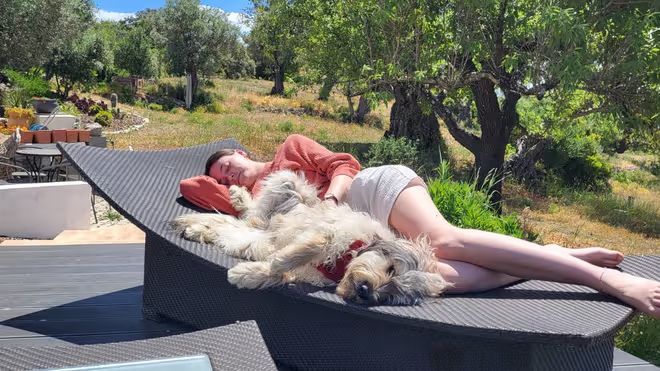
Why House Sits Are Actually Good for Deep Work
The standard concern about working from a house sit is that it will be distracting. New environment, unfamiliar space, temptation to explore, animals wanting attention. These are all real. But research on remote work consistently finds that most people are more productive working outside a traditional office and the house sit version of that dynamic has a specific advantage that standard work-from-home setups do not.
After days or weeks of moving constantly, arriving at a house sit removes the logistics. There is no driving to consider, no campsite to book, no next destination to research. The house is there. The wifi code is in the welcome guide. The kitchen is stocked. The to-do list is manageable. The mental energy that was being spent on travel planning becomes available for work.
The productivity compound that follows is visible in our output. More articles written, more content produced, more business built. The flow state that is quite difficult to access from a moving van becomes easier in a stable home. Caro creates more. I write more. The work feels lighter because the context has simplified.
The research supports this. Studies tracking remote workers consistently report higher productivity when people have control over their environment and schedule. A Gartner study of 10,000 employees found those with schedule control were around 20% more productive than those without it. A house sit is, in many ways, the maximum version of schedule control. You design the day, you manage the animals, and you decide when and how the work happens.
The Minimalist Setup: What You Actually Need
Caro and I travel with almost nothing that is work-specific. Laptop. Mouse. Power cable. That is the full setup. Everything is in the computer. Notes, drafts, research, client work, projects in progress. All of it accessible from any device, anywhere. When you work this way, the physical workspace becomes a solved problem rather than a logistical challenge.
When we arrive at a new sit, the workspace decision takes about ten minutes. We find:
A surface at a comfortable height with room for a laptop and mouse. A power outlet within reach. A decent connection to the router. A seat that can be used for a couple of hours without discomfort.
That is the entire requirement. In Manosque it was the dining table. In Portugal it has been the kitchen area and, when the weather is cool enough, the terrace. Caro tends toward tables and sofas. I work well at kitchen counters or coffee tables. Slightly lower than a desk, less formal, and somehow easier to stay at for longer stretches.
The temptation to over-engineer a workspace is real but counterproductive. Spending an hour arranging an optimal setup is an hour not working. Minimalism removes that friction. Find the table, open the laptop, start. The quality of the workspace matters far less than the quality of the intention.
| What matters | What does not matter |
|---|---|
| Power outlet within reach | Having a dedicated desk |
| Reliable WiFi | A second monitor |
| Comfortable seating for 2+ hours | A specific chair type |
| Sufficient surface space for laptop and mouse | Cable management |
| Reasonably quiet space | Silence — moderate background is fine |
| A separate area from where you sleep | Expensive equipment |
Building the Routine on a Short Sit

On sits of a week to two weeks, our routine tends to emerge rather than be imposed. The first few days are adjustment. Finding where things are, getting to know the animals, sleeping in a new bed, exploring the immediate area. The first week is not usually our most productive, and that is fine. Expecting peak output on day one of a new home is unrealistic.
By the end of the first week, the novelty has settled. The animals have a routine we understand and anticipate. Sleep quality improves. The desk no longer feels borrowed. It feels like the desk.
A typical working day on a shorter sit:
Morning wakes up on the animals' schedule. For a dog this means a pee walk within the first hour. For a cat, a food top-up and a brief acknowledgment. Coffee and breakfast together, unhurried. We do not try to start work before we have had time to wake up properly. This is one of the most consistent advantages of not commuting. Work starts around midday for us, once we feel settled, and continues until we are satisfied with the day's progress. No fixed end time, but dinner between six and eight, followed by the evening dog walk if there is one, and then properly free time.
This rhythm works for us because we are working for ourselves. The motivation has to be internal. more on that in a moment. For sitters who work for an employer with fixed hours, the framework is different but the underlying principle applies: build the routine around the animals' needs first, and fit the work into the windows the sit creates.
Building the Routine on a Long Sit
The upcoming six-month Portugal sit will be structurally different from anything we have done before. Six months in one place, a cat and four chickens to care for, a full apartment to maintain. The animal care is minimal. Chickens need morning feeding, egg collection, coop lockup at dusk. The cat needs feeding and company. But six months means building a real daily structure rather than a loose one.
The vision for that routine: 7am wake, feed the cat, open the coop, collect yesterday's eggs. Breakfast. Coffee on the terrace before the heat builds. Meditation. Then work, study. I am learning German and creating content. A proper gym schedule. Date nights. Days out to explore Portugal without urgency, because there is no deadline to leave.
The difference between a long sit and a short one, from a productivity perspective, is that a long sit rewards investment in the routine itself. Setting up a proper desk configuration, finding the right work hours, establishing an exercise habit. All of these compound over six months in a way they cannot over ten days. The six-month sit is where the house sitting lifestyle and the working lifestyle become essentially the same thing.
The Pets Are Not a Distraction. They Are a Feature
Every piece of productivity advice tells you to eliminate distractions. The house sit version of this would be to minimise pet interaction during work hours. In practice, the opposite is true.
The animals on a house sit force you off the laptop. A dog needs a walk at 10am regardless of whether you are in the middle of a thought. A cat jumping onto the keyboard demands a pause. These interruptions are not productivity killers. They are enforced breaks, and enforced breaks are one of the most evidence-backed productivity tools available.
The Pomodoro technique. Working in focused 25-minute bursts with short breaks between exists because sustained focused work for hours without interruption leads to diminishing returns. A dog walk is a 30-minute Pomodoro break that also gets you outside, away from a screen, and thinking about something other than the work. You return to the desk more able to focus, not less.
The animals also create the boundary that is hardest to maintain when working from home: the moment you have to stop working because something else actually requires you. That boundary is valuable. It prevents the "always on" pattern that burns out remote workers. The tendency to keep the laptop open past dinner, to check messages at 10pm, to never fully switch off because there is no physical departure from the office.
On Motivation: The Internal Cheerleader
I have tried a large number of productivity systems. Pomodoro timers. The Cold Turkey app blocking distracting websites. Google Calendar time-blocking. Habit trackers. Task management tools.
They all work for a while. Then they do not. Every system eventually becomes another thing to manage, and managing the system starts to displace doing the work.
What has actually kept Caro and I consistently productive across three years of house sitting is not a system. It is a reason. I want to travel. I want more of it. I want to continue this lifestyle, see more places, have more sits, build something that matters. The work is the mechanism for all of that. When I wake up and open the laptop, I am not forcing myself to work. I am working toward something I can see and feel.
This is not a demotivating observation for people who struggle with productivity. It is honest advice. If you do not have a compelling reason for the work, no app will create one. The internal cheerleader. The thing that makes you excited to start rather than relieved to stop, is the most reliable productivity system that exists. If the work is for someone else, the equivalent is simple: they can replace you, and knowing that creates its own clarity.
For house sitters who work remotely for employers, the house sit context adds a layer of complexity. You are in an environment that looks like a holiday. Your colleagues are not. The dog wants a walk. The discipline required to maintain professional output in that context is real, and it starts with being clear with yourself about what the day needs to produce before the day begins.
WiFi: The One Technical Variable That Matters
Everything else about a mobile work setup is solvable. Desk too low, work standing for a bit. Chair uncomfortable, work at the counter. Natural light insufficient, move to a different room. WiFi is the one dependency that cannot be improvised around.
We have never had a seriously disruptive WiFi failure on a house sit. Two situations stand out. In Manosque, the connection dropped once or twice a day. Not unusable, but unreliable enough to break concentration. We learned to treat the dropouts as enforced breaks and enjoy the sun instead, which turned out to be a reasonable outcome. In Portugal, we arrived to find the WiFi router still in its box, and not set up. Rather than wrestle with the homeowner's provider, we switched to our own 400GB of 5G mobile data. Faster, more reliable, and entirely under our control.
That mobile data backup is now a permanent part of our travel setup. Not for every sit, but as the fallback when the homeowner's connection fails or is slower than expected. Before accepting any sit where WiFi quality is critical to your work, check the connection during the pre-sit video call and read our guide to testing WiFi before a house sit. If you are uncertain, speedtest.net is the fastest way to check connection quality from anywhere.
The Sleep Adjustment Week
One consistent pattern across sits: the first week of sleep in a new home is rarely as good as it becomes by the second. New bed, new sounds, new ambient light, new neighbourhood noise. Even after three years and 20 sits of moving regularly, arriving somewhere new still takes a few nights to settle.
This is worth naming because it affects work output more directly than almost anything else. The first week of a sit is not the time to schedule your highest-priority deadlines. It is the time to explore the area, establish the routine with the animals, and let the environment become familiar. By week two, sleep has usually returned to normal and the productivity follows.
For a short sit of seven to ten days, this means accepting that the first half will be lighter output. Plan accordingly. For a longer sit, the adjustment week is a one-time cost that pays back across the weeks that follow.
Conclusion
House sits have been some of our most productive working periods across three years of house sitting. The combination of travel rest, established routine, and the gentle structure that animals provide creates a working environment that is noticeably better than many conventional setups, not despite being in someone else's home, but partly because of it.
The minimalist setup, laptop, mouse, power, WiFi, travels in a bag. The workspace is wherever the table and the outlet are. The motivation is internal and specific. The animals provide the breaks. The routine provides the structure.
For the six months ahead in Portugal, the long sit offers something shorter sits cannot: the chance to build habits that compound over time rather than just survive the week. That is what we are looking forward to most.
Read our house sitting for remote workers guide for the full picture of combining remote work with the house sitting lifestyle, and our time zone guide if your work involves clients or colleagues in different countries.
Join TrustedHouseSitters with 25% off and DM us @housesittersguide on Instagram. We answer everyone.

Frequently Asked Questions
Is it possible to work remotely from a house sit?
Yes. and for many sitters it produces more output than working from a permanent home or a van. The removal of travel logistics, the animals' enforced routine, and the stability of a proper desk and kitchen all contribute to a productive environment. The first week of any new sit involves adjustment, but from week two onwards the work tends to flow well. Our remote workers guide covers the full lifestyle picture.
What workspace setup do I need for a house sit?
Very little. A laptop, a mouse, a power outlet within reach, and a reliable WiFi connection cover the entire requirement. Most house sit homes have a dining table or kitchen counter that works well as a desk. Do not wait for ideal conditions. find the table, open the laptop, start. Check the WiFi speed before arrival using our WiFi testing guide.
How do pets affect productivity during a house sit?
Positively, in most cases. Pets enforce breaks. walks, feeding, play. that prevent the overworking pattern common in remote work. A dog walk at 10am is a 30-minute break from the screen that improves focus for the hours that follow. Treats the animal care as the structure of the day, not a disruption to it.
What is the best way to stay motivated working from a house sit?
Have a specific reason for the work that matters to you. Productivity tools and apps help in the short term but require internal motivation to sustain. If you are working to fund a lifestyle you truly want. travel, freedom, creative work. the house sit context reinforces that motivation daily. If you work for an employer, clarity about daily output expectations before the day begins is the practical equivalent.


Responses
What are your thoughts on this post?