

Breadcrumbs: Home > House Sitting Guide > House Sitting with Children
Quick Facts: House Sitting with Children in 2026
| Biggest barrier | Most homeowners have only one spare bedroom |
| Best filter | TrustedHouseSitters family-friendly filter, 2,188 listings |
| Europe option | Nomador has 430+ family-friendly listings, 320+ in France |
| Your strongest pitch | Families stay home more, so pets get consistent company |
| Must ask on the call | Has this dog lived with young children before |
| Typical saving | Accommodation worth €80 to €150 a night |
Families can house sit, but the pool is smaller: most homeowners have just one spare room. Use the family-friendly filter (2,188 listings on TrustedHouseSitters, 430+ on Nomador) and pitch your homebound routine as the advantage. Disclose every child, and ask whether the dog has lived with young children.
Honesty rule: List every family member in your application. Every single one. Arriving with people the homeowner did not know about is the fastest way to lose your account and your reviews
Our position: Caro and I don't have children. We travel as a couple. But after 20 sits across 12 countries and years reading community forums, we know why most family applications fail and what the ones that succeed do differently
The forum thread was practically on fire. A frustrated dad was venting about sending out fifty applications for a summer sit in Provence and getting fifty rejections. His crime: trying to travel with a toddler and a six-year-old.
Caro and I see this question constantly. We will be having a coffee in the campervan, scrolling through the Reddit community forums, and the same post appears: "Is it actually possible to house sit with kids, or am I just wasting my time?" We are not parents. We have never had to navigate the specific pressure of applying for sits as a family. But we have read enough of those threads, spoken to enough homeowners across our 20 sits, and spent enough time in the community to know exactly what is going wrong and what the families who actually pull this off are doing differently.
The short answer is that it is absolutely possible. The longer answer is that the game is genuinely harder for families, and pretending otherwise does not help anyone.

The One-Bedroom Problem: And How the Family-Friendly Filter Helps
The single most common reason families get rejected has nothing to do with how responsible they are or how well they write their application. It is pure logistics.
Across our sits in France, Germany, Austria, Italy, Greece, and Australia, the pattern is consistent: homeowners typically have one spare bedroom available for sitters. The rest of the house is occupied: kids' rooms that haven't been cleared out, a home office, a storage room that was never converted. When a family of four applies, the homeowner does the maths immediately. Where are they all going to sleep?
This is not hostility toward families. It is square footage. The good news is that TrustedHouseSitters has a dedicated family-friendly filter that cuts through this immediately. As of March 2026 there are 2,188 listings worldwide marked as family friendly by the homeowner, meaning they have actively indicated they welcome families with children. Of those, over 1,700 are in North America and over 900 are in the UK. These homeowners have self-selected. They are not going to be surprised or deterred by children in your application.
THS does not have a filter specifically for number of bedrooms, but it does let you filter by property type. Filtering for a house rather than an apartment will naturally surface larger properties with more sleeping space. It is not a perfect substitute for a bedroom count, but it removes a large portion of unsuitable one-room listings from the start. Use the family-friendly filter first, then layer the house filter on top, and your pool narrows to the sits most likely to work.
Applying to listings outside this filtered pool as a family of four is not a numbers game you can win through volume. It is a structural mismatch no application quality can overcome.
The "Sticky Fingers" Fear: What Is Actually Behind It
The second reason families get rejected is less about logistics and more about psychology. Homeowners with valuable or fragile items worry about two things when they see children listed on an application.
The first is damage. Adults are broadly predictable. A toddler is not. A homeowner who has spent twenty years collecting ceramic figurines is doing a mental calculation the moment they see "travelling with a three-year-old" in your profile. That calculation is usually not generous.
The second concern is attention. A homeowner with a dog that needs two walks a day and regular company worries that a family with a newborn will have its attention almost entirely consumed by the baby. The pet ends up as an afterthought. This is a legitimate concern and the application needs to address it directly rather than hoping the homeowner will not think of it.
Neither of these fears makes homeowners unreasonable. They are being asked to hand their home and their animals to people they cannot fully assess. The job of your application is to remove the uncertainty, not to hope it does not come up.
The Strategy: Frame Your Family as the Selling Point
The families that get accepted consistently do one thing differently: they reframe the thing that is working against them.
Being less mobile is not a disadvantage. It is the pitch.
Caro and I can leave for a full day's hiking without a second thought. We can book a restaurant two hours away on a whim. Families with young children generally cannot do this, and the right homeowner will understand immediately what that means for their pets. A dog that needs consistent company is not going to get it from sitters who are out exploring for eight hours a day. It is going to get it from parents who are on the sofa by eight in the evening because the kids are in bed.
The pitch, written plainly into your application: because we are travelling with young children, we are home far more than most sitters. We do not do long day trips or evening dinners away from the property. Your pets will have consistent company throughout the day, not just at feeding times.
One rule that sits underneath all of this, and it is non-negotiable: be honest about every family member in your application. Every adult, every child, every age. Homeowners are agreeing to host everyone who walks through their door. Arriving with a person the homeowner did not know about, even a toddler, even for one night, is a serious breach of trust that can end your account and your review history. The families that build long, successful house sitting careers are transparent from the first message. List everyone. It removes ambiguity and it builds exactly the kind of trust that gets you accepted.
This approach works particularly well for sits with dogs that have separation anxiety, older pets that need regular monitoring, or homeowners who have had bad experiences with sitters who treated the arrangement as a free holiday. You are offering something they genuinely cannot get from younger solo travellers looking to use the sit as a base for exploration. Use that.

The Safety Conversation You Cannot Skip
Before you apply to any sit with children in the picture, the pet safety question needs to be answered, not assumed. This is not a paperwork formality. It is the conversation that determines whether the sit is appropriate for your family at all.
In Bochum, I was walking one of the dogs when it slipped straight past me through a gap I had not noticed and bolted across the road into a forest. I sprinted after it immediately. What followed was an hour and a half of flat-out running through the trees, genuinely the most intense physical effort I have put in, not jogging between spots but continuous sprinting. The owner eventually had to leave work to come and help, and she was the one who found the dog in the end.
That dog was not aggressive. It was not dangerous. It just moved faster than expected at a moment I was not ready for, and the consequences of that took two adults and most of an afternoon to resolve. Now add a three-year-old to that moment. A child who also runs, also does not listen to commands, and also cannot be left unattended while you sprint into a forest after a dog that has just crossed a road.
The point is not that dogs are dangerous. The point is that even well-behaved animals can create situations that require your full physical and mental attention instantly. When you are responsible for young children and pets simultaneously, you need to know exactly what you are dealing with before you arrive.
The questions to ask on the video call, without exception: Has this dog lived with young children before? Does it have food aggression or resource guarding tendencies? Is the property fenced securely enough that a toddler cannot wander out? Has it ever bolted, chased, or reacted badly to sudden movement or loud noise?
If the homeowner cannot answer these confidently, or the answers give you pause, that is the information you need.
| Safety category | Key question to ask | Why it matters |
|---|---|---|
| Experience | Has the pet lived with children before? | Predicts the pet's stress levels and likely reactions |
| Boundaries | Does the dog show food aggression? | Critical for toddler safety during meal and treat times |
| Logistics | Is the property fully fenced? | Prevents accidental wandering or bolting by child or dog |
| Responsibility | Who is the emergency contact? | Ensures you have backup if a child or pet needs urgent help |
Our house sitting safety guide and our video call guide both cover the vetting process in detail. The family version of this conversation is a more specific version of the same framework.
Building a Profile That Gets Accepted
The platform you use matters, but your profile matters more. A thin profile with no reviews will not get a family of four into competitive sits regardless of how good the application is. Building that profile requires starting with sits that are genuinely well-suited to families.
Rural properties with large gardens are the natural starting point. The risk profile is lower for the homeowner: fragile antiques are less common, the animals tend to be working dogs or outdoor cats rather than sensitive indoor pets, and the space available for children to move around without causing damage is greater. A farmhouse in the French countryside with two dogs and a half-hectare garden is a more realistic first sit for a family than a flat in central London with an anxious whippet.
Once you have a review or two, the pool opens up. A verified review from a homeowner who can speak to how your family handled their home and their animals is worth more than any amount of profile description. Get the first review however you reasonably can, even if the sit is not the one you ultimately want.
The family-friendly filter exists across most major platforms, and roughly one third of all listings on any given platform tend to be marked family friendly. Knowing which platform to use and how to filter it is one of the most useful practical tools a family has.
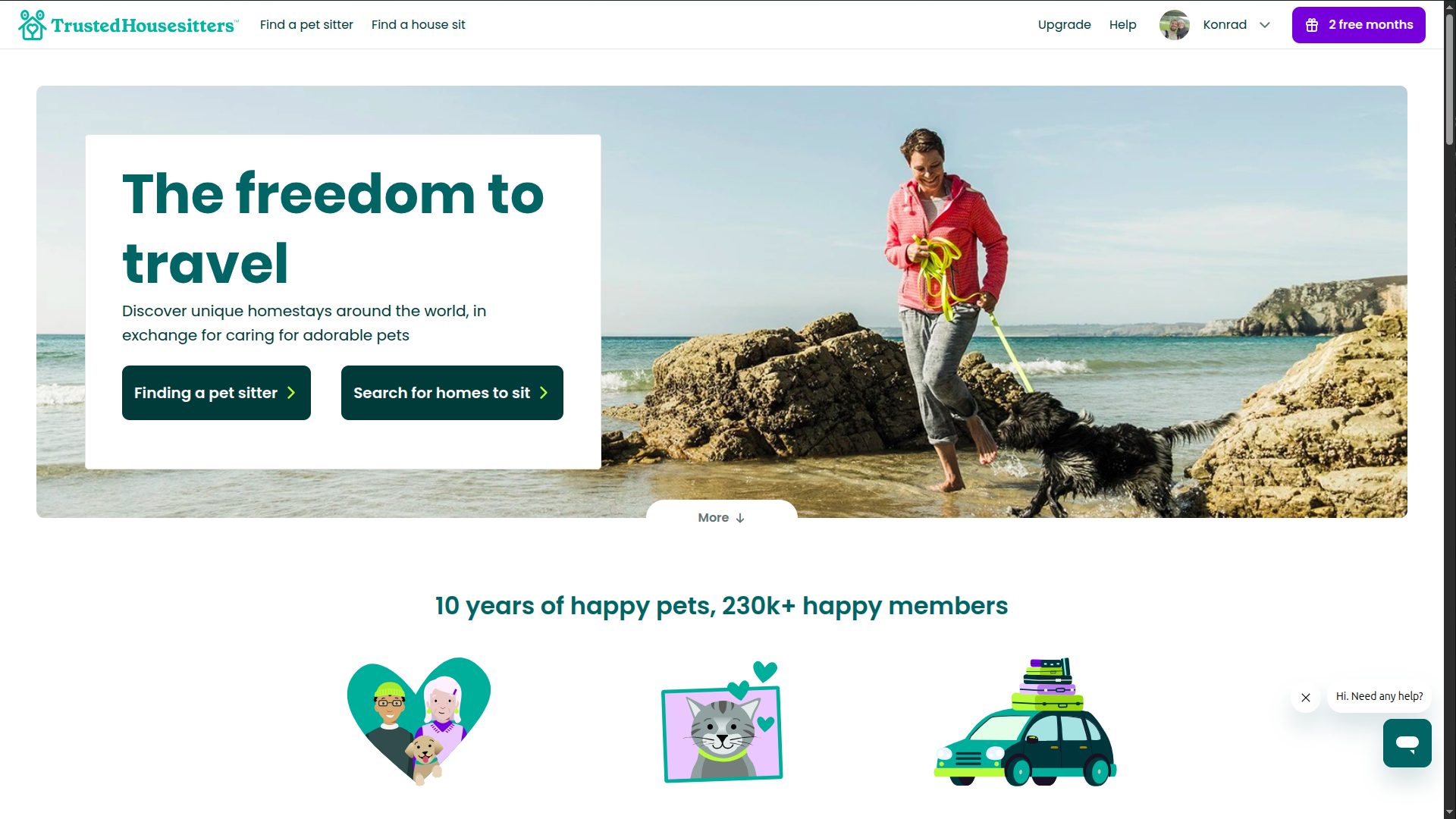
TrustedHouseSitters has 2,188 family-friendly listings globally as of March 2026, with over 1,700 in North America and over 900 in the UK. There is no bedroom-count filter, but filtering by house rather than apartment surfaces larger properties and cuts out most one-room listings immediately.
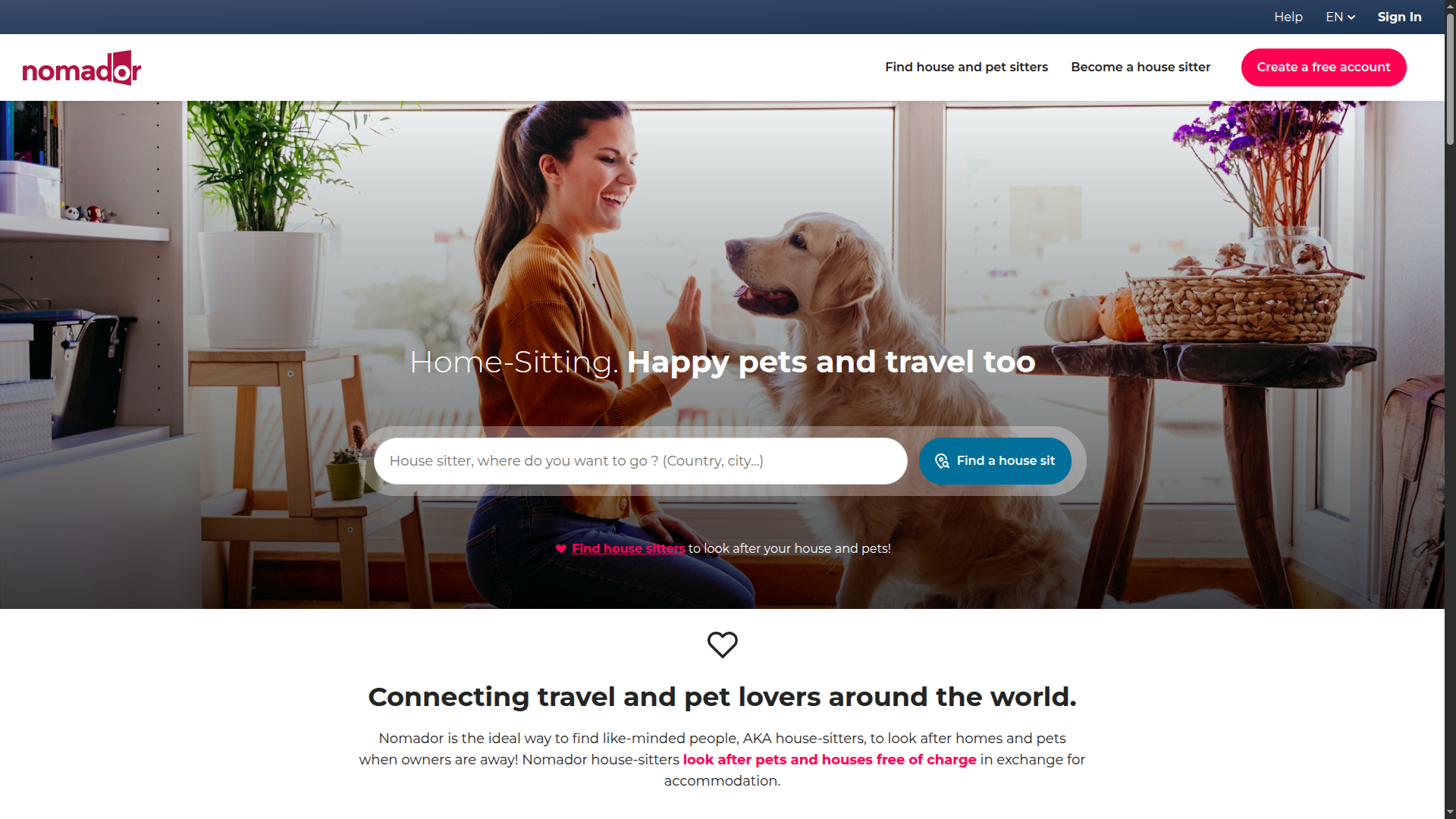
Nomador has around 430 family-friendly listings worldwide, with over 320 of those in France, making it the natural choice if Europe is where you want to sit. Nomador also lets you filter between house and apartment, which helps narrow the pool further.
House Sitters America, Aussie House Sitters, Kiwi House Sitters and UK House Sitters are all part of the same network, which means the filtering tools are consistent across all four. That network has the most granular property type options of any platform: house, apartment, duplex, caravan, and more, plus a family-friendly filter. If your destination is the US, Australia, New Zealand, or the UK, this network gives you both the inventory and the tools to narrow it effectively.
Our guide to which companies provide verified reviews is worth reading before you commit to a platform. A verified review carries meaningfully more weight with homeowners than an unverified one, and that distinction matters more for families trying to build trust quickly.
Is House Sitting with Children Worth It?
From what we observe across the community: yes, significantly. Families that crack the approval code consistently describe savings of several thousand euros or dollars per trip, covering accommodation that would otherwise cost €80 to €150 a night. For longer sits of two weeks or more, those numbers become genuinely life-changing for a family travel budget.
The sits that work best are rural, multi-bedroom, with outdoor space and animals suited to children. The applications that work lead with the stability argument, address the damage concern directly, and ask the right questions on the video call rather than assuming the animals are child-friendly because the listing says so.
It takes more applications than it does for a couple. The pool of suitable sits is smaller. But the pool is not so small that it is not worth entering.
Konrad and Caro
DM us @housesittersguide if you have questions, we answer everyone.
FAQ
Is house sitting with children actually possible, or do homeowners mostly prefer couples?
Yes, it is possible, but the pool of suitable listings is smaller. Most homeowners have only one spare bedroom, which immediately rules out families who need multiple rooms. The families that succeed use the family-friendly filters available on most major platforms, start with rural sits where space is less of a constraint, and build their first reviews before targeting more competitive urban or coastal listings.
How can we frame our family status as an advantage in an application?
Lead with the stability argument. Homeowners with pets that need consistent company, particularly dogs with separation anxiety, often find that younger solo sitters treat the sit as a base for exploration, leaving the animals for long stretches. Families with young children are genuinely more homebound. Make that explicit in your application: you will be home more, the pets will have more consistent company, and your evenings are on the sofa rather than out.
Do we need to disclose every family member in our application?
Yes, every single one, without exception. Homeowners are agreeing to host everyone who walks through their door. Arriving with a person they did not know about, even a young child, is a serious breach of trust that platforms take seriously. It can result in a negative review, a dispute, or account suspension. Being fully transparent from your first message is also simply the right thing to do, and homeowners notice and appreciate it.
What are the non-negotiable questions to ask about a pet's behaviour around children?
Ask whether the dog has lived with young children before. Beyond that: does it have food aggression or resource guarding? Has it ever bolted or reacted badly to sudden movement or loud noise? Is the property fenced securely enough for a toddler? A well-behaved dog can still create situations that demand instant adult attention. You need to know what you are dealing with before you arrive, not after.
What types of sits work best for families with young children?
Rural properties with large gardens and outdoor animals are the most family-compatible starting point. The risk of accidental damage is lower, the animals are often accustomed to busier and noisier environments, and the space available for children to move freely is greater. Avoid sits with collections of fragile or valuable items, anxious indoor pets, or a single guest room that cannot accommodate the full family.
Which house sitting platforms are best for families?
Use the family-friendly filter on whichever platform covers your target region. As of March 2026, TrustedHouseSitters has 2,188 family-friendly listings globally, over 1,700 in North America and 900+ in the UK. Nomador has around 430 family-friendly listings worldwide with 320+ in France, making it the go-to for European sits. House Sitters America, Aussie House Sitters, Kiwi House Sitters, and UK House Sitters are all part of the same network and share the most detailed property filters of any platform, including house, apartment, duplex, caravan, and more, plus a family-friendly option. Roughly one third of listings on most platforms are marked family friendly, so the pool is larger than most families assume before they start filtering. Our full platform comparison guide covers all options in detail.
How do we handle the concern homeowners have about property damage from children?
Address it directly in your application rather than hoping they will not think of it. Acknowledge that you understand homeowners sometimes have concerns about children and fragile items, and be specific about what you will do to manage that: keeping younger children out of rooms with valuables, supervising closely around delicate areas, and treating the property with the same care as your own home. Homeowners who raise it during the video call are looking for reassurance, not a reason to reject you. Give them the reassurance proactively.


Responses
What are your thoughts on this post?