

Home > Blog > House Sitting Portugal
Quick Facts
| Quick Facts | |
|---|---|
| THS Portugal listings (June 2026) | 22 |
| Best platform | TrustedHouseSitters, more listings than all others combined |
| Our Portugal sits | Two: a short sit in Tavira and a six-month sit near Albufeira (current) |
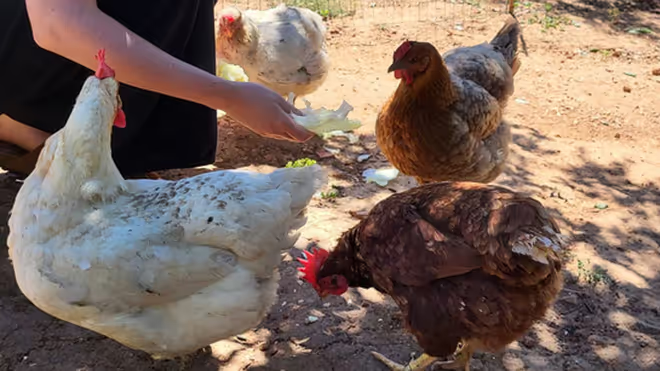
| Animals on current sit | One cat and four chickens (Kiwi, Clucky, Coocoo, Snowy) |
| Car required? | Yes, outside Lisbon and Porto |
| Best seasons | Spring (March to May) and Autumn (September to November) |
| Cost of living | Very affordable: wine from €2, coffee around €2, fresh produce cheap at markets |
| Visa for EU citizens | Not required, stay indefinitely |
| Visa for non-EU under 90 days | No visa needed under Schengen rules |
| Visa for stays over 90 days | D8 Digital Nomad Visa or D7 Passive Income Visa |
| Competition per listing | Low, most listings receive 3-5 applications |
| Best regions for sits | Algarve, Lisbon surrounds, Silver Coast |
| Language barrier | Minimal, English widely spoken in expat and tourist areas |
| Internet quality | Good in cities, variable in rural areas, always test before confirming |
| Pet types most common | Dogs and cats, our current sit has one cat and four chickens |
Portugal is a small, low-competition market: 22 TrustedHouseSitters listings out of 37 nationally, with no visa needed under 90 days. We landed our six-month Algarve sit as one of four applicants. That farmhouse would rent for over €1,000 a week. A car is essential outside Lisbon and Porto.
This is not immigration or legal advice. We are not immigration lawyers or licensed advisors. The information in this article is based on our own research and experience, and immigration and visa rules change frequently and vary by nationality, country, and individual circumstances. Always confirm current requirements directly with the relevant embassy, consulate, or a qualified immigration professional before you travel.
Portugal has around 22 active THS listings at any time, making it a low-competition market where strong applicants regularly land sits within their first few applications. No visa is required for stays under 90 days. The Algarve has the highest concentration of listings, followed by Lisbon and the Silver Coast. We are currently mid-way through a six-month sit near Albufeira, looking after one cat and four chickens named Kiwi, Clucky, Coocoo, and Snowy. This is written from inside that experience.
I am writing this from a table outside under shade, overlooking a view I still cannot quite believe is real. Caro found the listing when we were in Italy. She looked up from her phone and said, half-joking, "Should we do it?" I said yes. She applied. We got it. That is how straightforward house sitting in Portugal can be when the market is this low-competition and your profile is strong.
If you are interested in getting into house sitting, our book Travel More for Less puts the whole process in one place: clear, step by step guidance from your first questions to your first confirmed sit, and the reviews that open the door to the next one.
Why Portugal
Caro has wanted to come to Portugal for years. It existed for her as an idea long before it became a plan: the light, the tiles, the pace, the food. When the Algarve sit came up and the dates aligned, it was not a difficult decision.
I had been to Portugal once before, driving from Porto down to Lisbon on holiday. The road runs alongside the Douro past vineyards and river towns, and Lisbon arrives from the water in a way that very few cities manage. What stayed with me most was how unhurried everything felt. Not slow in the way of somewhere that has given up, but slow in the way of somewhere that has worked out what matters.
Six months in the Algarve, in a farmhouse, with a cat and four chickens, is a different version of Portugal from the one I saw on that drive. We are living in it rather than passing through it. And after a month, I can say with confidence: if someone is thinking about coming to Portugal for a house sit, do not think about it. Just do it. It is incredible, beautiful, warm, and the people are beyond friendly. Everyone says hello. Everyone acknowledges your existence. That sounds like a small thing until you have spent time in countries where it does not happen, and then you realise how much it matters.
Platform Numbers for Portugal
Portugal's house sitting market is smaller than its popularity as a destination might suggest. As of June 2026, the listing counts across all major platforms are:
| Platform | Portugal Listings (June 2026) |
|---|---|
| TrustedHouseSitters | 22 |
| MindMyHouse | 6 |
| Nomador | 4 |
| HouseCarers | 1 |
Total across all platforms: 37 sits in the entire country. That is not a search filter issue. Portugal simply has a smaller house sitting market than France, the UK, or Australia. Many Portuguese homeowners use the strong short-term rental market instead of house sitting when they travel. The sits that do exist tend toward longer durations. Our six-month sit is not unusual for this market.
The low volume has a genuine upside: competition per listing is lower than in comparable European markets. A strong profile and a personalised application go further here than in markets where homeowners receive fifty applications in the first hour. When we applied for our current sit, the homeowners responded quickly and the process was smooth.
TrustedHouseSitters is the only platform with meaningful coverage in Portugal. Nomador is excellent for France, where it dominates with over ~1100 listings, but its four Portugal listings make it a secondary option here at best. MindMyHouse has six listings at around $29 USD per year, worth browsing for the lower competition per listing.
Our Portugal sits were both confirmed through THS. A 25% discount on membership is available here, and our full THS review breaks down which membership tier makes sense for different travel plans.
Which Platform Has the Most Portugal Listings?
Based on our tracking in June 2026, TrustedHouseSitters leads Portugal with 22 active listings, more than all other platforms combined.
Nomador is the only meaningful alternative. It has stronger coverage in French-speaking Europe but does pick up Portuguese listings, particularly around Lisbon and the Algarve. Our Nomador pricing guide covers whether it is worth adding as a secondary platform for Portugal specifically.
All other platforms have fewer than 5 Portugal listings at any given time. For a Portugal sit, THS is the platform to prioritise. Our TrustedHouseSitters pricing guide covers every plan and which tier makes the most sense depending on how often you sit.

The Tavira Sit: Our First Portugal Experience
Our first Portugal sit was in Tavira, looking after a dog. The house was stunning, with a pool and a great view. The property was beautiful in a way that felt almost excessive for a free exchange, which is one of those things about house sitting that never quite stops being surreal.
The dog was a challenge on the first couple of nights. It had behavioral issues that were not fully disclosed before we arrived, including resource guarding and sound reactivity. There was no welcome guide. We figured out how to manage the situation ourselves, and once we did, the dog settled and became genuinely lovely.
The Tavira experience taught us two things about Portugal sits specifically. First, the properties tend to be beautiful. The combination of Portuguese architecture, outdoor space, and climate produces homes that are exceptional by any standard. Second, the majority of homeowners doing house sits in Portugal are UK expats, which means listings are almost always in English and the communication style is familiar for English-speaking sitters.
The Current Six-Month Sit: Living in Portugal
We are near Albufeira, on the outskirts rather than in the city, on a property with enough space and privacy that it feels like our own place. The care requirements are perfectly balanced: the cat is independent and affectionate on its own terms, the chickens follow a consistent daily routine that takes about thirty minutes morning and evening, and the rest of the day is ours.
The first month has been so easy that we are actually sad it has already passed.
The daily routine has settled into something that feels genuinely sustainable. We wake up, feed the chickens, have coffee, and start working. I sit at a table under shade with a view that I never get tired of looking at. Caro works from inside or by the pool. The cat appears when it wants attention and disappears when it does not. The chickens do their thing. Lunch is simple. The afternoons are for whatever we want them to be: more work, a drive to the shops, a swim, or nothing at all.
This is the version of house sitting that Caro and I talked about when we imagined what full-time travel could look like. The permission to stay still rather than constantly moving. The time to work on things we care about. The slow morning routine that actually stays slow because nobody is going anywhere.
Caro is addicted to pastéis de nata, the custard tarts that are everywhere in Portugal. We have eaten more ice cream in the past month than in the previous three years combined. These are not complaints.
The Reality of a Six-Month Portugal House Sit
The cat wakes us at 6am. He has spent years building a routine around his morning feeding time and has no intention of adjusting it for us. We get up, feed him, go back to bed for an hour, and then start the day properly. By the time we have coffee ready, the cat is somewhere in the garden doing whatever cats do between meals.
The chickens are the more interesting characters.
Kiwi has a physical disability that means she cannot stand fully upright and falls over regularly. She pecks with full force when you offer food from your hand, but the angle means it never actually hurts. She is the most vulnerable of the four and the one the others pay the most attention to.
Clucky takes it upon herself to protect Kiwi from Snowy, who has a tendency to bully her. When Snowy starts, Clucky jumps in and pecks her until she stops. It is a very clear dynamic and it plays out multiple times a day.
Snowy is the calmest of all four when handled. She does not flap, does not resist, and seems genuinely unbothered by being picked up. She is also, as far as we can tell, the one laying the most visually perfect eggs I have ever seen. The colour, the shape, the consistency. They look like they have been designed.
Coocoo is the oldest. She picks on everyone and answers to no one. Classic oldest sibling energy.
Kiwi lays freckled eggs, which are immediately identifiable and have become something we look forward to finding each morning. The eggs from all four chickens are exceptional. Everything they eat is organic and natural, and it shows in both the taste and the quality. After a month of eating these eggs daily, supermarket eggs feel like a downgrade.
The communication with the homeowners runs entirely through Caro. The owners are German-speaking and while my German is improving steadily thanks to an app I built myself to practise, everything of substance gets discussed in German with Caro acting as mediator. If the homeowners have a question for me, it comes through Caro. If I have something to raise, it goes the same way. It has worked without friction even when things have gone wrong.
Several things have gone wrong. A tree came down on the property. There were issues with shading structures. I had a family emergency in Cyprus that required me to fly out and leave Caro alone with the sit for a period. Every one of these situations was handled without tension, partly because the homeowners are genuinely warm people, and partly because the communication channel, even indirect, stayed open and clear throughout. Our guide on how to handle a family emergency during a house sit covers what to do when the unexpected happens mid-sit.
Six months is a long time to be anywhere. What it produces, if the sit is right, is something closer to actually living somewhere than anything else travel offers. We are not passing through Portugal. We are in it. That is the version of house sitting worth planning for. Our guide on slow travel through house sitting covers the philosophy behind it if you want to read more before committing to a long sit.
For anyone considering their first long sit with chickens specifically, our guide to house sitting with chickens or ducks covers the practical side of the daily routine.
The Drive: Athens to the Algarve
Getting to the Portugal sit involved one of the longest drives we have done in the T4. From Athens, we drove north through the Balkans, jumping from country to country because we were in the area and it made sense to explore. Montenegro, Bosnia, Serbia, Hungary, Slovenia, Italy through the Dolomites, down through France, across Spain, and into Portugal.
The route largely followed what we had originally planned, though we adjusted timing as we went, spending longer in some places than others. The places that deserved more time got more time, which is one of the genuine advantages of traveling in the T4 rather than flying between sits.
The full logic of combining van life with house sitting is that the van means we can take the long route, stop where we want, and arrive having driven through multiple countries rather than stepping off a flight. The sit is the destination. The drive is the trip. Neither would be possible without the other.
Practical Guide: What We Actually Found
Everything below is from direct experience of living in Portugal, not from research or assumptions made before arriving.
Internet and Remote Work
We are on the outskirts of a town, not in a city, and we do not have fibre optic internet. The house has wifi that gives us download speeds of roughly 20 to 40 megabytes per second, which is fast enough for writing articles, creating images, and general daily work.
I also carry a backup phone with a Portuguese 5G SIM and 400GB of data, which I use when working outside. This setup gives us redundancy: if the house wifi drops or slows, the 5G covers the gap. Caro uses the house wifi for her work on carosclass.com and has not had any issues.
For sitters who need to make video calls or upload large files regularly, the honest advice is to not assume the internet will be fast just because Portugal has good infrastructure in cities. Rural and semi-rural properties, which is where most Portugal sits are located, may have slower connections. Always ask the homeowner during the video call to run a speed test while you are talking. What a homeowner considers "good internet" and what a remote worker needs are often different things.
Our backup internet setup came out of necessity rather than planning. When Caro and I moved to Bochum early in our travels, we borrowed a router from Caro's father's workplace, expecting to use it for eighteen months. Within a week it was recalled. We went looking for a solution and landed on a mobile hotspot SIM with 400GB of data per month. We have used it ever since.
That 400GB gives us the freedom to move anywhere in Europe without worrying about connectivity. In Portugal, when the house wifi slows under the weight of too many devices, I move outside and work from the hotspot. The speeds are good, the reliability is better than the house wifi, and working outside under shade in the Algarve is not a hardship.
For Portugal specifically: NOS, MEO, and Vodafone all have reasonable 5G coverage in the Algarve and Lisbon. Rural coverage drops off. If you are taking a sit in central or northern Portugal away from the coast, test coverage at the specific address before committing. Our guide on how to test WiFi before a house sit covers how to do this during the video call with the homeowner.
Our best home office setups guide covers the workspace side of remote work during sits.

Cost of Living
Portugal is genuinely affordable, and after a month of living here rather than passing through on holiday, the numbers hold up.
Coffee in a shopping centre costs around €2 per cup, which is roughly half what it costs in Germany, France, or the Netherlands. We do not go out for coffee often, but when we do, the price never stings. Wine is where Portugal really stands out. Bottles start as low as €2 for something perfectly drinkable. Caro and I tend to spend around €7 per bottle on bio-organic wine, not because of the price but because it agrees with us better. Fresh produce at markets is inexpensive and excellent in quality. Meat is affordable. The overall cost of living is low compared to most of Western Europe.
For sitters coming from the UK, Scandinavia, or Switzerland, Portugal will feel remarkably cheap. For sitters coming from the Balkans or Southeast Asia, the difference will be smaller. Either way, the combination of free accommodation through house sitting and Portugal's low food and daily costs makes it one of the most financially efficient places in Europe to base yourself for an extended period.
What Portugal House Sitting Actually Saves You
The abstract case for house sitting is easy to make. The concrete numbers are more convincing.
A property like the one we are currently in near Albufeira, farmhouse, private, views to the sea, close to the main Algarve towns, would conservatively cost upwards of €1,000 per week as a short-term rental in summer. That puts the monthly equivalent at around €4,000. Over six months, that is €24,000 in accommodation costs that we are not paying.
We are spending approximately €500 to €600 per month between the two of us on food, our mobile internet, and the van. That is it. No rent, no utilities, no accommodation costs of any kind.
To put that in context: our total spend over six months in one of the most beautiful parts of Portugal will be around €3,000 to €3,600 combined. A single month's rent on this property at market rate would cost more than our entire six-month stay.
Caro and I have saved over $26,500 in accommodation costs across three years of house sitting, and that figure does not yet include this six-month Portugal sit. When it does, the total will be considerably higher. If you want to understand the full financial picture of house sitting versus conventional travel, our guide to how much house sitting costs breaks down the numbers in detail.
Weather and Climate
We are here in summer and it is hot. Properly hot. During the day, shade is not optional. At night, we run a fan to cool down the bedroom enough to sleep. The fan also keeps the mosquitoes away, which is a genuine bonus because the mosquitoes in the Algarve are relentless. They are not quite Australian-level relentless, but they are close.
Spring (March to May) and Autumn (September to November) are the most comfortable seasons for a sit. The temperatures are mild, the light is beautiful, and the tourist crowds thin out significantly. Summer (June to August) is manageable if you are comfortable with heat and have access to shade, water, and a fan. Winter (December to February) is mild by European standards but the stone houses that stay cool in summer get cold and damp in the darker months. If you are taking a sit that runs into winter, ask about heating. Wood burners, pellet stoves, and electric panel heaters are all common, and their quality varies. Stone floors in winter mean slippers are not optional.

The People
This is the thing about Portugal that surprised me most, even though I had been told about it before arriving.
Everyone says hello. Walking down a street, passing someone on a path, entering a shop. There is an acknowledgment. A nod, a greeting, a smile. It sounds unremarkable until you have spent months in countries where people look through you rather than at you. Here, your existence is acknowledged constantly, casually, and warmly.
This makes a real difference to how it feels to live somewhere versus visit it. As a house sitter, especially on a longer sit, you are not a tourist. You are someone who goes to the same shops, parks in the same spots, walks the same routes. Being greeted rather than ignored during those daily routines makes the whole experience more pleasant in a way that is hard to overstate.
Transport
A car is essential for the Algarve, for central Portugal, and for the north. The distances between towns are significant and public transport outside the main coastal strip is sparse. We have the T4, which handles everything, but even a small rental car would cover what is needed.
In Lisbon and Porto, public transport covers everything and a car is more of a hindrance than a help. The CP train network is affordable and scenic for intercity travel if you arrive without a vehicle.
For sitters combining Portugal with van life, the parking guide covers how to handle the van during a sit, and the VW T4 guide covers the specific setup we use.
Visa Requirements for House Sitting in Portugal
This is one of the most searched questions about Portugal house sitting and it deserves a proper answer rather than a footnote.
EU and EEA citizens have no restrictions. Caro holds a German passport and I hold Polish and Australian passports. For us, moving to Portugal for six months required no visa process, no application, no paperwork. We drove from Italy, crossed the border, and that was it. For any EU or EEA citizen, Portugal is as accessible as driving to the next town.
Non-EU citizens staying under 90 days are covered by standard Schengen rules. Portugal counts toward your 90-day allowance within any 180-day period. No visa is needed and house sitting itself does not constitute working in Portugal legally. You are not employed, you are not paid, and you are caring for a home and pets in exchange for free accommodation. That exchange does not trigger work visa requirements.
Non-EU citizens staying over 90 days need a visa before arriving. The two most relevant options are the D8 Digital Nomad Visa, which requires proof of remote income of approximately €3,480 per month, and the D7 Passive Income Visa, which has a lower income threshold of approximately €870 per month. Both are applied for before entry. Our house sitting legal issues guide and the what to tell customs when house sitting abroad article cover the broader legal picture. Our digital nomad visas and house sitting guide goes into detail on the D8 specifically.
Our situation: Caro and I planned nothing visa-related for this six-month sit because EU citizenship makes it straightforward. What I would say to anyone from outside the EU considering a long Portugal sit is that the D7 is the more accessible of the two options given the lower income threshold, and Portugal's consulates are generally well reviewed for processing times. Verify current requirements directly with the Portuguese consulate for your specific nationality before booking. Requirements change and we are not immigration lawyers.
Regional Guide
The Algarve
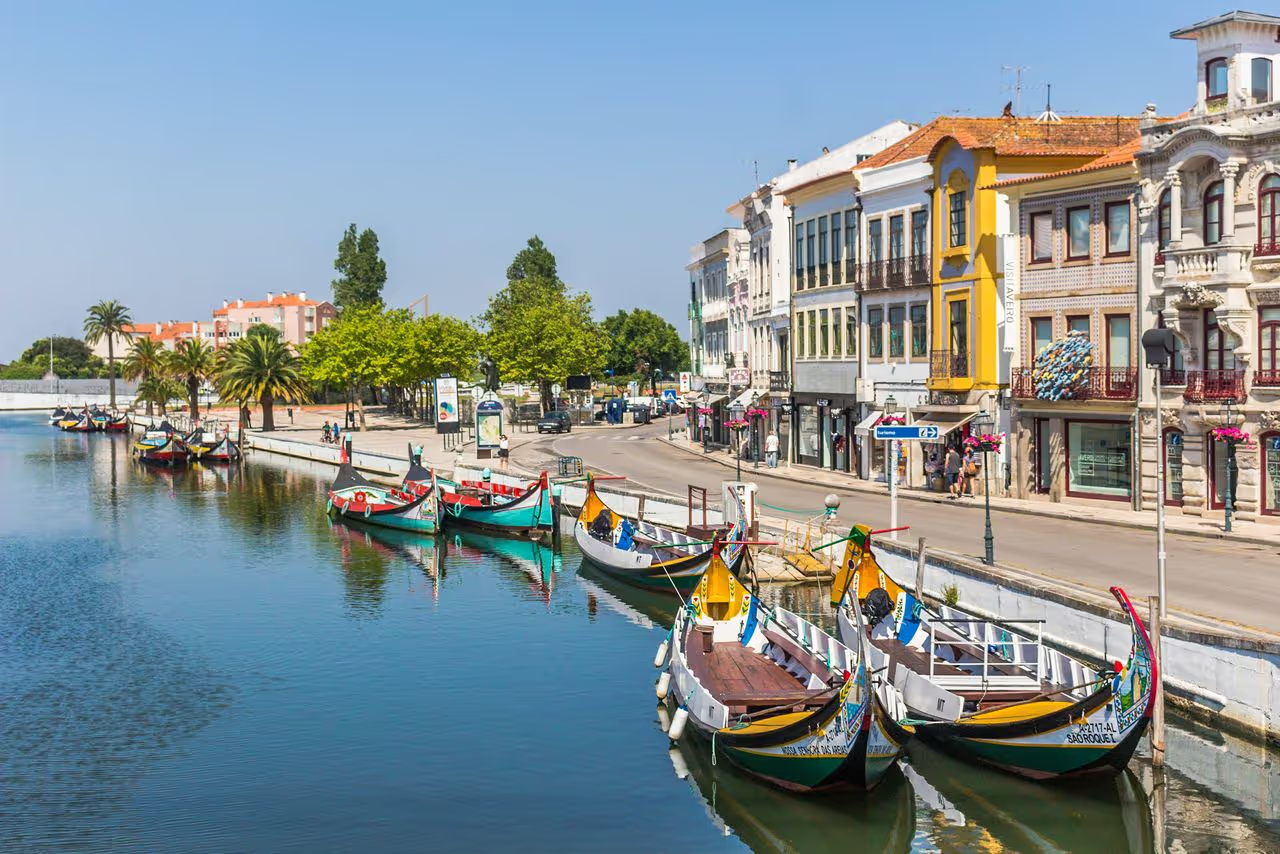
Where we are. The southern coast is Portugal's most internationally recognised region: dramatic cliff coastlines, warm weather for most of the year, and a large expat community that means English is widely spoken everywhere. Homeowners in the Algarve tend to travel for extended periods, which produces the longer sits, one to six months, that characterise this market.
A car is essential. Summer is peak tourist season and the most competitive time for sits. May and September are the shoulder months with better weather for daily outdoor life and fewer applicants.
Lisbon and Porto
Both cities have good public transport and do not require a car. Lisbon sits tend to involve apartments and cats, and are popular with sitters who want the city experience. Porto sits on the Douro River with some of the best food and wine in Portugal within walking distance of most sits. I drove through Porto on my earlier trip and spent two days there. The city deserves far more time than that.
Northern and Central Portugal
Greener, wetter, and more traditionally Portuguese than the Algarve. Sits here often involve larger properties, more animals, and longer durations. A car is essential. Competition is among the lowest in Portugal because fewer international sitters look this far north or inland, which makes the region worth considering for anyone building their first Portugal reviews.
Madeira and the Azores
Island sits appear occasionally on THS and represent some of the most unusual opportunities in Portugal. Very low competition because most sitters do not think to look there, and the settings are extraordinary. Worth monitoring separately if island life appeals.
Tips for Getting a Portugal Sit
With only 22 THS listings in the entire country as of June 2026, the approach needs to be different from higher-volume markets.
Set THS alerts for Portugal and check them regularly. With this few listings, new sits may only appear a few times per month. The sitters who respond within hours get the conversations. The ones who check weekly miss them.
Apply further in advance than you would for busier markets. We confirmed our current six-month sit several months before the start date. Last-minute Portugal sits exist but are not the norm.
If you are flexible on exact location, apply broadly within Portugal rather than holding out for a specific region. Filtering to just the Algarve or just Lisbon leaves very few options.
The low volume means competition per listing is lower than in France, the UK, or Australia. A strong profile and a personalised application go further here than almost anywhere in Europe. Our profile guide and AI application guide cover how to make both as strong as possible.

What We Wish We Had Known Before Arriving
The mosquitoes are serious. A fan at night keeps them away and keeps the room cool. Worth knowing before you arrive in summer.
The pastéis de nata addiction is real. Budget accordingly.
The homeowner community in Portugal is heavily UK expat. Listings are almost always in English and the dynamic is often familiar and warm from the first message.
The produce is exceptional and cheap. If you like to cook, Portugal is one of the best house sitting markets in Europe.
The pace of life is slower than most of Western Europe, and it is slower in the best possible way. Not sluggish. Just unhurried. This is the pace that makes a long-term sit feel less like an extended stay and more like actually living somewhere.
Conclusion
Portugal is one of the best house sitting destinations in Europe. The market is small, only 22 THS listings as of June 2026, but the quality of what is available, the affordability of daily life, the warmth of the people, and the beauty of the country make it worth the effort of getting in early and applying well.
We are over a month into a six-month sit and have not once considered leaving early. The cat is content. The chickens are consistent. The views are extraordinary. The pastéis de nata are a daily event. If someone is thinking about coming to Portugal for a house sit, stop thinking and start applying.
Are you planning a Portugal sit, or have you already done one? Drop your experience in the comments below. I read every one.
Start with TrustedHouseSitters using the 25% discount, set up alerts for Portugal, and apply the moment something appears. Browse MindMyHouse and Nomador for free alongside for additional coverage and lower competition.
Caro and I have completed 20 house sits across 12 countries, driven 19,000km in Australia and 24,000km in our 1998 VW T4, and saved over $26,500 in accommodation costs over three years of house sitting. If you have questions about house sitting in Portugal, send us a message on Instagram, we read every DM.

Frequently Asked Questions
What is the best house sitting platform for Portugal?
TrustedHouseSitters with 22 active listings as of June 2026 has more than all other platforms combined. MindMyHouse has 6, Nomador has 4, and HouseCarers has 1. THS is effectively the only platform with real coverage. Browse the others for free for additional opportunities at lower competition.
How many house sits are available in Portugal?
Approximately 37 across all major platforms as of June 2026. Portugal has a smaller house sitting market than its popularity as a destination suggests. New sits appear regularly but total volume is low compared to France, the UK, or Australia. The upside is that competition per listing is also lower.
Do I need a car for house sitting in Portugal?
Outside Lisbon and Porto, yes. The Algarve in particular has large distances between towns and sparse public transport outside the main coastal strip. Most Portugal sits are rural or semi-rural and not accessible without a vehicle. Always confirm transport requirements with the homeowner before accepting a sit.
Can I stay in Portugal for more than 90 days as a house sitter?
EU citizens can stay indefinitely. Non-EU visitors are subject to the 90-day Schengen limit for standard tourist entry. A longer sit requires either the D7 Passive Income Visa or Portugal's Digital Nomad Visa, both applied for before arrival. We are not immigration lawyers. Verify current requirements with the Portuguese consulate for your nationality.
Is Portugal affordable for house sitters?
Very. Coffee is around €2 per cup, wine starts from €2 per bottle, and fresh produce at markets is inexpensive and excellent. Combined with free accommodation through house sitting, Portugal is one of the most financially efficient places in Europe to base yourself for an extended period.
Is the internet good enough for remote work in Portugal?
In cities, fibre optic is widely available and fast. In rural and semi-rural areas, where most sits are located, speeds vary. We get 20 to 40 megabytes per second on house wifi and use a backup 5G phone SIM for redundancy. Always ask the homeowner to run a speed test during the video call before confirming.
What is the best time of year to house sit in Portugal?
Spring (March to May) and Autumn (September to November) offer the most comfortable weather. Summer is hot, especially in the Algarve, but manageable with shade and a fan. Winter is mild by European standards but stone houses can get cold and damp. Ask about heating before confirming a winter sit.
Are mosquitoes a problem in Portugal?
In the Algarve in summer, yes. They are relentless, particularly in the evenings. A fan at night keeps them away and keeps the room cool at the same time. Worth knowing and preparing for before arriving.
Can I house sit in Portugal without speaking Portuguese?
Yes. English is widely spoken in the Algarve, Lisbon, and Porto, particularly among the expat homeowner community that makes up the majority of Portugal THS listings. Our current six-month sit is with German-speaking owners and we manage entirely without Portuguese. Most THS homeowners in Portugal communicate in English from the first message.
How competitive is house sitting in Portugal?
Less competitive than France, Spain, or Italy. With around 22 THS listings and a smaller pool of applicants targeting Portugal specifically, a well-written application from a strong profile converts at a higher rate than in busier markets. We secured our current six-month sit as one of four applicants. A personalised application and a prompt response to new listings are the two things that make the difference here.
Which platform has the most Portugal house sitting listings?
TrustedHouseSitters, with around 22 active listings as of June 2026. Nomador is the only other platform with any meaningful Portugal coverage. All other platforms have fewer than five Portugal listings at any given time.
What is a portugal house sit actually like day to day?
Slower and more settled than short sits. Most Portugal sits run two weeks or longer, and the six-month format we are currently in is not unusual for the Algarve. Daily responsibilities depend on the animals: our sit involves feeding one cat and four chickens morning and evening, which takes around thirty minutes each session. The rest of the day is yours. Our guide on house sitting with chickens or ducks covers what farm bird care actually involves if you have not done it before.


Responses
What are your thoughts on this post?