

Home > Blog > House Sitting Platform: Community or Corporation
Quick Facts
| THS acquired by | Mayfair Equity Partners in 2023, valuing the platform at over $100 million |
| What followed | A per-sit booking fee on top of annual membership — for sitters and homeowners |
| Community reaction | Widespread anger, forum posts about betrayal, accusations of broken values |
| Our position | THS is a business, always was — but it still delivers extraordinary value |
| The B Corp question | Certification many community members call disingenuous — explained below |
| Best community-focused alternative | Nomador — stopover feature resembles Couchsurfing more than a corporate platform |
| The practical answer | Use THS for the listings, refer widely to reduce the cost to near zero |
TrustedHouseSitters sold to private equity in 2023 at over $100 million, and the booking fee followed. The anger is fair, but the platform still holds 10,000+ listings. We spent under €400 on membership across 20 sits against €24,000 saved on accommodation, so the maths still wins.
In 2023, TrustedHouseSitters was acquired by private equity firm Mayfair Equity Partners in a deal valuing the company at over $100 million. Shortly after, a per-sit booking fee was introduced on top of annual membership. Charged to both sitters and homeowners. The community reacted with what the forum accurately described as visceral pushback.
I want to engage with this in truth because I think both sides of the debate have merit, and because the practical question. Whether THS is still worth using despite its corporate direction. Has a clear answer that the philosophical debate sometimes obscures.
If you are interested in getting into house sitting, our book Travel More for Less puts the whole process in one place: clear, step by step guidance from your first questions to your first confirmed sit, and the reviews that open the door to the next one.
Use our 25% discount when joining. Our TrustedHouseSitters pricing guide covers every plan in detail.
The Booking Fee and the Community's Anger
The booking fee is the catalyst for the current debate, but the anger runs deeper than a single charge. Long-term THS members describe a gradual shift: features that used to be available to all members being moved behind higher tiers, the five-applicant cap on listings that limits sitter competition in ways members find frustrating, and marketing that has shifted toward an Airbnb-style "travel the world for free" framing rather than the mutual exchange language that built the original community.
The acquisition by Mayfair Equity Partners sharpened all of this. Private equity is not acquired for altruistic purposes. It is acquired to generate returns. Members who felt they were part of a values-driven community found themselves watching those values being repriced. The forum post titled "A Community or a Business?" captured this: the community framing had given members a sense of ownership they never actually had, and the corporate reality arriving as a shock felt like betrayal.
I understand the frustration. But I also think the community memory is doing some selective editing. THS has always been a business. It charged membership fees from the beginning. The community forum was always a feature of a commercial product, not a separate organisation. The warmth of the early community culture was genuine, but it existed within a structure designed to generate revenue. The private equity acquisition made the commercial reality more visible and less apologetic. But it did not create something that was not already there.
What B Corp Certification Actually Means
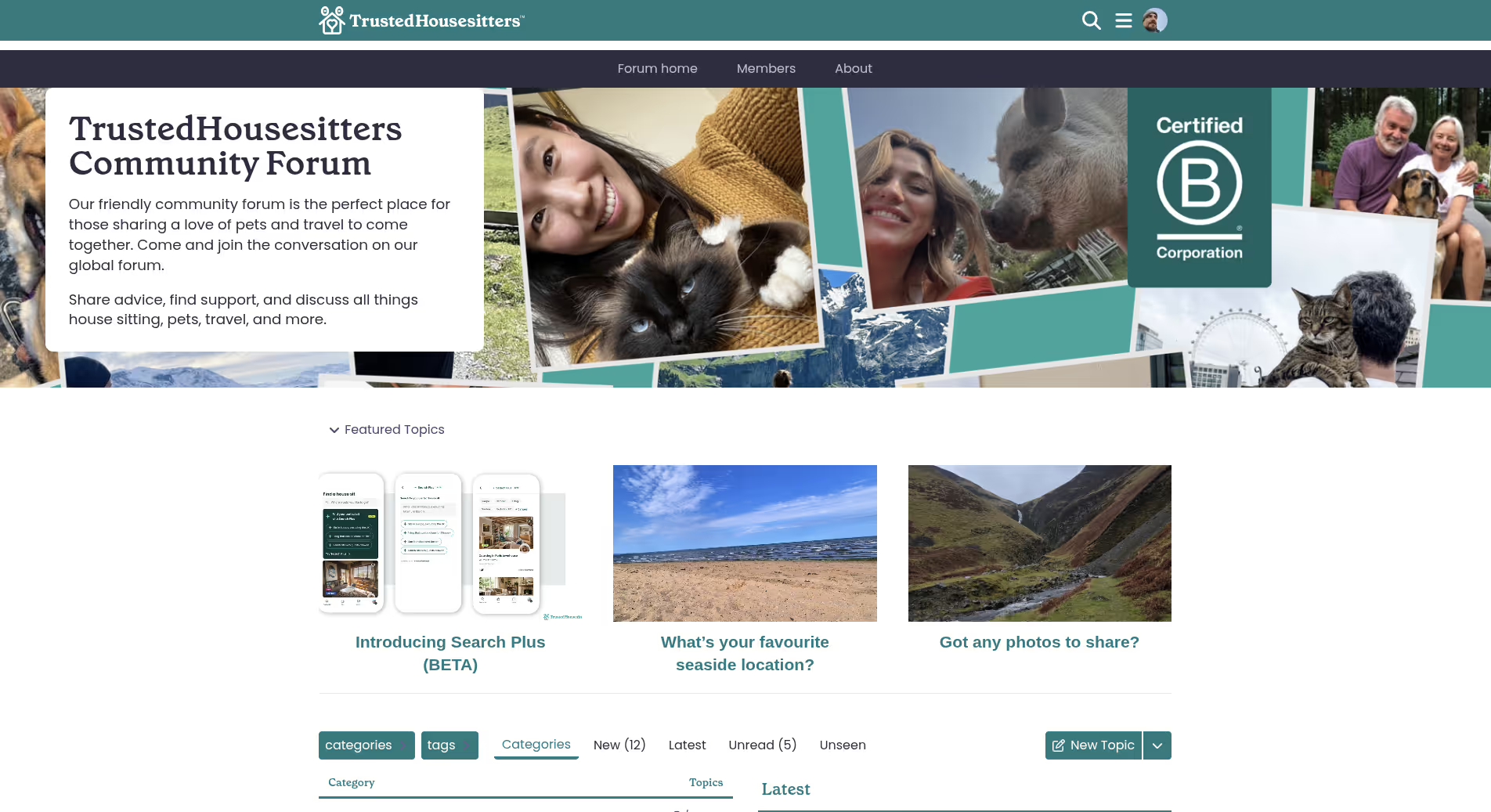
Several community members dismiss THS's B Corp certification as disingenuous. It is worth explaining what B Corp is before assessing whether that criticism is fair.
B Corp certification is awarded by B Lab, a non-profit organisation, to companies that meet specific standards of social and environmental performance, accountability, and transparency. Certified companies must score at least 80 points on the B Impact Assessment, which evaluates governance, workers, community, environment, and customers. Recertification is required every three years.
B Corp does not mean a company is a non-profit or that it prioritises community over profit. It means it has been assessed as meeting a threshold of responsible business practice. Many significant commercial enterprises hold B Corp certification while remaining profit-focused.
The criticism that THS's certification is disingenuous essentially asks whether a platform that introduces booking fees while holding B Corp status is operating inconsistently. It is a fair question. The community's answer is largely yes. The values the certification claims to represent feel at odds with the financial decisions being made. THS's view would presumably be that the certification covers a broader assessment of company behaviour, not a commitment to freeze pricing.
Both positions are defensible. What the B Corp debate reflects most clearly is that certification is not a substitute for trust, and trust is built through actions rather than credentials. Our TrustedHouseSitters review covers the platform experience in full without the philosophical framing.

Why THS Still Makes Sense Despite All of This
My honest view: the community anger is understandable but the practical conclusion, that THS is not worth using, does not follow from the premise.
THS has over 10,000 active listings. No other platform is close globally. The mobile app with push notifications, the 24/7 vet helpline, the mandatory ID verification for sitters, the blind review system. These are features that smaller platforms do not have and that matter in real sits. The booking fee adds cost for frequent sitters on lower tiers, but the Premium plan eliminates it entirely, and at six sits per year Premium is already cheaper than Standard with fees included. Our booking fee guide covers the maths precisely.
The bigger frame is this: even accounting for the full Premium cost, house sitting through THS is the most affordable serious travel model I have encountered after a lifetime of travel. €400 across three years for over €24,000 of accommodation. Even if costs tripled, it would still be an extraordinary return.
HouseCarers has stayed at roughly the same price for years and now has under 100 listings and an interface that reflects its age. Price stability that does not fund growth produces a product that shrinks. THS charges more and spends heavily on advertising, infrastructure, and product development. That spending is why the listing base continues to grow. The community frustration about price is legitimate. The causal relationship, more money spent on the platform produces more listings which produces more value for users is also real.
What THS has failed to do is communicate this clearly. There is no public roadmap. There is no explanation of where the booking fee revenue goes or what platform improvements it funds. The announcements arrive with corporate language that the community correctly identifies as insincere. If THS published a product roadmap showing what the additional revenue was being used for, the reaction to the booking fee would have been significantly different. Transparency is not a nice-to-have in a community-adjacent business. It is the minimum required to maintain trust.
Does THS Feel Like a Community?
I want to be direct about this: I do not think of THS as a community and I do not think most active house sitters do either. A matchmaking service for homeowners and sitters is what it is. Yes, there is a forum. Yes, there is a Reddit. But I do not attend THS events or gatherings and I would guess most people reading this do not either.
The platform that most resembles genuine community behaviour in the house sitting space is Nomador, specifically because of its stopover feature. Which allows members to offer a single overnight to a travelling sitter with no house sitting obligation, similar to Couchsurfing. That is a person-to-person hospitality exchange with no commercial transaction inside it. That is closer to what "community" actually means. THS does not have an equivalent.
This does not make THS worse at being a matchmaking platform. It makes it accurately described as one. The anger about THS not being a community might be better directed at the original framing. Which invited members to think of themselves as part of something more than a commercial service. Rather than at the business decisions that followed.

The Competition Problem
One of the strongest arguments in favour of the community position is that competition has not materialised at the scale needed to keep THS accountable.
Here is the competitive landscape as it actually stands:
Nomador has the strongest potential. It already dominates France, has a community-oriented positioning, and has the infrastructure to grow. What it lacks is an affiliate programme, a referral system with compelling rewards, and a mobile app with push notifications. With those three additions, Nomador could grow significantly within a short period. The listing base is already there in its home market. The growth mechanics are missing. Our Nomador rebrand article covers what the platform needs to do next.
The regional network. Aussie House Sitters, House Sitters Canada, Kiwi House Sitters, House Sitters America, House Sitters UK. Represents a truly interesting opportunity. These five platforms collectively have strong listings across most of the major English-speaking house sitting markets. If they merged their listings under a single global interface, they would have approximately 2,000 listings at any given time, making them an instant competitor to THS on English-speaking volume. The pieces exist. The aggregation has not happened.
MindMyHouse at $29/year has been running since 2005. Its limitation is not price. People will pay more for perceived value, which is why THS dominates despite costing four times as much. The limitation is that MindMyHouse does not invest in the growth mechanisms that attract both supply and demand. A $29 platform that does not spend on advertising has no mechanism for growing the listing base that creates the value.
HouseSit Match is a family-run business with mandatory ID checks on all members, which is a meaningful trust signal. But with under 30 listings at any given time, it has prioritised verification over volume in a way that limits its utility for most sitters. Most sitters, given the choice between mandatory ID checks with 30 listings and no mandatory ID checks with 10,000 listings, will choose the volume.
The Practical Answer
The debate is worth having. The practical conclusion for most sitters is not complicated.
Use THS for the listing volume. Refer consistently using the referral link to compound credits and reduce the real annual cost toward zero over time. Caro and I now have years of Premium membership ahead of us at no additional cost because of referral credits. The platform costs us nothing at this point.
Supplement with Nomador if your sits are in France or French-speaking Europe. Add regional platforms. Aussie House Sitters with our HSG15 discount code for Australia, Kiwi House Sitters for New Zealand. Where the regional volume justifies it.
Spending energy being frustrated about THS's corporate direction is a choice. The alternative is using the system as it exists, reducing the cost through the mechanisms the system itself provides, and letting the listing base do what it has always done. Deliver sits that most people can only dream about, at a cost that is truly insignificant relative to the value returned.
Join TrustedHouseSitters with 25% off. DM us @housesittersguide on Instagram. We answer everyone.

Frequently Asked Questions
Did TrustedHouseSitters change after being acquired by private equity?
The acquisition by Mayfair Equity Partners in 2023 accelerated changes that had been building for years. The booking fee, the five-applicant cap, and the shift toward a more commercial marketing voice all followed. Whether this represents a fundamental values change or a visibility shift in what was always a commercial operation depends on perspective. The platform remains the largest and most feature-rich in the space regardless of ownership structure.
What is B Corp certification and does THS deserve it?
B Corp is awarded by B Lab to companies meeting standards in social and environmental performance, governance, and transparency. It does not mean non-profit or anti-commercial. Whether THS's certification is consistent with its pricing decisions is a legitimate question with reasonable views on both sides. Certification is assessed across a broad range of company behaviours, not a single pricing policy.
Is TrustedHouseSitters still worth using despite the booking fee?
Yes. For most sitters the listing volume is irreplaceable. The Premium plan eliminates the booking fee entirely. At six or more sits per year, Premium is already cheaper than Standard with fees included. Across three years and 20 sits, Caro and I spent under €400 on membership against over €24,000 in saved accommodation. Even at three times the cost, the return would be extraordinary.
Which house sitting platform has the most community feel?
Nomador, specifically because of its stopover feature. A Couchsurfing-style overnight exchange between community members with no house sitting obligation. This is a genuine person-to-person hospitality exchange that no other major platform offers. THS is a matchmaking service with a forum, which is not the same thing.


Responses
What are your thoughts on this post?