

Home > Blog > House Sitting Agreement Template
Quick Facts
| Quick Facts | |
|---|---|
| Do most house sits use a written agreement? | Rarely. Most run on the platform's own terms plus messages and a walkthrough |
| What matters more than a signed document? | A video walkthrough before and after the sit |
| What is the one clause that matters most? | The agreed dates, held by both sides |
| Is a house sitting agreement legally binding? | It carries weight, but proving negligence is difficult either way |
| Is there a free template? | Yes, our House Sitting Agreement Generator |
| Is this legal advice? | No. Have any agreement reviewed by a qualified lawyer before relying on it |
Across 20 sits we have used a formal written agreement exactly zero times, because confirming through a platform already accepts its terms. One earns its place on private sits arranged outside a platform. Include the dates above all, then pet care and home care, and film a walkthrough.
This is not legal advice, and everything below should be checked against your own situation, ideally with a lawyer, before you rely on it for anything serious.
Disclaimer: This article and the linked are general templates, not legal advice. Housesittersguide.com is not a party to any agreement created from this content and takes no responsibility for its contents or any dispute arising from it. Have any agreement reviewed by a qualified lawyer before either party relies on it.
A house sitting agreement is not something Caro and I have needed on most of our 20 sits, because TrustedHouseSitters already has you agree to a sit with a click, and on the handful of private arrangements we have done, the handover conversation and the messages before and after covered everything. But that does not mean a written agreement is pointless. It is good practice, it gives both sides a shared reference point, and for anyone doing a private sit outside a platform, having one costs nothing and can prevent a genuine misunderstanding.
We built this page because "house sitting agreement" is something people search for constantly, and most of what comes up is generic. Caro and I have completed 20 house sits across 12 countries, and across all of them we have used a formal written agreement exactly zero times. That is not an argument against having one. It is context for how much weight to give it.
If you are interested in getting into house sitting, our book Travel More for Less puts the whole process in one place: clear, step by step guidance from your first questions to your first confirmed sit, and the reviews that open the door to the next one.
In my experience that combination does most of the work an agreement is meant to do. A written agreement adds a layer on top of that, and for some situations, particularly private sits with no platform terms behind them, it is worth having.
So this article is not going to oversell what a signed document can do. It is going to walk through what actually matters if you want one, why I think the video walkthrough does more real protective work than the paperwork, and how to use the free generator we built so you are not starting from a blank page.

Do You Actually Need a Written Agreement?
Honestly, probably not, for most sits. Barely anything goes wrong during a typical house sit, and when you are booking through a platform like TrustedHouseSitters, Nomador, or one of the regional sites, you are already agreeing to that platform's terms the moment you confirm the sit.
Our house sitting legal issues guide covers what those platform terms actually do and do not cover, and it is worth reading alongside this one, because the two pieces are meant to work together: that article covers the legal grounding, this one covers the practical document.
Where a written agreement earns its place is on private sits, arranged outside any platform, where there is no set of terms sitting behind the relationship already. If you found the sit through a friend, a local group, or word of mouth, you and the homeowner are building the whole framework from scratch. That is exactly the situation where writing things down helps.
I will say something that might sound counterintuitive coming from someone recommending a template: I do not think a signed agreement carries as much practical strength as people assume.
It is genuinely difficult for a homeowner to prove a sitter was negligent, or that damage was the sitter's fault, unless it was established beforehand what condition things were in. A document you both sign is one way to establish that.
A video walkthrough before the sit starts and again at checkout does the same job, arguably better, because it captures the actual condition of the home rather than a written promise about it.
What Actually Went Wrong Without One
We do not have a story about a written agreement failing us, because we have never really needed one to fail. The closest thing we have to a cautionary example is our sit in Tavira, Portugal, and it illustrates the point from a different angle.
There was no welcome guide for that sit. Everything was scrawled on a single piece of paper, and none of it was specific enough to actually hold anyone to anything. What we had agreed to before arriving was not what we found once we were there, and the homeowner did not follow through on several things that had been discussed.
We stayed anyway, and in hindsight we are genuinely glad we did, even though the sit ended early because the homeowner came back sooner than planned. It was a hard sit and it taught us more than most of the easy ones. But it is a clean example of what a document, even an informal one, is actually for: not covering every possible scenario, just making sure both people are working from the same understanding of what was promised.
If you have ever had a homeowner or sitter change the terms partway through a sit, we would genuinely like to hear about it in the comments. It is more common than people admit.

What to Include in a House Sitting Agreement
Based on our own experience, most of what matters in a house sitting agreement comes down to three things, and everything past that is optional detail worth discussing but not worth agonising over.
The dates. This is the one I would call non-negotiable. Both people are usually travelling around a sit, and if either side decides to leave early or extend without agreement, it disrupts the other person's plans in a way that is genuinely unfair.
Do not go into a sit thinking "it will probably be fine if we stay a bit longer" or "we will just head off a day early." Whatever start and end dates you agree to, treat them as fixed unless both sides actively agree to change them.
Pet care. What the animals need, how often, and anything specific to their health or routine. This is the section most welcome guides already cover well, but it should be confirmed in writing regardless of how the rest of the agreement is structured.
Home care. The condition the home should be left in, and any specific maintenance the sitter is expected to handle (watering plants, taking out bins on a certain day, and so on).
Everything else, house rules, guest policy, who covers utilities on a longer sit, vehicle use, is worth discussing and writing down, but I consider it optional rather than essential. As long as both sides have talked it through and it is recorded somewhere, even a WhatsApp thread, you are in reasonable shape.
For a full breakdown of the boundary between reasonable requests and ones that cross into unpaid labor, that is its own topic worth reading before you agree to anything unusual.
Why the Video Walkthrough Might Matter More Than the Document
I want to be direct about this because I think it gets overlooked. The real weak point of any house sitting agreement, ours included, is that it is very hard for a homeowner to prove a sitter was negligent, or that a specific piece of damage was the sitter's fault, unless the condition of the home was established beforehand. A signed document without evidence of the home's actual condition is a promise, not proof.
A video walkthrough with the homeowner before the sit starts, and again during checkout, captures something a written agreement cannot: what the home and pets actually looked like at that moment. If something is disputed afterward, that footage is far more useful than a clause. Some homeowners also use hidden cameras for their own peace of mind, which is worth knowing your rights around before a sit begins.
In practice, a thorough welcome guide, read and acknowledged by both sides, probably does just as much good as a formal agreement, especially if both people sign off on it at the start and end of the sit. Think of the agreement less as a legal shield and more as a shared checklist that both people have actually looked at.
Using the Free House Sitting Agreement Generator
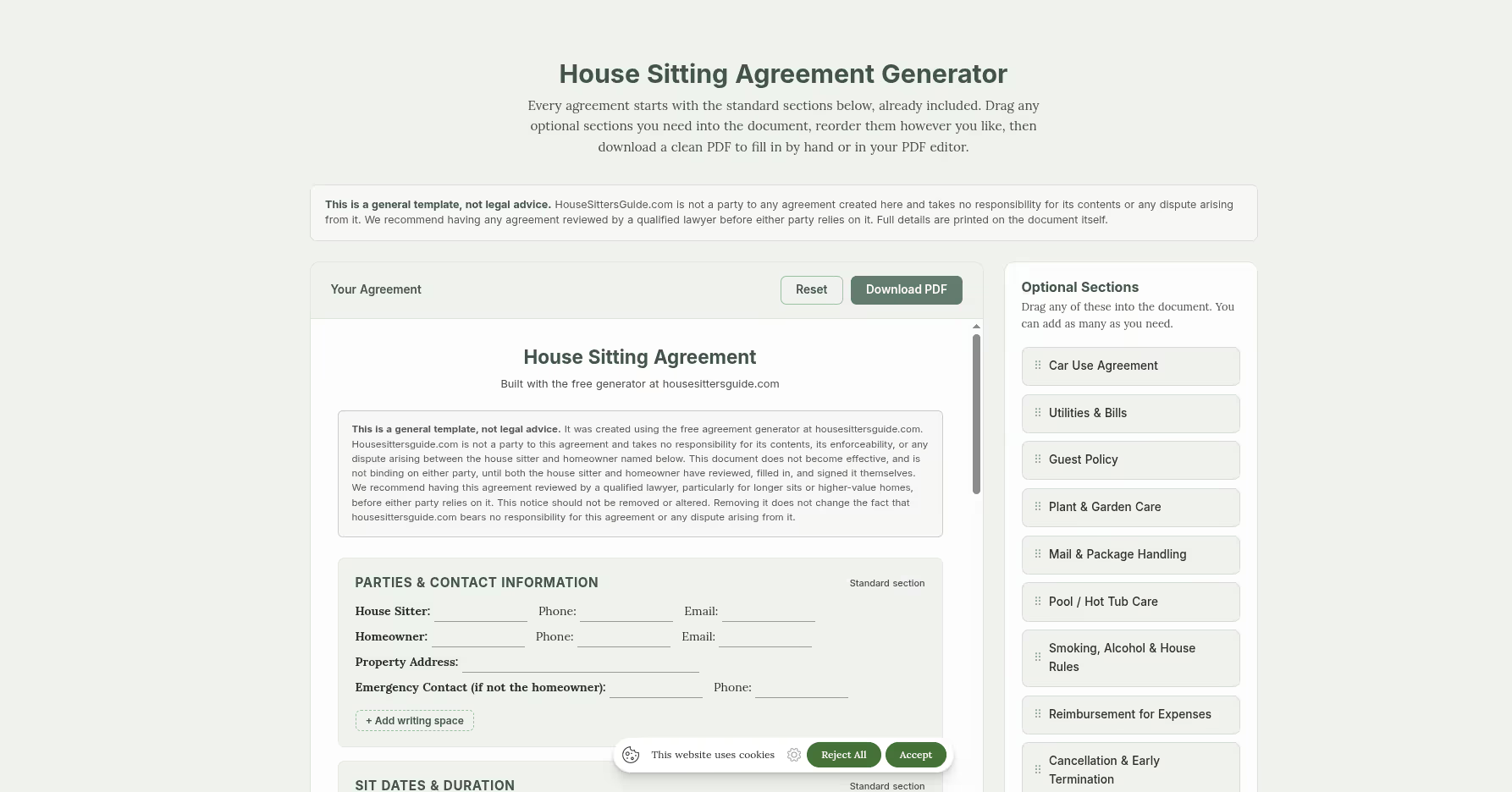
We built a House Sitting Agreement Generator because "house sitting agreement" is something people search for constantly, and most of what is out there is generic filler rather than something you can actually use.
Ours starts with the standard sections already built in: dates, pet care, and home care, the same three things I flagged as essential above. From there you can drag in optional sections for anything else relevant to your specific sit, reorder everything however makes sense, and download a clean PDF to fill in and sign.
It is a template, not a contract drafted by a lawyer for your specific situation, and the disclaimer on the page and printed on the document itself says exactly that. Use it as a starting point to make sure you and the other person are covering the same ground, not as a substitute for actual legal advice if the sit involves anything unusual (a long-term stay, use of a vehicle, or anything with real financial stakes attached).
If you end up using the generator for a sit, let us know in the comments how it went, what you added, and whether anything was missing that we should think about adding as an optional section.
Short Sits vs Longer Sits: What Actually Changes
The core of the agreement does not really change based on length. Dates, pet care, and home care matter whether the sit is a long weekend or, like our current sit in Portugal, a six-month stay. What changes is how much of the optional detail becomes worth spelling out.
On a short sit, you can usually leave a lot unsaid and rely on common sense. On a longer sit, things like who pays for what if a utility bill comes due mid-sit, what happens if either side needs to travel during the sit, and how ongoing communication will work become worth agreeing on explicitly, simply because there is more time for something to come up. None of this needs to be formal. It just needs to be discussed and recorded somewhere both people can refer back to.

For Homeowners: Why This Still Matters
We have never personally needed to sign a separate agreement, largely because messages carry a surprising amount of weight in practice, even outside a platform. But it is worth being honest about where that leaves homeowners: it is genuinely difficult to prove a sitter was negligent unless the sitter effectively admits it themselves, or there is footage or documentation from before the sit to compare against. That is a real disadvantage for homeowners, not a hypothetical one.
If you are a homeowner reading this rather than a sitter, the practical takeaway is the same one that applies throughout this article: a video walkthrough, a properly detailed welcome guide, and clear written terms about pet care, home care, and dates will do more for you than a generic agreement template on its own.
If a dispute does happen despite all that, our guide to resolving disputes on TrustedHouseSitters and our guide on what to do if the home is filthy on arrival both cover what your actual options look like once something has already gone wrong.
Conclusion
A house sitting agreement is a useful tool, not a guarantee. For most sits booked through a platform, the platform's terms plus a good welcome guide and a video walk through will cover you. For private sits arranged outside a platform, a written agreement is genuinely worth having, and our free generator exists so you are not starting from nothing. Focus on the dates, pet care, and home care first. Everything else is worth discussing, but it is the conversation that matters more than the clause.
Caro and I have completed 20 house sits across 12 countries, driven 19,000km in Australia and 24,000km in our 1998 VW T4, and saved over $26,500 in accommodation costs over three years of house sitting. If you have questions about house sitting agreements, DM us @housesittersguide, we answer everyone.

Frequently Asked Questions
Do I need a written agreement for a sit booked through TrustedHouseSitters?
Not usually. Confirming a sit through the platform already means agreeing to its terms, and our house sitting legal issues guide covers what those terms do and do not protect you against. A written agreement adds the most value on private sits arranged outside a platform.
Is a house sitting agreement legally binding?
It carries some weight as a record of what both sides agreed to, but proving a breach, particularly negligence, is genuinely difficult without supporting evidence like a video walkthrough. Treat it as a shared reference point rather than a guarantee, and have it reviewed by a lawyer if the sit involves anything with real financial or legal stakes.
What is the single most important clause in a house sitting agreement?
The dates. Both people are usually travelling around a sit, and either side leaving early or extending without agreement disrupts the other person's plans. Pet care and home care come next, and everything past that is optional detail worth discussing rather than essential to include.
Is your agreement generator free to use?
Yes. It includes the standard sections already built in, with optional sections you can drag into the document and reorder before downloading a PDF. It is a template, not a substitute for legal advice.
Should homeowners insist on a signed agreement for every sit?
That is a personal call, but a signed agreement without a video walkthrough or detailed welcome guide to back it up is weaker than people assume. A walkthrough documenting the home's actual condition, alongside clear written terms, protects both sides more effectively than a signature on its own.


Responses
What are your thoughts on this post?