

Home > Blog > House Sitting New Zealand 2026: The Complete Guide
Quick Facts
| Quick Facts | |
|---|---|
| Best platform by volume | Kiwi House Sitters (NZ-specific, dominant) |
| Global platform | TrustedHouseSitters (stronger for international sitters) |
| Majority sit length | Long-term, two weeks or more |
| Do you need a car | Yes, almost everywhere outside central Auckland and Wellington |
| Biosecurity fine | $400 NZD on the spot for undeclared items, $800 for high-risk items |
| Visa position | Legal grey area on a tourist visa, check NZ Immigration before travelling |
| Best season to start | Autumn (March to May) for lower competition and warm weather |
New Zealand produces some of the best long-term house sitting opportunities in the world. The listing volume on local platforms is high, the homeowners are among the warmest you will encounter anywhere, and the country itself rewards staying in one place and exploring outward from it. If you are serious about house sitting in New Zealand, the platform combination and the approach to long-term sits outlined in this guide will give you everything you need to get started.
I have been to New Zealand once. I went with my two sisters and one of their boyfriends, hired a car, drove around the North Island for ten days, and covered more variety in that time than most countries offer in a month. At the time I was staying in hostels and had no idea house sitting existed. I have thought about that trip many times since, in the context of what it would have looked like if I had known.
If you are interested in getting into house sitting, our book Travel More for Less puts the whole process in one place: clear, step by step guidance from your first questions to your first confirmed sit, and the reviews that open the door to the next one.
For anyone planning Auckland specifically, the Auckland house sitting guide covers that city in detail. This article covers the full country.

Why New Zealand Produces So Many Long-Term Sits
This is the detail that surprises most people researching New Zealand house sitting for the first time. The majority of listings on Kiwi House Sitters are long-term sits of two weeks or more. That is not an outlier. It reflects something structural about how New Zealanders travel.
New Zealand is a long way from everywhere. The minimum flight time to nearby countries is around three hours. Getting to North America takes the better part of 12-24 hours. When Kiwis go somewhere, they go properly, because the journey justifies it. A three-week trip to Europe takes the same logistical effort as a three-month one once you factor in the flight. Homeowners here are not popping away for a long weekend. They are going for real, and they need someone who can genuinely settle into the house rather than pass through.
For sitters, this is one of the most significant advantages the New Zealand market offers. There is a real difference between a three-day sit and a three-week one, and it goes beyond the numbers. A three-day sit is essentially a job. You arrive, you orient yourself, you manage the pets, and before you have properly settled in you are packing again. A three-week sit is something else entirely. You put your things down properly. You find a place for everything. You learn the house, the neighbourhood, the pets' actual personalities rather than their first-impression behaviour. You start to build a routine.
I am currently on a six-month sit in Portugal with Caro, and that experience has clarified something I had only partially understood from shorter sits. The longer you stay, the more compounding value you get from the stability. Our morning here is shaped by the cat, who has spent years building a routine around a 6am feeding time and has no intention of changing it for us. We wake up, feed the cat and the chickens, water the plants, have coffee, and then we have focused time to work. For me that means building housesittersguide.com. This site grew 380% in a single month during this sit. That kind of output does not happen when you are moving every few days. It happens when you have a stable base, no logistics to manage, and time that belongs to you. A long-term New Zealand sit offers exactly that kind of environment, and that is precisely why I would prioritise them over short ones if you have the flexibility.
Our guide on the realities of long-term house sitting covers what to agree before a homeowner leaves and how to approach the first week of a long sit.
The Platforms and What the Numbers Show
There are two platforms worth your attention for New Zealand. Everything else is a distant third.
| Platform | NZ listings | Notes |
|---|---|---|
| Kiwi House Sitters | 490~ | Dominant local platform, highest volume by far |
| TrustedHouseSitters | 110~ | Best for international sitters with existing review history |
| NZ House Sitters | 20~ | Separate platform, low volume, worth a check only |
| Nomador | 0 | No NZ presence, skip entirely |
Kiwi House Sitters is the starting point for anyone serious about sitting in New Zealand. It is the dominant local platform by a wide margin, has been running since 2004, and the homeowner community here is built specifically around New Zealand. The lifetime homeowner membership model, where owners pay once and list indefinitely, means the listing base grows consistently rather than cycling out with expired annual memberships. At roughly $89 NZD per year for sitters, it is also among the most affordable platforms in any market. Sign up through this link and use code HSG15 at checkout for 15% off your membership. Using the link and the code together generates a small commission for this site at no extra cost to you. That is what keeps these guides free and the articles coming.
Our full Kiwi House Sitters pricing and review covers everything you need to know before joining.
TrustedHouseSitters is the platform Caro and I use globally and the one our reviews are attached to. The NZ listings on THS skew toward homeowners who want the verification, cover, and review structure of a global platform. For international sitters arriving with an established review history, those reviews carry directly into the New Zealand market. A homeowner seeing a sitter with verified sits across Europe treats that profile differently from an unknown applicant.
Running both platforms gives you the full market. The listing overlap between a local NZ platform and THS is low enough that you are genuinely expanding your options rather than seeing the same sits twice. Our guide to how much house sitting costs puts the combined membership cost in context against what you save in accommodation.
NZ House Sitters is a completely separate platform from Kiwi House Sitters despite the similar name. Listing volume is low enough that it is not worth building a New Zealand strategy around. Worth a browse if you are targeting a specific region, nothing more.

What New Zealanders Are Actually Like
I have visited 60 countries and a small number of them leave a specific impression that stays. Not because of the landscapes, though New Zealand's are extraordinary, but because of the people. New Zealand sits in a group of three countries, alongside Australia and Portugal, where something different happens when you interact with strangers.
People acknowledge your existence in a way that is not transactional. In a shop, someone scanning your items does not just process the sale. They ask how you are doing and actually wait for an answer. They notice things about you. It sounds like a small thing until you have spent time in countries where it does not happen, and then the contrast is immediate.
I remember arriving at the car rental desk in New Zealand with my sisters. We had booked a specific car and the one available was smaller. In most countries, particularly in Europe, that conversation involves a degree of friction, forms, waiting, someone calling a manager.
At this desk, the person behind the counter smiled, said that was no problem at all, and simply upgraded us. No fuss, no negotiation, a smile and a solution. That moment is small in itself but it was representative of dozens of similar interactions across ten days. The warmth was consistent.
If that quality of people extends to the house sitting community, and from what the community reports it does, then the homeowner briefings, the mid-sit communication, and the handover process in New Zealand are likely to be more forthcoming and generous than the average.
An arrangement with a homeowner who trusts you immediately and goes out of their way to make sure you have everything you need is a fundamentally different sit from one where the relationship is formal and careful. New Zealand homeowners appear to lean heavily toward the former. Our guide on what to do when there is no welcome guide covers the situations where that warmth does not translate into a proper briefing, which can happen anywhere.
What the North Island Is Actually Like
I can only speak to the North Island from direct experience, but the North Island alone has enough variety to feel like several different countries stacked together.
Rotorua is where the sulphur hits you first. The geothermal vents that run under the town produce a smell that is immediately distinctive, something between rotten eggs and minerals, and when you arrive the instinct is to question the decision to stop. After an hour you stop noticing it. Rotorua is genuinely interesting: geothermal activity visible everywhere, Maori cultural experiences that are unlike anything in the rest of the world, a town that has a laid-back, slightly eccentric character that grows on you. We did not stay long enough and I think about going back.
Waitomo is where we did the black water rafting, and it is one of the most memorable experiences I have had anywhere across 60 countries of travel. You go into the caves with a headtorch and a rubber tube, float through underground rivers in complete darkness, and then the guide tells everyone to turn off their torches at the same moment. For a few seconds there is absolute blackness while your eyes adjust. Then the ceiling above you begins to glow. It looks exactly like stars, a full sky of them, but they are glowworms covering every surface of the cave above you. At that moment the guide handed out marshmallow fish, which are a classic New Zealand sweet, and there is no other way to describe the next few minutes than pure bliss.
Sitting in an underground river in total darkness, looking up at thousands of glowworms, eating a marshmallow fish. It is completely surreal and completely wonderful. If you are sitting anywhere near the Waikato region during a New Zealand sit, Waitomo is not optional. Our guide on what house sitters usually do day to day covers how to balance excursions like this with your actual responsibilities.
Taupo is my favourite place on the North Island and the place I most want to take Caro. I was there to snowboard on Tongariro, the active volcano that rises above the lake, and the experience of standing at the top on a snowboard with the snow all around you, the lake enormous and impossibly blue in the distance below, greenery at the edges where the snow ends, and the sun setting behind the peaks, is one of the most vivid moments I have from anywhere in the world.
I want her there for that specifically. Lake Taupo itself is the caldera of a supervolcano, 616 square kilometres, and it does not look real when you first arrive at its edge. The scale of water combined with volcanic peaks behind it is the kind of view that stops a conversation mid-sentence. Sits in the Taupo region from what I have researched tend to be longer-term and more rural, which suits the area perfectly.

The Value of Using a Sit as a Base for Exploration
One of the things that makes New Zealand distinctive as a house sitting destination is the size of the country relative to what it contains. It is genuinely small. From Auckland you can reach Rotorua in three hours, Taupo in four, Waitomo in two and a half. The whole North Island is navigable in a way that makes a sit in one location feel like a base for a much larger experience rather than a commitment to one town.
If you are choosing sits with exploration in mind, the type of pet matters. An older dog or an independent outdoor cat can be left for several hours at a time without the sit falling apart, which gives you the range for day trips into the surrounding landscape. A young dog or multiple indoor cats is a different situation. Our guide on walking a dog in an unfamiliar area and the piece on house sitting with multiple cats both cover the day-to-day reality of different pet combinations if you are weighing up which sits to apply for.
Hiring a car and moving between regions during or between sits is, in my view, the best way to experience New Zealand properly. That is exactly how we did the North Island the first time (without the house sits), and covering that much variety in ten days by car left an impression that has lasted nineteen years.
North Island vs South Island
The North Island is where most listings are and where most first-time visitors start. It is better connected by road, the listing density is higher across every platform, and the main cities produce a consistent stream of sits throughout the year.
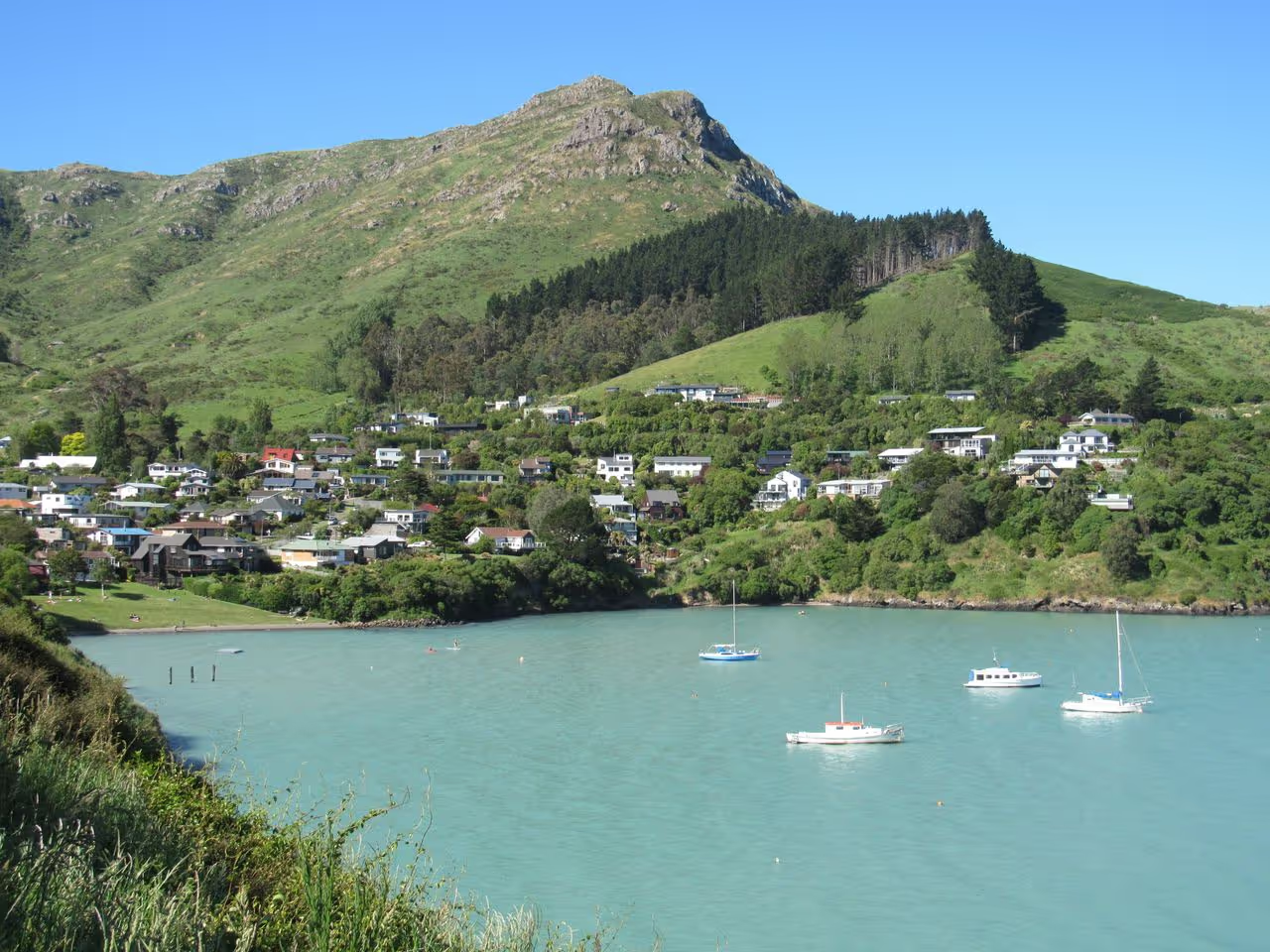
The South Island is where the landscapes become cinematic. Christchurch is the main South Island city and has strong listing numbers on Kiwi House Sitters. Beyond it: Queenstown, Fiordland, the Marlborough Sounds, the glaciers of the West Coast. The sits that come up on the South Island tend to be longer and in more remote locations, because the homeowners who choose to live there travel for extended periods when they go. Listing density is lower, but competition is also lower and the sits themselves tend to be in places you would genuinely struggle to stay affordably any other way.
We have not been to the South Island and it is firmly on the plan. Trying to cover both islands in under three weeks is technically possible but leaves neither feeling complete. New Zealand rewards patience and a slow approach, which is exactly what house sitting makes possible.
Getting Around: Transport Comes First
Outside central Auckland and Wellington, you need your own vehicle. Public transport between the main cities is workable, but once you leave the urban centres the distances and road layouts require a car. The North Island's most interesting sits, anything rural in the Waikato, Taupo, the Coromandel, most of Northland, are not practically accessible without one.
Some homeowners offer use of their car as part of the arrangement, particularly for rural sits where they know functioning without transport is not realistic. This needs to be agreed and confirmed in writing before the sit starts. Our car lending guide covers exactly how to raise that conversation and what to have documented before you arrive.
The Biosecurity Rules That Catch People Out
New Zealand has the strictest biosecurity of any country I am aware of. The fines are not discretionary and they apply regardless of intent.
| Item type | Fine (2026) |
|---|---|
| Standard undeclared food or plant material | $400 NZD on the spot |
| High-risk items (meat, seeds, fresh fruit) | $800 NZD on the spot |
The items that catch people are almost always innocuous. An apple given out on the plane. A snack picked up in the transit airport. Mud on hiking boots from a trip weeks earlier. The strategy is simple: if in doubt, declare it. Declaring is free and most declared items are simply disposed of. The fine comes from not declaring, not from having the item.
The 2026 update worth knowing: New Zealand moved fully to the Digital New Zealand Traveller Declaration (NZTD), replacing the paper card filled out on the plane. Complete it before you land. If you are already standing in the customs queue and you realise you have something undeclared in your bag, update your declaration on your phone before you reach the officer. That update counts as a valid declaration and the fine does not apply. The full restricted items list is on the New Zealand MPI biosecurity website.
If you are bringing hiking boots to use for dog walks during your sit, clean them thoroughly before you board. If you have any food at all, declare it.
The Visa Position for International Sitters
House sitting in New Zealand on a tourist visa sits in a legal grey area. New Zealand Immigration may consider providing pet care in exchange for accommodation as gain, which could technically require a work visa. Many international sitters do this on tourist visas without issue, but the risk is real. Check the current position with New Zealand Immigration before you travel. Our guides on house sitting legal issues and what to tell customs when house sitting abroad cover the full picture. We are not immigration advisors and this is not legal advice.
What to Pack That Is Specific to New Zealand
Four seasons in one day is not a figure of speech in New Zealand. We started climbing Tongariro in a t-shirt and came down in conditions that required everything we had. A waterproof layer and proper base layers are functional items here, not precautions. If you are sitting anywhere near the volcanic parks, the Waitakere Ranges, or anywhere on the South Island, proper footwear matters. Our house sitting packing guide covers the full list including the things specific to longer sits.
The Cost Reality
New Zealand looks expensive on first glance. The price tags in NZD can seem jarring, particularly arriving from Southeast Asia. The reality for US or European travellers is more nuanced. After currency conversion, most everyday costs land at similar or better value than equivalent spending at home. For Americans especially, the USD to NZD rate makes New Zealand considerably more affordable than it first appears.
What matters for house sitters specifically is that the largest single cost, accommodation, is removed from the equation entirely. Running Kiwi House Sitters alongside TrustedHouseSitters costs less per year than a single night in an Auckland hotel. Our guide on how much house sitting costs puts the full financial picture across a year of sitting against the equivalent in conventional travel.
Landing Your First New Zealand Sit
Build your profile before you start applying. A thin profile will not compete on the better listings, particularly on THS where international sitters with established review histories are applying to the same sits. Our house sitting profile guide covers what homeowners look for before they shortlist and what makes one application stand out over another.
Do a video call with every homeowner before confirming. Given that Kiwi homeowners tend to be warm and communicative, the video call is where that quality comes through and where trust gets established properly. Managing the time zone from Europe requires planning but it is worth the effort. Our house sitting video call guide covers what to ask and what to look for. If you are starting without any existing reviews, the guide on how to get house sits without prior experience walks through the practical steps for building a profile that works from zero.
Conclusion
New Zealand is one of the most rewarding house sitting destinations in the world. The listing volume is strong, the long-term sit culture suits anyone who wants to genuinely settle into a place rather than pass through it, and the country rewards the slower pace that house sitting makes possible. From the glowworm caves at Waitomo to the volcanic lake at Taupo, from the warmth of the people to the sheer variety packed into a country this small, it earns everything that is said about it.
When Caro and I get there, we are sitting. And we are staying long enough to do it properly.
Caro and I have completed 20 house sits across 12 countries, driven 19,000km in Australia and 24,000km in our 1998 VW T4, and saved over $26,500 in accommodation costs over three years of house sitting. If you have questions about house sitting in New Zealand, send us a message on Instagram, we read every DM.

Frequently Asked Questions
Which platform is best for house sitting in New Zealand?
Kiwi House Sitters for volume. It is the dominant local platform by a wide margin and has been running since 2004. TrustedHouseSitters is the best supplement for international sitters with an existing review history. Running both together covers the full market for less per year than two nights in an Auckland hotel.
Are most New Zealand sits long-term or short-term?
The majority are long-term, two weeks or more. This reflects how Kiwis travel: when they go, they go properly, because the flight times involved justify a longer trip. For sitters, this is an advantage. A long-term sit gives you time to build a genuine routine and use New Zealand as a base for real exploration rather than a rushed visit.
Do I need a car to house sit in New Zealand?
Outside central Auckland and Wellington, yes. Most regional sits and all South Island sits require your own transport. Some homeowners offer use of their car for rural sits, but this needs to be agreed in writing before you commit. Our car lending guide covers how to raise that conversation.
What is the biosecurity fine for undeclared items at New Zealand customs?
$400 NZD on the spot for standard undeclared items, $800 for high-risk items like meat and seeds. Complete the Digital New Zealand Traveller Declaration before you land. You can update it on your phone while standing in the customs queue if you realise you have something undeclared before reaching the officer.
Can I house sit in New Zealand on a tourist visa?
It is a legal grey area. New Zealand Immigration may consider pet care in exchange for accommodation as gain requiring a work visa. Many sitters do this on tourist visas without issue, but the risk is real. Check the current position with New Zealand Immigration before you travel.
Is the South Island worth targeting for house sitting?
Yes, but treat it as a dedicated trip rather than an add-on to the North Island. Listing density is lower but the sits are longer and more remote, in some of the most dramatic landscapes in the world. Christchurch is the main South Island city and has strong listing numbers. Competition is lower than Auckland or Wellington, and the sits themselves tend to be in places you would struggle to stay affordably any other way.
What is the best time of year to house sit in New Zealand?
Autumn, March to May, for lower competition and comfortable temperatures. Summer, December to February, for the highest listing volume but also the most competition. Winter, June to August, is mild in the North Island by most international standards and listing competition drops considerably, making it underrated for flexible sitters.


Responses
What are your thoughts on this post?