

Home > Blog > House Sitter Definition
Quick Facts
| Dictionary definition | A person who resides in a homeowner's residence for an agreed period |
| Real definition | Someone trusted to take full responsibility for a home and its animals while the owner is away |
| What it involves | Pet care, home security, minor issue management, maintaining routines |
| What it is not | Pet sitting (drop-in only), tenancy (no lease, no rent), a free holiday |
| The exchange | Free accommodation in return for pet care and home stewardship |
| Who does it | Remote workers, digital nomads, retirees, couples, anyone who wants to live somewhere new affordably |
| Our experience | 20 sits across 12 countries, from 3 nights to 6 months |
A house sitter is someone a homeowner trusts to take full responsibility for their home and their animals while they are away, in exchange for free accommodation. No rent, no lease, no money changing hands in either direction. After 20 sits across 12 countries, that is the definition we have lived, not just written about.
A house sitter is a person who temporarily takes full responsibility for someone's home and the care of their animals while the owner travels. In exchange for that responsibility, the sitter lives in the property rent-free. No money changes hands in either direction. The arrangement is built entirely on trust.
That is the definition that matters. The dictionary version ("a person who resides in a homeowner's residence for an agreed-upon time") is technically accurate and practically useless. It tells you nothing about what the role actually involves or why it works.
After 20 sits across 12 countries, from a five-month stint in rural France to a Greek island with melting fuses, here is what the definition looks like in practice.
My First Sit: Five Months in France
My first house sit was in Montanel, France. I was solo, barely spoke French, and entirely unprepared for what five months in a rural French village would do to how I understood home, travel, and daily life.
This was not staying at someone's place. It was becoming a temporary local. Shopping at the village market. Learning which baker made the best baguettes. Understanding the rhythm of a French household from the inside rather than as a visitor looking in. That experience reframed what house sitting actually is. It is not about the house. It is about stepping into someone else's life and maintaining it exactly as they left it.

The Guardian Mindset
The most important thing to understand about house sitting is that you are not a guest. You are the homeowner's proxy.
When you are a guest, someone else handles the problems. The toilet blocks? You tell the host. The dog seems off? Not your concern.
When you are a house sitter, the problems are yours to solve. You assess, act, and communicate, in that order. You do not call the homeowner at midnight for every small thing, but you do contact them immediately when something truly needs their input.
This is the line that separates house sitting from every other form of temporary accommodation. The homeowner has trusted you with what matters most to them and travelled knowing you are there. That is a different kind of responsibility to being a paying guest.
When Caro Did Her First Sit
By the time Caro joined me for the Bochum sit in June 2023, I had already done the Montanel five months and a Sydney sit 500 metres from the Harbour Bridge looking after a toy poodle named Coco. I understood how it worked.
For Caro it was a completely new concept. Someone was simply giving us their home and their cats for a few weeks? For free? She was uncertain at first. The arrangement seemed too generous. What if something went wrong?
We met the homeowner, who showed us around, introduced us to her two cats, and left for her trip. That was it. We were in charge.
The homeowner had left some money in a drawer during the handover and pointed it out to us. "Just in case something comes up," she said. That gesture stayed with me. She was not just leaving money. She was communicating that she trusted us completely. She knew we would only touch it if something needed fixing, not because it was there. That is the level of trust house sitting runs on.
Within a couple of days Caro was hooked. She now scrolls TrustedHouseSitters regularly, looking for our next destinations. That first Bochum sit changed how both of us travel.
The Moment Responsibility Becomes Real
For me, arriving at a new sit is fast. I get comfortable in unfamiliar spaces quickly. Within an hour I have found the wifi password, worked out the coffee machine, and settled in. Caro takes a little longer but finds her rhythm through the animals. She will spend the first evening getting to know the pets and their routines.
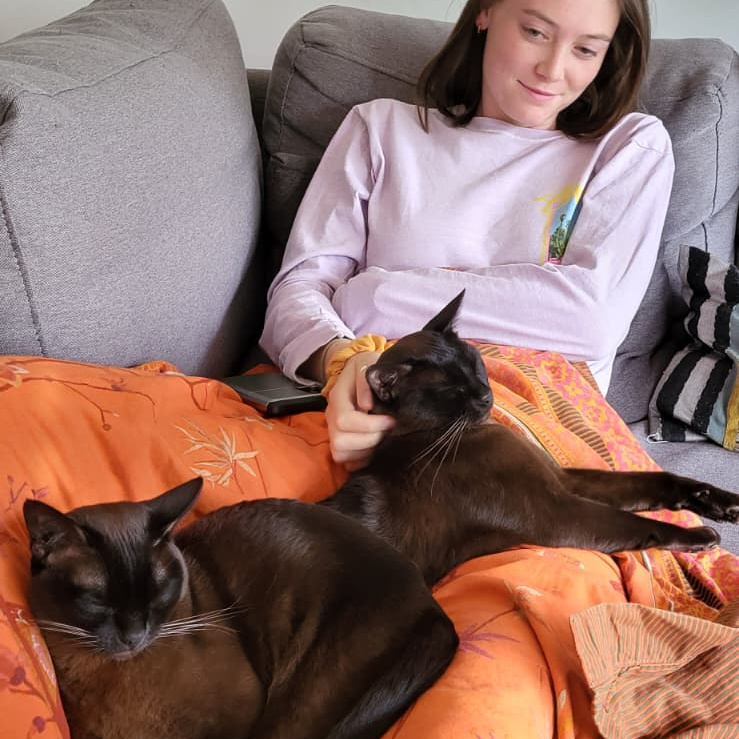
For new sitters there is usually a specific moment when the weight of the responsibility becomes real. Ours came in Bochum when one of the cats developed a swollen paw while the homeowner was away. We did not know whether it was a bite, an injury, or something more serious. We used the TrustedHouseSitters 24/7 vet line, sent photographs, and had a professional assessment within minutes. The vet confirmed it looked like a bug bite and told us what to monitor. We then updated the homeowner.
That moment shifted something. We were not staying in someone's home. We were responsible for the animals in it. Those are different things.
What the Role Actually Asks of You
The daily reality of house sitting is more specific than most guides describe.
Pet care is the core responsibility and goes beyond feeding and water. You learn each animal's individual quirks and maintain their existing routine rather than imposing your own. At our Linz, Austria sit in a beautiful mansion twenty minutes straight uphill from the town centre, we looked after Boris the cat and Chilli the dog. Boris had a habit of disappearing on multiday outdoor walks, which initially alarmed us before we learned it was entirely normal for him. Chilli needed substantial daily exercise or she would keep the whole house awake at night. Learning those things in the first twenty-four hours is the job.
Home security is the second pillar. Being present is itself the most effective security measure: lights on and off at natural times, blinds open during the day, post collected so nothing piles up at the door, the house looking lived-in from the outside. This is what protects an empty property far more than any alarm system.
Minor issues require judgment. At our Kefalonia sit, we turned on the water heating and the fuses did not just trip. They melted. We turned off all the fuses in the house immediately, documented what had happened, and contacted the homeowners. They organised an electrician. The situation was resolved without drama because we communicated quickly and clearly rather than attempting to fix something beyond our competence or, worse, ignoring it.
Emergency protocol for any house sitting incident:
Photograph or document the issue immediately. Message the homeowner with a clear description and the photo. If the issue involves an animal, contact the platform's vet line or a local vet simultaneously. If the issue involves the property and requires urgent repair, ask the homeowner to authorise a tradesperson. Follow up with a written summary once the situation is resolved so there is a clear record for both parties. This protocol applies whether the incident is a melted fuse, a sick animal, a leak, or a broken appliance: document first, act second, communicate throughout.
Maintaining household routines covers everything else: plants watered at the right intervals, bins out on the right days, the house returned to the condition it was in when we arrived. The full daily routine, the checklist, and how many animals is the right number to take on are covered in our guide to what house sitters actually do all day.
What House Sitting Is Not
| House sitter | Pet sitter (drop-in) | Tenant | |
|---|---|---|---|
| Residency | Lives in the home full-time | Visits 1 to 2 times daily | Permanent resident |
| Payment | Lifestyle exchange (€0) | Paid per visit | Pays rent and signs a lease |
| Primary goal | Home security and pet care | Basic pet feeding | Long-term housing |
| Legal status | Bilateral service agreement | Service provider contract | Residential lease |
| Presence | 24/7 continuous | 30 to 60 minutes per visit | Ongoing |
| Accountability | Full household responsibility | Animal welfare only | Property rights and obligations |
It is worth being direct about the things house sitting is not, because the misunderstandings are common.
It is not a free holiday. You have daily responsibilities. Animals need care at set times. The house needs attention. Leaving for three days to explore a nearby city without arranging cover for the animals is not house sitting. It is abandonment of the role.
It is not a tenancy. You have no tenant rights, no lease, no claim to the property. When the homeowner returns, you leave. This is a temporary service arrangement formalised by a house sitting agreement, not a rental contract.
It is not the same as pet sitting. A pet sitter visits for thirty minutes to feed and check on animals. A house sitter lives in the property continuously, providing constant presence for both the animals and the home. The level of responsibility and the relationship with the homeowner are entirely different.
It is not usually paid. The overwhelming majority of sits on platforms like TrustedHouseSitters and Nomador operate on a pure exchange: free accommodation for pet care and home security. Some homeowners offer a stipend for exceptional demands, but this is the exception rather than the rule.
Whether a sit is paid says very little about the sitter's ability. That is the argument we make at length in our guide to being a professional house sitter: an experienced exchange sitter is often the stronger choice, and payment changes the transaction rather than the competence.
The Trust That Makes It Work
House sitting functions because both parties are betting on each other's integrity.
The homeowner bets that you will care for their home and animals as you said you would, that you will not throw parties, leave the pets unattended, or disappear for a week. You bet that the homeowner has been honest about the workload, the condition of the house, and what the animals actually need.
This mutual risk is why the review systems on paid platforms matter so much. A blind review system, where neither party can see what the other has written until both have submitted, creates accountability in both directions. Our review history across 20 TrustedHouseSitters sits represents the accumulated trust of fifteen homeowners who chose to vouch for us in writing. That is what makes the next application work.

Our Athens Sit: What the Day Actually Looks Like
The Athens sit captures what house sitting looks like in practice. We had a French Bulldog with a talent for timing his flatulence directly at whoever was closest, and two cats. The sit was planned for five days and extended to seven because our campervan schedule was flexible.
Caro woke first each morning to handle the animals: food, water, the dog's morning walk. I followed around eight. We had coffee and breakfast together, then either explored neighbourhoods we would never have found as tourists or worked from the kitchen table. The local markets, the coffee shops that actual Athenians use rather than the ones near the tourist sites, the specific bakeries that the homeowner had mentioned in the welcome guide. That texture of a place is only accessible when you are living in it rather than staying near it.
Evenings: I worked on the website while Caro worked on her teaching materials. The animals had their evening routine. We cooked whatever we had picked up at the market. Then life, in someone else's home, in a city we had come to know in a specific and unhurried way.
That is house sitting. Not glamorous. Not a performance. Just a different way of being somewhere.
Conclusion
A house sitter is someone a homeowner trusts enough to hand over the keys to their home and the care of their animals, often having met them only on a video call. That is the real definition. The logistics (platforms, membership fees, review systems, welcome guides) are the infrastructure that makes that trust possible at scale. That is the person. The activity itself, what it costs, what it saves and how people start, is covered in our guide to house sitting.
We went from a first sit in Bochum to Sydney, Linz, Cortona, Kefalonia, Athens, and are now several months into a six-month sit in Portugal. The animals and locations keep changing. The core of the arrangement stays the same: someone trusted us with what mattered most to them.
If you are thinking about starting, our step-by-step getting started guide covers everything from building your first profile to landing that first review. Use our 25% discount on TrustedHouseSitters to get started.
Caro and I have completed 20 house sits across 12 countries, driven 19,000km in Australia and 24,000km in our 1998 VW T4, and saved over $26,500 in accommodation costs over three years of house sitting.
DM us @housesittersguide on Instagram if you have questions about what house sitting actually involves. We answer everyone.

Frequently Asked Questions
Is a house sitter considered a tenant?
No. A house sitter has no tenancy rights because there is no lease and no rent is exchanged. It is a temporary service arrangement, typically formalised with a house sitting agreement that outlines responsibilities rather than tenancy terms. When the homeowner returns, the sitter leaves. We have done 20 sits across 12 countries and have never signed a lease or paid rent for a single one.
What is the difference between a house sitter and a pet sitter?
A pet sitter visits the property for short periods to feed and check on animals. A house sitter lives in the property continuously. The difference matters practically: when the cat's paw swelled overnight in Bochum, we were there to notice it and act within the hour. A drop-in pet sitter arriving twelve hours later would have missed the window for early assessment. The level of presence, responsibility, and relationship with the homeowner is entirely different.
Does a house sitter pay for utilities?
For short to medium sits, no. Utilities are typically covered by the homeowner as part of the exchange. This should be confirmed during the video call before the sit begins, particularly for longer sits where the cost of heating, electricity, and water becomes more significant. We have not paid utilities on any of our twenty sits, but for sits of several months it is worth clarifying explicitly.
What legal documents are needed for house sitting?
A house sitting agreement covering dates, responsibilities, pet care expectations, emergency contacts, and any house rules is strongly recommended. A vet authorisation form allowing the sitter to consent to emergency treatment is also worth having for any sit involving animals. These are not complicated documents but they prevent ambiguity in the situations where clarity matters most.
Can house sitting become a full-time lifestyle?
Yes, and we are living proof of it. By chaining sits together and filling gaps with van life, we have eliminated accommodation as a cost entirely. We have saved over €24,000 across our sits. The model requires a location-independent income source, but for remote workers, freelancers, and online business owners, the combination of house sitting and a portable income is a sustainable long-term lifestyle rather than just a travel hack.
What happens if something goes seriously wrong during a sit?
You contact the homeowner immediately, explain clearly what has happened, and work together on a solution. When the fuses melted in Kefalonia, we turned everything off, documented the situation, and called the homeowners. They organised an electrician. The key is communication speed and clarity, not attempting to hide the problem or fix something outside your competence. Homeowners who use house sitting platforms understand that things occasionally go wrong. What they cannot tolerate is finding out after the fact.


Responses
What are your thoughts on this post?