

Home > Blog > Hidden Cameras and Your Rights as a House Sitter
Quick Facts
| THS policy | Indoor cameras must be switched off for the duration of a sit — not just disclosed |
| Nomador policy | Owners are required to inform sitters of all recording devices — cameras in private areas are prohibited |
| Bathrooms and bedrooms | Illegal to film guests in these areas in every country covered in this article |
| Living areas | Varies by country — but on a house sit, all indoor cameras must be off per platform rules |
| If you find an undisclosed indoor camera | Contact the homeowner, ask them to switch it off, document in writing, escalate to platform if needed |
| Concealed camera in private area | Contact the platform and the police |
| This article is not legal advice | Laws vary by jurisdiction — consult a lawyer for specific situations |
Under TrustedHouseSitters clause 5.2.15, indoor cameras must be switched off for the whole sit. Disclosure alone is not enough. Outdoor cameras are allowed but must not record interiors. If a camera is concealed in a bedroom or bathroom, photograph it and contact the platform.
This is not legal advice. We are not lawyers. The information in this article is based on our own research into privacy and recording laws as they generally apply to house sitting situations. These laws vary significantly by country and even by region within a country. If you believe your privacy rights have been violated, consult a lawyer in your specific jurisdiction.
House sitting means living in someone else's home. That is the deal, and it is a good one. But it also means spending weeks in a space designed by someone you have met once, where you do not know exactly what is watching.
If you are interested in getting into house sitting, our book Travel More for Less puts the whole process in one place: clear, step by step guidance from your first questions to your first confirmed sit, and the reviews that open the door to the next one.
This article covers the platform policies, the legal picture across nine countries, what to do when you find a camera, and why your presence in a home is better protection than any camera anyway.
TrustedHouseSitters Policy: Cameras Must Be Off
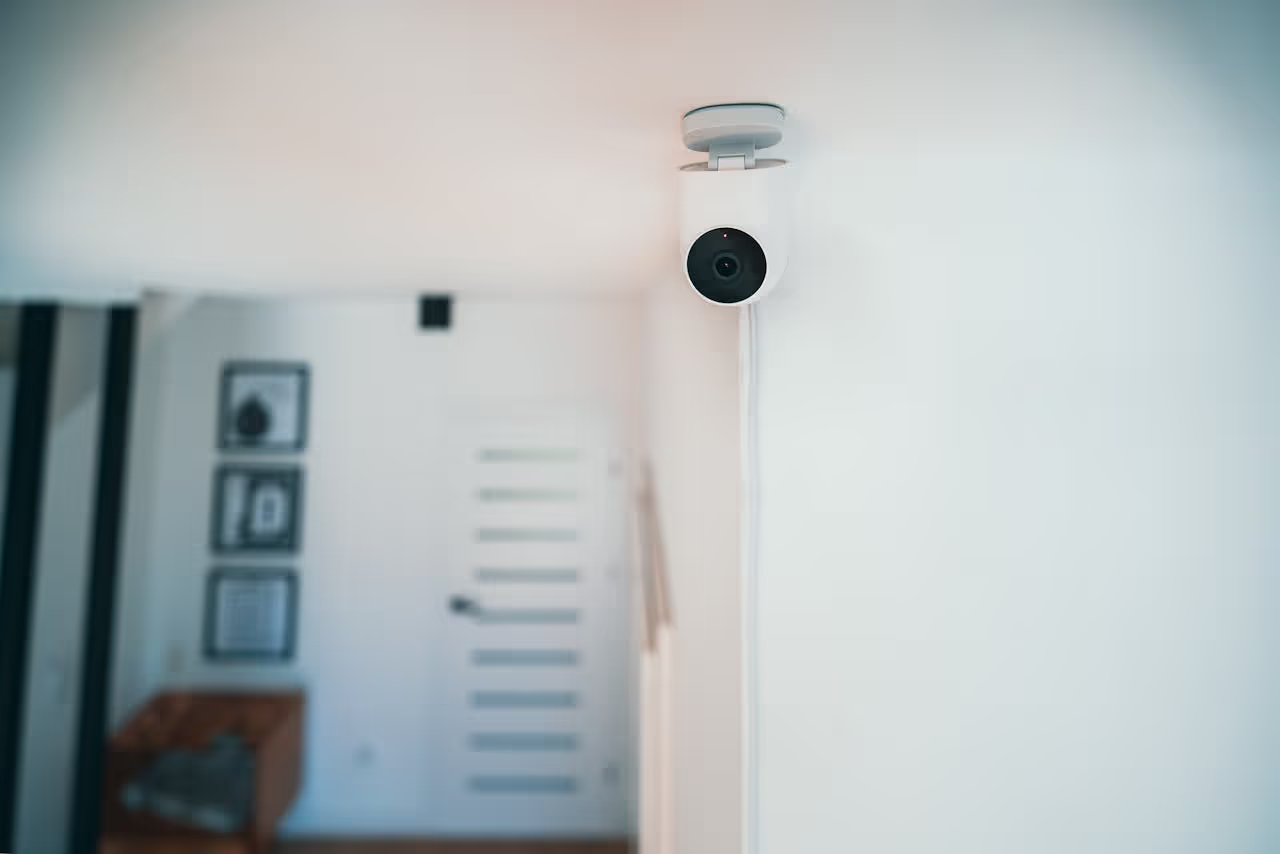
The THS policy on this is not ambiguous. Under the Terms and Conditions (clause 5.2.15), indoor cameras must be disabled for the duration of the sit. Not disclosed, not pointed at the ceiling. Disabled.
This is a stronger rule than many sitters realise. Disclosure alone is not enough. A homeowner who tells you there is a camera in the living room but leaves it running has violated the platform's terms, regardless of how openly they mentioned it. If you arrive at a sit and find an indoor camera that is on, you are within your rights to ask for it to be switched off immediately.
The policy is clear on exterior cameras too: these are permitted, but they cannot be positioned to record interior spaces, and they should not be used to monitor or micromanage the sitter's movements around the property.
The enforcement gap is real. THS cannot send someone to check. What the policy gives you is a documented basis for escalation: if a homeowner refuses to disable an indoor camera, that refusal is a breach of the platform's terms, and Membership Services can take action up to and including removing the homeowner's account.
Nomador Policy: Disclosure and Private Area Protection
Nomador's terms (Article 4.2.11 and 4.2.12) require homeowners to inform sitters of the existence and purpose of any image and video capture device inside or outside the accommodation. Cameras in private areas (bathrooms, toilets, and bedrooms) are strictly prohibited regardless of whether they are disclosed.
Our Experience in Kefalonia
On our Kefalonia sit, we arrived to find two outdoor cameras: one pointing toward the road and one positioned over the balcony terrace. Both were clearly visible, impossible to miss. Neither had been mentioned by the homeowner before we arrived.
They were outdoor cameras, so technically within what most platforms permit. But knowing a camera was pointing over the terrace changed how we used that space. We were less inclined to spend time outside in the evenings, less relaxed in what should have been a private outdoor area. The cameras had not been disclosed, and even though they pointed outward rather than inward, the effect was exactly what you would expect: we did not feel like the home was entirely ours to inhabit.
That experience captures something the community forum expresses repeatedly: the rules may be on your side, but the psychological reality of being watched in a space you are supposed to be at home in is its own issue, separate from legality.
Your Presence Is Better Security Than Any Camera
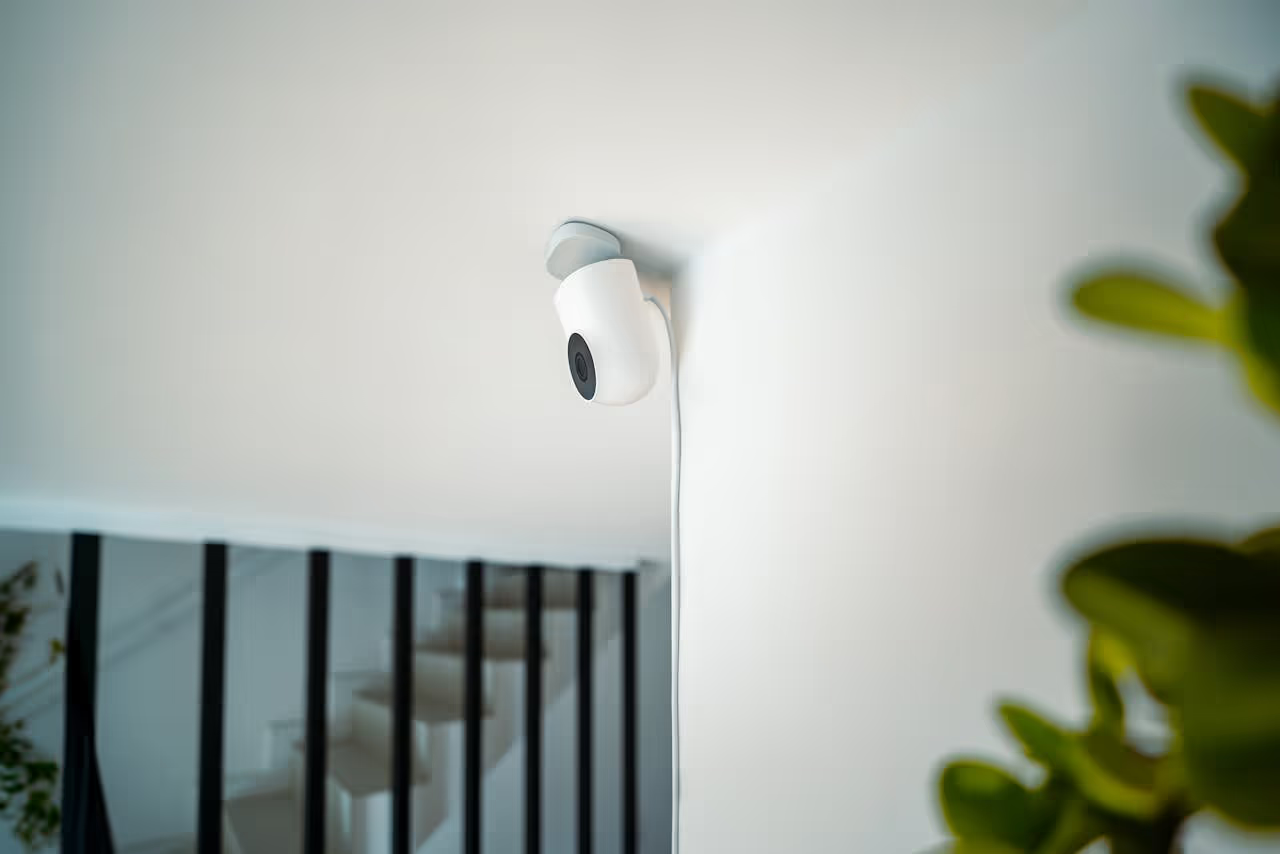
Here is a point worth making clearly: you, as a sitter, are better home security than any camera.
A house that looks lived in is significantly less attractive to burglars than an empty one. Lights going on and off, a car in the driveway, noise from inside, someone collecting the post: these are the signals that deter opportunistic theft. A camera records what happens. A sitter prevents it.
During a typical sit, you spend a substantial portion of each day in the home. You are there at night. You know the neighbours. You notice unusual activity. In most cases, the homeowner returns to find their home exactly as they left it precisely because a person was living there, not because a device was recording it.
This does not mean cameras are pointless for general security. Outdoor cameras have genuine deterrent value. But it does mean that a homeowner who feels they need to monitor the sitter via indoor camera has misunderstood the arrangement. The sitter is not the risk. The sitter is the protection.
How to Handle It: Step by Step
Step one: Identify. When you arrive at a sit, do a walkthrough. Look for cameras in living areas, hallways, kitchens, bedrooms, and bathrooms. Smart speakers with cameras (some Echo and Google Nest devices have them), smoke detectors with unusual lenses, and small wireless devices plugged into wall sockets are among the less obvious options.
Step two: Determine whether they are on. A camera that is clearly powered down or unplugged is a different situation from one with an active indicator light. If you are not sure, ask.
Step three: Contact the homeowner. If you find an indoor camera that appears to be active, contact the homeowner calmly and directly. A message through the platform or WhatsApp works. The key is to have it in writing. "I have noticed there is a camera in the [room]. Could you confirm it is switched off for the duration of the sit? I want to make sure we are comfortable for the whole stay." Most homeowners in this situation apologise and fix it immediately.
Step four: Document. Whether they respond well or not, keep the exchange in your messages. This protects you if the situation escalates, and it supports your review if you decide to mention the camera experience at the end of the sit.
Step five: Escalate if needed. If a homeowner refuses to disable an indoor camera, contact Membership Services. The refusal is a breach of platform terms. You also have the right to end the sit early. Most platforms consider undisclosed or non-disabled indoor cameras sufficient grounds for early cancellation without penalty.
Step six: Police involvement. If you find a camera that is hidden, concealed in an object, or positioned in a bathroom or bedroom, the situation is different. Contact the platform immediately and document everything. Depending on your country, recording in a private area without consent is a criminal offence, not just a platform violation, and you may have grounds to contact the police.
How to Spot Hidden Cameras
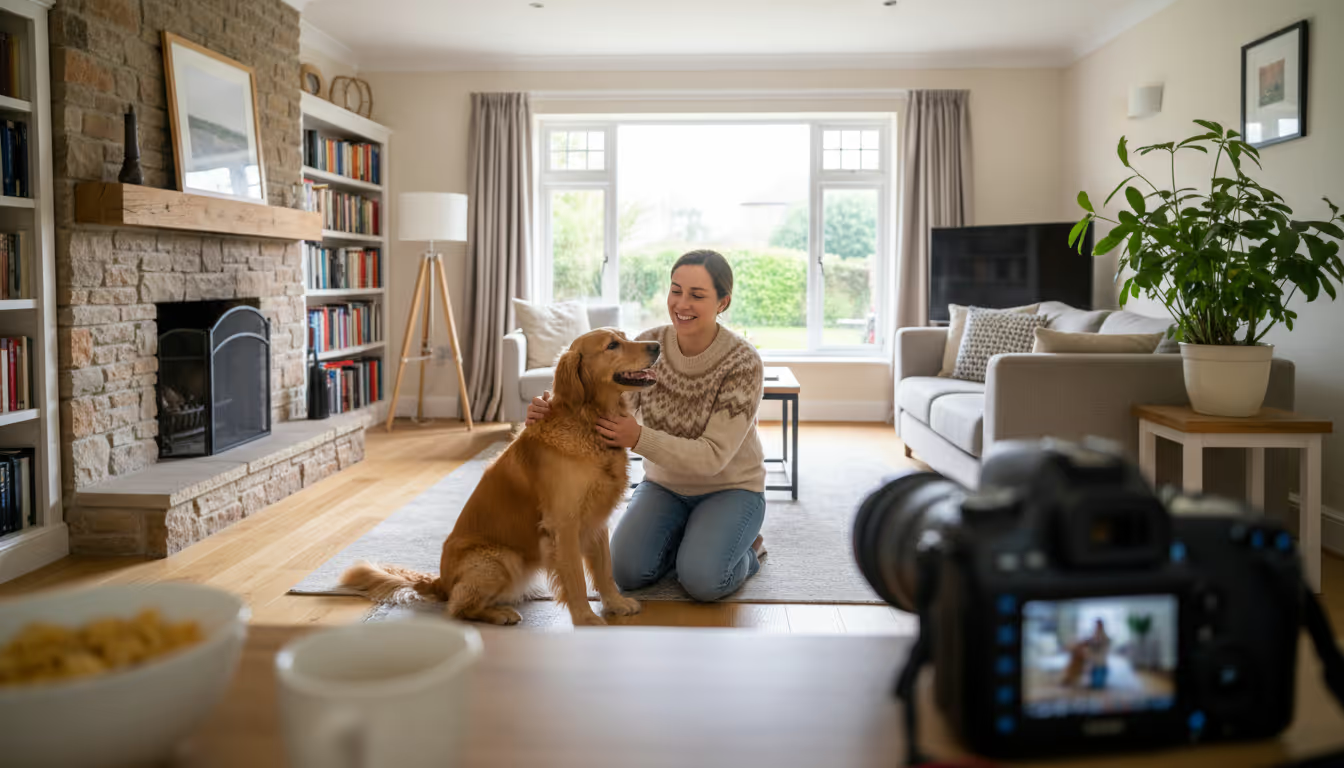
You do not need specialist equipment to do a basic check. These are the most common locations and disguises:
Smoke detectors positioned in bedrooms or bathrooms. Clocks and alarm clocks facing the bed. Charger cubes plugged into wall sockets near sleeping areas. Books or decorative objects on shelves facing the room. Air purifiers or diffusers with unusual lenses. Smart doorbells angled to capture interior hallway areas.
The most reliable non-equipment method is to turn off all lights in a room and slowly scan with your phone camera. Many cameras use infrared for night vision and your phone can pick up that light even in the dark. If you want more certainty, a basic RF signal detector (available for under €20) will pick up most wireless camera signals.
If you find something you suspect is a camera, do not touch it. Photograph it in place, note the time and location, and contact the platform before doing anything else.
International Law: Your Rights by Country
This is a general overview based on the laws as understood as of April 2026. It is not legal advice. If you face a serious situation involving suspected illegal surveillance, consult a lawyer in the relevant jurisdiction.
The universal principle across all countries below: filming guests in bedrooms or bathrooms without their knowledge or consent is illegal. No exceptions.
| Country | Indoor cameras with guests | Bedrooms and bathrooms | GDPR / Data protection | Notes |
|---|---|---|---|---|
| United Kingdom | Permitted in living areas under household exemption — but THS policy requires them off | Illegal | UK GDPR + Data Protection Act 2018 | Covert surveillance of guests generally not allowed; ICO guidance applies if cameras extend beyond property boundary |
| United States | Varies by state — living areas often permitted; consent required in many states for hidden cameras | Illegal in all states | No federal equivalent to GDPR — state laws vary significantly | States including California, Arkansas, Hawaii require consent for any private space recording |
| Canada | Criminal Code Section 162 prohibits voyeurism in private spaces; disclosure generally expected | Illegal | PIPEDA applies to personal data | Guest bedroom and bathroom surveillance criminal |
| France | Requires notification of all recording devices; GDPR applies | Illegal | GDPR + French data protection law (CNIL) | Hidden indoor surveillance of guests can result in criminal liability |
| Germany | Strict — German courts and regulators historically aggressive on privacy; GDPR + Bundesdatenschutzgesetz | Illegal | GDPR fully applies | Strongest enforcement culture in EU; hidden cameras in any private dwelling area very high legal risk |
| Spain | Must register with AEPD; GDPR applies; 2025 courts reinforced written consent requirements | Illegal | GDPR + Ley Orgánica 3/2018 | Fines for non-compliant surveillance even for private individuals |
| Switzerland | Not EU GDPR but Swiss nDSG (Federal Act on Data Protection) — similar principles | Illegal | Swiss nDSG — full revision in force from 2023 | Recording individuals without consent in private spaces subject to criminal sanction |
| Australia | State-level surveillance laws vary; generally require disclosure for indoors; Privacy Act 1988 | Illegal | Privacy Act 1988 (organisations); state surveillance acts for individuals | Queensland and NSW have specific surveillance device acts |
| New Zealand | Surveillance Devices Act — no recording in private places without consent | Illegal | Privacy Act 2020 | Recording guests in bedrooms or bathrooms is a criminal offence |
For deeper reading on the law in your specific country:
United States: NerdWallet security camera laws guide and SafeWise state-by-state overview
Australia: Office of the Australian Information Commissioner at oaic.gov.au
New Zealand: Office of the Privacy Commissioner at privacy.org.nz
EU countries (France, Germany, Spain): European Data Protection Board at edpb.europa.eu
Switzerland: Federal Data Protection and Information Commissioner at edoeb.admin.ch
Ask Before You Arrive
You do not need to ask about cameras on every single pre-sit video call as a matter of routine. But for longer sits, or if you have particular concerns, it is a reasonable and entirely appropriate question.
The most natural framing: "Do you have any cameras inside or outside the home? We just want to know what to expect when we arrive." Most homeowners will answer without issue. A homeowner who reacts badly to that question is giving you useful information before you have committed to the sit.
If a homeowner confirms indoor cameras, follow up: "Will those be switched off while we are there, as per THS policy?" The answer tells you a great deal about how the sit will go.
Our guide to what to ask a homeowner before a house sit covers the full pre-sit conversation in detail.
The Platform Responsibility Gap
One thing the community consistently raises is that THS has a clear policy but limited ability to enforce it. Homeowners who do not read the terms they agreed to will not know the rule. Homeowners who know the rule can still choose to ignore it.
The fix sitters ask for most often, and the one we think makes sense, is a camera acknowledgement checkbox in the listing setup process. Before a homeowner can publish a listing, they should be required to confirm they understand the platform's indoor camera policy and agree to comply with it. This does not guarantee compliance, but it removes the "I didn't know" defence entirely, and it changes the evidence base if a dispute arises. A homeowner who checked a box agreeing to disable all indoor cameras cannot later claim ignorance.
Until platforms implement something like this, the practical protection comes from asking the question during the video call, documenting the answer in writing, and knowing exactly what your options are if something is not right when you arrive.
Conclusion
The rules are clear. Indoor cameras must be off during a sit on every major house sitting platform. Filming guests in bedrooms or bathrooms is illegal in every country covered in this article. Your presence in the home is better security than any camera, and a homeowner who understands that should not need to watch you at all.
If you find an undisclosed indoor camera: ask for it to be switched off, document the exchange, escalate to the platform if needed. If it is concealed in a private area: contact the platform, photograph it, and consider whether the police need to be involved.
For most sits, this will never be relevant. The overwhelming majority of homeowners are decent people who simply have not thought carefully about their cameras in the context of having a guest. A brief conversation handles it. What matters is knowing what your rights are before you need them.
Join TrustedHouseSitters with 25% off using our discount link and start sitting with confidence.
DM us @housesittersguide on Instagram if you have had a camera situation and want advice. We answer everyone.
Frequently Asked Questions
Can a homeowner have cameras inside during a house sit?
No, not on TrustedHouseSitters. The platform's Terms and Conditions (clause 5.2.15) require all indoor cameras to be disabled for the duration of the sit. Disclosure alone is not enough. They must be switched off. Nomador's terms similarly require owners to disclose all recording devices and prohibit cameras in private areas.
What should I do if I find a hidden camera during a house sit?
Do not touch it. Photograph it in place, note the time and location, and contact the platform immediately. If the camera is in a bedroom or bathroom, you may also have grounds to contact the police depending on your country. Our step-by-step guide above covers the full process.
Is it legal for a homeowner to have cameras inside their own home?
In living areas, generally yes, but with significant restrictions when guests are present. In every country covered in this article, filming guests in bedrooms or bathrooms without their knowledge or consent is illegal. Under GDPR in EU countries, even cameras in living areas require proper legal basis when they capture identifiable individuals. Check the country table above for the specific rules in your location.
Are outdoor cameras allowed during a house sit?
THS policy permits exterior cameras, but they cannot be positioned to record interior spaces or used to monitor the sitter. From a personal comfort perspective, even outdoor cameras pointed at terraces or private garden areas can make a sit feel uncomfortable, as was our experience in Kefalonia. If outdoor cameras are making you feel watched, it is reasonable to raise it with the homeowner.


Responses
What are your thoughts on this post?