

Home > Blog > Digital Nomad Visas and House Sitting
Quick Facts
| Countries with digital nomad visas (2026) | 50+ worldwide, new programmes added regularly |
| Top-ranked 2026 | Spain, Malta, Portugal, Germany, Hungary |
| EU citizens in Europe | Free movement — no visa required, no day limits |
| Non-EU Schengen limit | 90 days in any 180-day period across the entire zone |
| US, UK, Australia, Canada, NZ | No dedicated digital nomad visas — tourist entry covers most sits |
| Our approach | Travel first, sit as the cherry on top — never fly specifically for a sit |
| Best safety net | Drive to sits where possible — a cancellation does not strand you |
| Disclaimer | Visa rules change frequently — always verify through official government sources |
For EU citizens the visa question barely applies. Everyone else faces Schengen's 90 days in any 180, which a Portuguese D8 or Spanish visa solves. The real strategy is travel-first: drive where you can, so a cancelled sit costs a camping fee, not a flight.
This is not immigration or legal advice. We are not immigration lawyers or licensed advisors. The information in this article is based on our own research and experience, and immigration and visa rules change frequently and vary by nationality, country, and individual circumstances. Always confirm current requirements directly with the relevant embassy, consulate, or a qualified immigration professional before you travel.
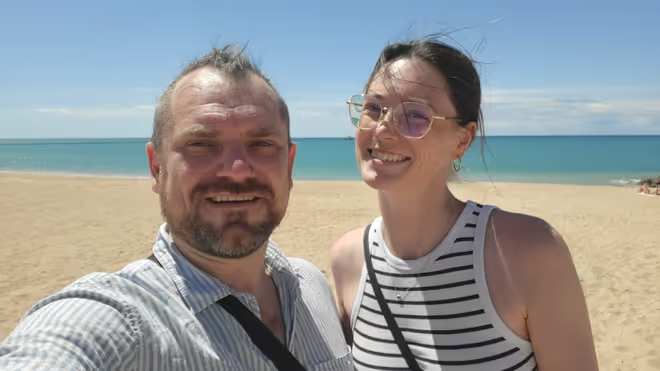
Caro and I have completed 20 sits across 12 countries. In all of that time, visa management has almost never been a meaningful obstacle. Because I hold Polish citizenship, which means free movement across the European Union, no day limits, no 90-day clock, no Schengen calculations. Caro holds German citizenship. For most of our sits in Europe, we are simply two Europeans on holiday who happen to have a house and some pets to look after every few weeks.
This matters because the digital nomad visa question looks very different depending on your nationality. For EU citizens sitting in Europe, it barely applies. For Australian, American, British, Canadian, and New Zealand sitters planning extended European stays, the Schengen rules and digital nomad visa landscape become important. This article covers both realities, the countries where digital nomad visas and house sitting combine well, and the travel philosophy that has kept our planning simple across three years.
If you are interested in getting into house sitting, our book Travel More for Less puts the whole process in one place: clear, step by step guidance from your first questions to your first confirmed sit, and the reviews that open the door to the next one.
Visa rules change regularly. Everything in this article reflects best available information as of May 2026. Always verify through official government sources before travelling.

EU Citizens: The Simplest Case
If you hold citizenship in an EU or EEA member state, free movement within Europe means house sitting across France, Germany, Spain, Portugal, Italy, Greece, and the rest of the EU requires no visa, no permit, and no day counting.
I hold Polish citizenship alongside Australian citizenship. In Europe, I travel on my Polish passport. Caro holds German citizenship. Between the two of us, our European travel is effectively open. We drive to sits, stay as long as the sit runs, and move on. The campervan is our base between sits and there is no customs issue, no visa concern, and no calculation of how many Schengen days remain. We are two European citizens on an extended road trip who occasionally look after other people's pets. Nothing more than that.
If you are a European citizen and house sitting primarily in Europe, the visa section of this article largely does not apply to you. What applies is the travel philosophy. And that is the same regardless of nationality.
The Travel-First Philosophy
The most sustainable approach to combining house sitting with international travel is to plan the travel first and treat house sitting as an upgrade on top, not the reason you are somewhere.
We never flew specifically for a house sit. We never drove to a country specifically because a sit was there. We drive through Europe in the campervan, following a route that makes sense for us, and when sits appear in the locations we are already heading, we apply. If a sit materialises, we have free accommodation in a great location. If it does not, the trip continues as planned. The campervan is always the fallback.
This is not just a preference. It is risk management. House sits fall through. Homeowners cancel. Listings disappear after you have committed to being somewhere. A trip built around a specific sit that then collapses is a trip in chaos. A trip built around where you want to be, with sits as an additional layer, is resilient. Our sit cancellation recovery guide covers the contingency planning side of this.
Driving adds a second layer of protection that flying cannot match. If we book a flight to a country specifically for a sit and the sit cancels, we are stranded somewhere with a non-refundable ticket and no base. If we drive to a country for a sit and it cancels, we are in the campervan in a country we wanted to visit anyway. The worst outcome is a camping fee. For sitters who cannot drive everywhere. International sits in Australia, the US, New Zealand. The principle still applies: have the travel booked and paid for before you commit to the sit, not after. That way a cancellation is a minor inconvenience rather than a financial hit.
This approach also makes customs crossings uncomplicated. When crossing borders, we are tourists. We are traveling, seeing countries, living in a campervan. Every now and then we have a house to look after and some pets. We have never been questioned about it, because we are not misrepresenting anything. We are exactly what we look like: two people on a long road trip through Europe. Our guide to what to tell customs when house sitting abroad covers the customs crossing question in detail.
The Vietnam Lesson: Sort Your Visa Before You Leave
The closest I have ever come to a visa crisis had nothing to do with house sitting. Before a trip to Vietnam, I applied for an expedited e-visa the day before the flight, not in advance. I was at the airport waiting at the gate, watching the boarding window close, refreshing my email. The visa came through with minutes to spare before they stopped letting people on.
It was fine. It also did not need to happen. Visa processing times vary by country, by application volume, and by time of year. An expedited visa that takes four hours in quiet times can take longer when systems are busy. The lesson is simple: sort your visa before you reach the airport. For any country that requires advance visa processing, build in buffer time measured in days rather than hours.
For house sitters planning long-term stays in countries that require digital nomad visas, this principle scales up considerably. Digital nomad visa applications in Portugal, Spain, and Germany typically take weeks to months to process. Attempting to arrange one after you have arrived and started a sit is both logistically difficult and legally dubious. Apply before you travel.
The Schengen 90-Day Rule: Critical for Non-EU Sitters
For non-EU nationals. Australians, Americans, Britons, Canadians, New Zealanders. The Schengen Zone's 90/180 rule is the primary constraint on extended European house sitting.
The rule: a maximum of 90 days in any rolling 180-day period across the entire Schengen Zone. Not 90 days per country. 90 days across all Schengen countries combined. A sit in France, a sit in Germany, and a sit in Spain all count toward the same 90-day allowance. One day in any Schengen country is one day against the total.
For a sitter doing multiple European sits across a year, this creates a hard ceiling on continuous European presence without a visa. A single three-month sit in Portugal fills the entire 90-day allowance. After that, the sitter must leave the Schengen Zone for 90 days before returning. This is where digital nomad visas become directly relevant. They provide legal residence, removing the tourist clock.
Countries outside the Schengen Zone that do not count toward the 90-day limit include: Georgia, the UK, Ireland, Albania, Kosovo, North Macedonia, Serbia, and Bosnia. Time spent in any of these does not affect the Schengen calculation and can serve as a natural reset between European periods.
Digital Nomad Visas: The Best Options for House Sitters in 2026
Over 50 countries now offer dedicated digital nomad or remote work visas. The following represent the strongest options for house sitters, combining accessible programmes with meaningful THS listing volumes.
| Country | Visa | Duration | Min monthly income | House sits | Why it works |
|---|---|---|---|---|---|
| Portugal | D8 Digital Nomad | 1 year, renewable to 5 | ~€3,480/month | Strong | We are on a 6-month Portugal sit now. Rich listing base, affordable living |
| Spain | Digital Nomad Visa | 1 year, renewable to 5 | ~€2,849/month | 10-50 listings at any time | Top-ranked in 2026, Mediterranean lifestyle, growing listing count |
| Greece | Digital Nomad Visa | 1 year, renewable | ~€3,500/month | Moderate | Kefalonia, Athens. Easy lifestyle, excellent climate |
| Germany | Freelancer Visa | Up to 3 years | Varies by case | High | Bochum was our first sit. Berlin and Munich listings are strong |
| Croatia | Digital Nomad Visa | Up to 12 months | ~€2,539/month | Moderate | No tax on foreign income for eligible earners |
| Malta | Nomad Residence Permit | 1 year, renewable | ~€2,700/month | Low | Mediterranean base, English-speaking, strong infrastructure |
| Hungary | White Card | 1 year, renewable | ~€3,000/month | Low | Affordable central European base, English-speaking in Budapest |
| Georgia | Visa-free | Up to 1 year | No formal minimum | Very few sits | One of the most accessible programmes globally and outside Schengen. Very few THS listings currently available |
| Estonia | Digital Nomad Visa | 1 year | ~€3,504/month | Low | First dedicated digital nomad visa globally, launched 2020 |
| Colombia | Digital Nomad Visa | 2 years | ~$900–1,200/month | Low | Lowest income threshold of any major programme |
| Brazil | Digital Nomad Visa | 1 year, renewable | ~$1,500/month | Low | Affordable entry point outside Europe |
All income thresholds are approximate and subject to change. Verify with the official consulate or embassy before applying.
Visa Requirements for Major House Sitting Countries
The countries with the highest THS listing volumes. US, UK, Australia. Do not offer digital nomad visas. Most sits in these countries fall comfortably within standard tourist visa allowances.
| Country | Digital nomad visa? | Tourist entry (most nationalities) | House sitter notes |
|---|---|---|---|
| United States | No | ESTA: 90 days for Visa Waiver nationalities | Most sits completable within the 90-day window. No right to work on ESTA |
| United Kingdom | No | ETA: up to 6 months for eligible nationalities | £20 ETA fee from April 2026. Strong THS listings across the country |
| Australia | No | eVisitor/ETA: up to 90 days; some nationalities up to 1 year | Working holiday visa available for many nationalities under 35 |
| Canada | No | eTA: up to 6 months | Many nationalities visa-free for 6 months |
| New Zealand | No | Visitor visa: up to 9 months for eligible nationalities | Strong Kiwi House Sitters platform. Working holiday visa for under-35s |
| Switzerland | No dedicated nomad visa | 90 days in Schengen (Schengen member, not EU) | Counts toward the 90-day Schengen allowance. Strong listings |
| Germany | Freelancer Visa (not nomad-specific) | 90 days in Schengen | Freelancer Visa requires tax registration. High listing volume |
Tourist entry does not grant the right to work. House sitting. An accommodation exchange rather than paid employment. Is generally treated as a personal arrangement rather than employment, but the legal interpretation varies by country. Our legal issues guide covers the broader picture. For any stays exceeding tourist allowances, consult an immigration professional.
How Digital Nomad Visas and House Sitting Work Together
A digital nomad visa provides legal residency. House sitting provides the accommodation. The two combine well when you are based in one country for an extended period and want to chain consecutive or sequential sits within that country or region.
Portugal is the clearest current example. The D8 visa allows remote workers to stay for a year with a path to permanent residency. Portugal has a growing THS listing base, typically 10 to 50 active listings at any time, with affordable living, excellent quality of life, and a well-established digital nomad infrastructure. A non-EU sitter with a D8 visa can use Portugal as a long-term base, completing back-to-back sits across the country while maintaining legal residency throughout.
Spain ranks first in the 2026 Digital Nomad Visa Index and combines a growing listing count (typically 10 to 50 active listings at any time) with a visa renewable to five years and access to public services. One of the most comprehensive arrangements available globally.
Georgia is worth considering for sitters from nationalities with more restricted access, or those who want the simplest possible entry process. Many nationalities can stay up to a year with no formal income threshold and no Schengen Zone impact. It is worth noting that THS listings in Georgia are very limited at present. Georgia is best treated as a visa reset base between European periods rather than as an active house sitting destination. Time in Georgia does not affect the 90-day European allowance and resets the clock for a return to Europe.
Conclusion
For EU citizens, the visa question in Europe is largely resolved by citizenship. For non-EU sitters planning extended European presence, the Schengen 90/180 rule is the primary constraint, and Portugal, Spain, and Georgia offer the most accessible digital nomad visa solutions to work around it.
For everyone: plan the travel first. Drive where you can. Have the campervan or the backup plan before you commit to a sit. The sit is the bonus, not the foundation. A cancelled sit when you are already on the road is a minor inconvenience. A cancelled sit after you have flown across the world and prepaid accommodation is a different situation entirely.
Sort any visas well in advance. Not at the airport gate. The margin for error on digital nomad visa applications is measured in weeks, not minutes.
Read our house sitting in Europe guide and our house sitting for remote workers guide for the broader lifestyle picture.
Join TrustedHouseSitters with 25% off and DM us @housesittersguide on Instagram. We answer everyone.
Frequently Asked Questions
Do I need a special visa to house sit internationally?
For most sits within standard tourist allowances, no. EU citizens have free movement across Europe. For non-EU nationals, tourist visa allowances cover most typical sit durations in the US, UK, Australia, and Schengen Europe. Extended stays. Particularly consecutive multi-month sits in the Schengen Zone. May require a digital nomad visa. Always verify your specific nationality's requirements through official sources.
What is the Schengen 90-day rule?
Non-EU nationals may spend a maximum of 90 days in any rolling 180-day period across the entire Schengen Zone. This covers most of continental Europe and includes France, Germany, Spain, Italy, Portugal, Greece, and Switzerland. Multiple sits across different Schengen countries all count toward the same 90-day allowance. See our Europe guide for regional planning.
Which digital nomad visas work best for house sitters?
Portugal, Spain, and Georgia offer the strongest combination of accessible visa programmes and meaningful THS listing volumes. Portugal and Spain provide European bases with paths to long-term residency. Georgia has no income minimum and sits outside the Schengen Zone, making it a natural reset point between European periods.
Should I fly to another country specifically for a house sit?
We would not recommend it. Drive where possible. A sit cancellation when you are in the campervan is a camping fee. A sit cancellation after an international flight is a much more expensive problem. Plan the travel first, apply for sits in the places you are already going, and treat the sit as an upgrade rather than the reason for the trip.


Responses
What are your thoughts on this post?