

Home > Blog > What to Do When a Cat Won't Let You Sleep
Quick Facts
| Quick Facts | |
|---|---|
| Why cats wake you up | Food, attention, or simply because they are awake and you are not |
| Most common time | Between 5am and 6am, driven by feeding schedule |
| The solution that worked for us | Pillows against the bedroom door. Simple, silent, effective. |
| Should you change the cat's routine? | On a short sit, no. It won't achieve anything, it stresses the pet, and cats are notoriously hard to retrain anyway. |
| How important is sleep during a sit? | Critical. Three nights of poor sleep and you stop functioning properly. |
There is a cat in Portugal that has been waking Caro and me at 6am every single morning for over a month. It scratches the bedroom door. It meows. It has absolutely no interest in whether we are ready to be awake. Breakfast is at 6am because breakfast has always been at 6am, and no amount of ignoring, door-hitting, or hoping will change a routine that was established years before we arrived. This article is about what actually works when someone else's cat decides your sleep schedule is their business.
Most of the advice I found while researching this topic is aimed at cat owners: buy an automatic feeder, shift the feeding time gradually, redesign your bedroom layout. None of that applies to a house sitter. You cannot buy equipment for someone else's home. You cannot restructure a routine that has been in place for years. You need to work within the constraints of someone else's space and someone else's pet, and find solutions that get you through the sit with your sleep and your sanity intact.
If you are interested in getting into house sitting, our book Travel More for Less puts the whole process in one place: clear, step by step guidance from your first questions to your first confirmed sit, and the reviews that open the door to the next one.
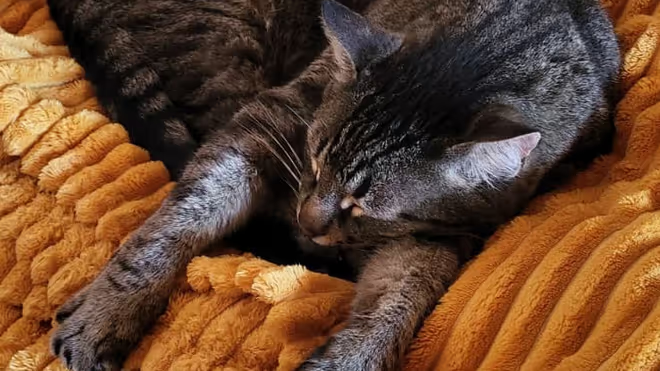
Why the Cat Is Waking You Up
Cats are crepuscular, meaning they are naturally most active at dawn and dusk. The cat scratching your door at 5:30am is not being difficult. It is being a cat. Its internal clock says the sun is coming up and it is time to eat, explore, or simply be awake and social. The fact that you went to bed at midnight and would prefer another two hours of sleep is not information the cat processes or cares about.
On our current Portugal sit, the cat operates on a strict six-hour feeding cycle. It knows exactly when food is due, and it will remind us with increasing urgency as that window approaches. At 6am, it appears at the bedroom door and begins its campaign. Scratching first, then meowing. If we do not respond quickly enough, the volume and persistence escalate. That pestering is a health signal as much as a nuisance, because it is how you notice a cat has stopped eating.
This is not a behaviour problem. This is a cat that has been fed at 6am for years by its owner, and expects the same from whoever is in the house. The routine existed before us and will continue after us. Our job is not to fix it. Our job is to manage it in a way that lets everyone, including us, function. It is also the reassuring version of the story. The opposite one, a cat that stops asking for anything at all, is the one worth worrying about.
What We Tried and What Actually Worked
The first approach was ignoring it. This did not work. A cat that knows scratching the door produces results will continue scratching the door, and waiting it out only trains it to scratch longer and louder.
The second approach was less elegant. One morning when the cat was scratching, I snuck up to the door and waited. When it scratched again, I hit the door hard enough to startle it. The cat disappeared and did not come near the door for three days. For three mornings, we slept undisturbed. Then the scratching came back, slightly quieter, but persistent. The scare tactic had a shelf life of about 72 hours.
The third approach is what actually solved it. I placed large pillows against the base of the bedroom door. The cat could not physically reach the door to scratch it. No scratching meant no noise. No noise meant sleep. The first morning after placing the pillows, nothing happened until we opened the door at 6am and found the cat sitting there silently, waiting for breakfast. One morning we accidentally slept until 6:30. Opened the door. Cat was right there. Ready. Patient. But crucially, silent.
The pillows have stayed against the door every night since. The solution cost nothing, took five seconds to set up, and completely resolved the problem. It is not sophisticated. It does not need to be.

Why Changing the Routine Does Not Make Sense
On a short sit, two weeks or even a month, trying to shift a cat's feeding time or sleep pattern is not going to achieve anything meaningful. Cats take a long time to adjust to routine changes, and even then, from what Caro and I have experienced across our sits, they are so independent that trying to reinforce new behaviour is genuinely difficult. A dog will often respond to consistent redirection within a few days. A cat will look at you, consider your suggestion, and continue doing exactly what it was doing before.
Beyond the difficulty of actually achieving a change, there is a more practical reason to leave things alone. Shifting a cat from a 6am feeding time to a 7am feeding time means the cat spends two weeks adapting to the new schedule, and then the homeowner returns and puts it back. The cat goes from one routine to another and then back again within the space of a month, which creates confusion and stress for an animal that thrives on consistency.
On a longer sit, there might be slightly more room to make small adjustments, but even then, the question is whether the adjustment is worth the effort for something that is ultimately temporary. On our six-month Portugal sit, we did not try to change the cat's feeding schedule. We changed our own sleep schedule instead. The result was better for us, better for the cat, and required no retraining of anyone except ourselves.
Adjust Your Schedule, Not the Cat's
The approach that has worked best for us is simple: go to bed earlier.
On the Portugal sit, we shifted to a 10pm to 6am sleep schedule. Eight hours. The cat wakes us at 6am, which now aligns with when we would be waking up anyway. Instead of fighting the cat's timeline, we matched ours to it.
This has actually improved our days. In summer in Portugal, the mornings are the best time to be outside. By 10am the heat makes outdoor work uncomfortable. By waking at 6am, we get four good hours of cool morning before the temperature climbs. The cat's schedule, which initially felt like an imposition, turned out to be better for us than what we were doing before.
This is not always possible. Some sitters work late, have evening commitments, or simply function better on a later schedule. But where it is possible, adjusting your own bedtime to accommodate the cat's wake-up time is the least disruptive solution for everyone. The cat gets fed on time. You get a full night of sleep. Nobody is stressed.

Dogs Are Different
For comparison, dogs wake you up differently and the solutions are different too.
In Cortona, Teddy the Labrador would climb three flights of stairs to our bedroom and place his nose directly next to ours on the pillow. Not aggressively. Not loudly. Just the quiet, wet presence of a dog nose at 7am telling you that it was time for breakfast and a walk. There was no ignoring it. The nose was right there.
Most dogs we have sat will become restless or vocal when they need to eat or go outside to the toilet. The difference from cats is that dogs generally respond to the morning routine starting rather than demanding it start. Once you get up and begin the process, the dog settles into it.
The Manosque sit was the most peaceful sleeping arrangement we have had. The cat and the dog would both jump into the bed and sleep between us. The dog had a particular way of settling in: walking in tight circles, finding exactly the right spot, and then leaning sideways until it collapsed like a falling tree. It was comical every single time. In that arrangement, nobody woke anyone up because everyone was comfortable.
When to Close the Door
Caro and I generally leave the bedroom door open during sits if the pets are easy-going. If a cat or dog is comfortable sleeping in the bedroom without disrupting our rest, there is no reason to exclude them. The Manosque arrangement worked beautifully because the animals were calm overnight.
The door closes when sleep is being genuinely affected. Sleep is not optional during a house sit. It is the foundation that everything else depends on. After three nights of insufficient sleep on a sit earlier in our journey, I was not functioning. My concentration was gone. My mood was affected. The basic tasks of the sit, feeding, cleaning, communicating with the homeowner, all became harder than they needed to be because I was running on empty.
If a cat is waking you repeatedly during the night, close the door. If the cat scratches the door, add a barrier. If the homeowner has told you the cat sleeps in the bedroom, try it for the first night or two and see how it goes. If it works, great. If it does not, the door closes. Your ability to function is not something to sacrifice for a sleeping arrangement, and a well-rested sitter provides better care than an exhausted one who kept the door open out of guilt.
Our what homeowners wish house sitters knew article covers the broader principle of following the routine while making necessary adjustments for practical reasons. Sleeping is one of those practical reasons.

What to Tell the Homeowner
In most cases, nothing. A cat waking you at 6am for breakfast is a normal part of living with a cat, and the homeowner already knows their cat does this. They live with it every day. Messaging them to report it is not useful information.
If the cat's behaviour at night is significantly worse than what was described, if it is yowling for hours, knocking things over, or showing signs of genuine distress rather than just wanting food, that is worth mentioning. Not as a complaint, but as an observation. "The cat seems unsettled at night, is this normal or should we be concerned?" is a reasonable message that gives the homeowner the chance to provide context without making them feel their pet is a burden.
If you have closed the bedroom door and the homeowner specifically asked you to keep it open, let them know what happened and why. "The cat was scratching the door from 4am and it was affecting our ability to function during the day, so we have been closing the door overnight and adding a cushion barrier. The cat is fine and gets fed at 6am as usual." That is factual, reasonable, and shows you are still following the routine on everything that matters.
Practical Solutions That Work for House Sitters
| Problem | Solution | Why it works for sitters |
|---|---|---|
| Cat scratches the door at dawn | Place pillows or cushions against the base of the door | Blocks physical access without any permanent changes to the home |
| Cat meows for food at 5am | Adjust your own bedtime to accommodate the cat's schedule | You are not going to retrain the cat in two weeks, but you can change when you fall asleep |
| Cat runs around the house at 3am | Close the bedroom door, use earplugs if needed | Normal crepuscular behaviour that does not require intervention, just separation |
| Cat jumps on the bed and walks on you | Try one or two nights with the door open, close it if sleep is affected | Some cats settle after the first night, others do not. Test and adjust. |
| Cat yowls persistently at night | Check food, water, and litter tray. If all are fine and it continues, mention it to the homeowner. | Persistent vocalisation can indicate stress from the owner's absence or a medical issue |
| You are losing significant sleep | Prioritise your rest. Close the door. Add a barrier. Adjust your schedule. | A well-rested sitter provides better care than an exhausted one who kept the door open out of guilt |
Conclusion
A cat that wakes you at dawn is not a problem to solve. It is a routine to work around. Trying to retrain someone else's cat during a sit is unlikely to work, creates unnecessary stress for the animal, and leaves the homeowner with a confused pet when they return. What you can do is close the door, add a barrier if the scratching continues, and adjust your own bedtime so the cat's 6am wake-up call lands at the end of a full night of sleep rather than in the middle of it.
Pillows against the door. 10pm bedtime. Cat fed at 6am as usual. Everyone sleeps, everyone eats, and nobody is stressed. It is not elegant. It does not need to be.
Caro and I have completed 20 house sits across 12 countries, driven 19,000km in Australia and 24,000km in our 1998 VW T4, and saved over $26,500 in accommodation costs over three years of house sitting. If you have questions about managing a cat during a sit, send us a message on Instagram, we read every DM.

Frequently Asked Questions
Why does the cat wake me up so early during a house sit?
Cats are crepuscular, naturally most active at dawn and dusk. The cat is following its internal clock and the feeding routine its owner established. If the cat is used to being fed at 6am, it will expect food at 6am regardless of who is in the house.
Can I change the cat's feeding time during a sit?
On a short sit, it is not worth attempting. Cats are difficult to retrain, the change would not have time to take effect, and the homeowner would need to re-establish the original schedule when they return. The cat goes from one routine to another and back again, which creates unnecessary confusion and stress.
Should I close the bedroom door if the cat is disruptive at night?
Yes, if your sleep is being significantly affected. A well-rested sitter provides better care than an exhausted one. If the homeowner asked you to keep the door open, try it for a night or two. If it does not work, close the door and let the homeowner know why.
What if the cat scratches the bedroom door when it is closed?
Place pillows or cushions against the base of the door. This blocks the cat from physically reaching the door and eliminates the scratching noise. It costs nothing, takes seconds to set up, and makes no permanent changes to the home.
Should I tell the homeowner the cat is waking me up?
Usually not. The homeowner already knows their cat wakes up early. If the behaviour seems significantly worse than what you would expect, such as hours of yowling or signs of distress, mention it as an observation so the homeowner can provide context.
How do I get enough sleep when looking after an early-rising cat?
Adjust your bedtime to accommodate the cat's wake-up time. On our current Portugal sit, we shifted to a 10pm to 6am schedule. This gives us eight hours of sleep and aligns our morning with the cat's feeding time. In summer, the early mornings turned out to be the best part of the day.


Responses
What are your thoughts on this post?