

Home > Blog > Campervan vs House Sitting
Quick Facts
| Which is cheaper? | House sitting: under €100 a year, free accommodation on sits. |
| Van running costs | About €800 a month on the road, €100 during sits. |
| Upfront van cost | Our VW T4 cost €6,500 all-in to get on the road. |
| Best model | Hybrid: van for gaps, house sitting for settled periods. |
| Should you buy a van? | Start with house sitting; rent a van two weeks first. |
| Biggest van drawback | Rain: seven damp days in a small van is miserable. |
House sitting is the lower-cost, higher-comfort entry point — a TrustedHouseSitters membership costs under €100/year with our discount and accommodation on sits is free. Full-time van life in Europe costs €800-€1,500 per month depending on movement and setup. The optimal model is hybrid: a campervan for the gaps between sits, house sitting for the settled periods, combining the flexibility of van life with the comfort and zero accommodation cost of house sitting. Our VW T4 cost €6,500 all-in to get on the road; monthly costs drop from ~€800 on the road to ~€100 during a house sit. If you are new to both, start with house sitting — it costs almost nothing, gives up no comfort, and lets you test the lifestyle before committing to a van purchase.
I have done both. Right now I am doing both simultaneously. Six months into a house sit in Portugal with the VW T4 parked outside. Caro and I covered 19,000 kilometres through more than twenty countries and nine house sits between November 2025 and May 2026. I know what a bad week in the van feels like and I know what a bad week on a house sit feels like. They are different problems. This article is the honest comparison.
If you are interested in getting into house sitting, our book Travel More for Less puts the whole process in one place: clear, step by step guidance from your first questions to your first confirmed sit, and the reviews that open the door to the next one.
The Real Costs: Van Life
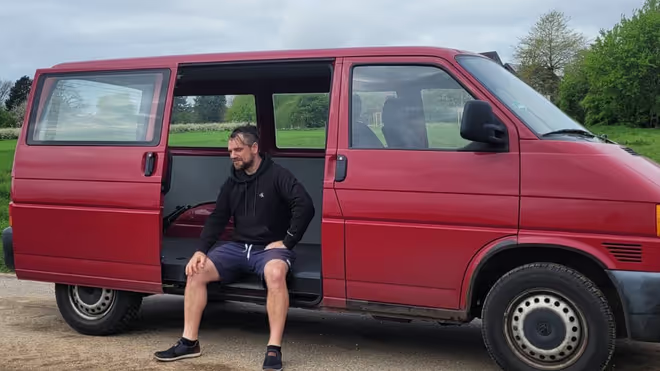
Upfront. Our VW T4 cost €3,500. Pre-trip mechanics. Clutch, electrics, muffler, full service. Came to approximately €1,500. The interior build, including a 200Ah power station, solar panels, fridge, and the 200x140cm bed we built from plywood, cost another €1,500. Total to get on the road: approximately €6,500.
The T4 was already at 73,000km when we bought it. Which for a VW T4 is essentially new. These vans do not stop. Since the initial work we have replaced the front brakes and done two oil changes. That is it. The ongoing maintenance has been truly minimal.
Monthly running costs on the road: approximately €800 covering fuel, oil, minor repairs, and insurance. When we are on a house sit and barely move the van, monthly costs drop to around €100.
What the research gets wrong is treating van life as a €50,000-€80,000 investment. That is the Instagram van. A 30-year-old working van. The kind that does not attract police attention, does not signal to thieves that there is valuable equipment inside, and blends into any industrial estate or quiet street. Costs a fraction of that and runs better than many newer conversions. The stealth is a feature, not a compromise. Our campervan travel between house sits guide covers the route economics in full.
The Real Costs: House Sitting
Under €100 per year for a THS membership with our discount code gets you access to 12,000+ listings globally with no booking fee on Premium plans. The accommodation cost is zero on confirmed sits. No cleaning fees, no weekly rental pressure, no security deposits.
The hidden cost that catches new sitters is car rental. Many good sits are outside city centres. The kind of property with a garden, with outdoor animals, with the space that justifies a house sitter. Getting there and around without your own vehicle requires either renting or relying on local transport. We never face this problem because the van is the car. This is one of the biggest practical advantages of combining both: the van solves the mobility problem that house sitting on its own cannot.
Our save $10,000 house sitting guide covers the full financial case.
A Bad Week in the Van
Rain for seven days in a small van is one of the more truly miserable travel experiences available. Everything becomes damp. Cooking with the doors closed is unpleasant. The solar panel stops charging the power station. The toilet situation becomes increasingly inconvenient. Caro and I end up in coffee shops during the day, eating takeaway at night, and the days start blurring together in a way that feels depressing rather than adventurous.
We have been lucky. We were usually moving enough that the weather changed before it became a real problem. But we know people who were pinned in the Peloponnese for three solid weeks of rain. They left. Not because they wanted to, but because the alternative. Staying in a 6m² box with no sun and nowhere to go was unsustainable.
The other van stress that does not make the social media version: parking. Our stealth advantage is real but it is not infinite. In popular summer locations, every coastal spot is taken. In cities, overnight parking requires research, judgment, and occasionally the willingness to move at 2am when something does not feel right. After a while you develop a reliable instinct for whether a spot is safe. Before you develop that instinct, there are some uncomfortable nights. Park4Night helps significantly. Trusting your gut matters more.
A Bad Week on a House Sit
House sit problems are different in character. They are not about physical discomfort. They are about the animals and the relationship with the homeowner.
Our first Portugal sit. The reactive dog. Was truly difficult. Resource guarding the bed on the first night, barking through subsequent nights, enough sleep deprivation in the first three days that Caro and I seriously considered leaving. The dog was not dangerous once the bedroom was off-limits, but three nights of broken sleep in an unfamiliar situation is its own kind of hard. We stayed, the situation stabilised, and by day four the dynamic had shifted. But those first days were not easy.
On the current Portugal six-month sit, the cat wakes us at 6:00am. This was truly irritating for the first week. Now it is just our schedule. We get up early, which turns out to be productive. The adjustment happened. That is the difference between van problems and house sit problems: van problems are environmental and cannot always be resolved. House sit problems are usually manageable with patience and adaptation.
Comfort: The Honest Comparison
Van life comfort is real but it has limits that do not apply to house sitting. We cannot stand up fully in the van. We have a 200x140 bed, which is larger than most van setups, but it is still a van. There is no bath. Hot water exists but requires planning. The kitchen is functional but it is a 40cm worktop with one stove top.
House sitting gives you a full home. A proper kitchen, a bath, a working desk, outdoor space, often a garden. After a long drive through winter Europe, arriving at a house sit and having a proper shower and a kitchen with counter space feels extraordinary by contrast.
The comparison is not really van versus house. It is motion versus stillness. The van gives you external freedom: go anywhere, wake up in a forest, be in three countries in a week. House sitting gives you internal freedom: stop, settle, build a routine, actually process the places you have been passing through. Both have value. Neither replaces the other.
Our best countries for van life and house sitting guide covers where each approach works best by region.
Traveling as a Couple: The Van Test
The van has been a relationship test in the best possible sense. You cannot hide in 6m². If there are unresolved communication problems, they will surface within the first month. If your comfort levels and travel preferences are truly incompatible, that incompatibility becomes visible very quickly.
Caro and I work well together because we have similar instincts about how to travel and we communicate when we do not. There is no guessing. We both know when the other needs space. Which in a small van means sitting quietly, taking a walk alone, or accepting that silence is not distance. Looking back at older relationships, this would have been impossible. The van would have broken them before the second country.
The practical advice: if you are considering this with a partner, rent a van for two weeks before buying one. You will know within ten days whether the dynamic works. Not whether the travel is enjoyable. It almost certainly will be. But whether the two of you in a small moving box is sustainable for months. Our van life and house sitting upgrade guide covers the transition decision.

The €10,000 Question
If someone came to me with €10,000 and asked whether to buy a van or use that money to fund house sitting travel, my answer would be: start with house sitting.
Under €100 for a THS membership with our discount puts you in extraordinary homes with pets in incredible places, with a full kitchen, a proper bed, and all the creature comforts you would have at home. The saving is enormous. The experience is accessible. The downside is minimal. You do not sacrifice basic comfort to do it.
Van life at any price point involves giving things up: running water on demand, a flushing toilet, a full-sized kitchen, the ability to stand up, the guarantee of not being too cold or too damp on a bad night. Some people take to this immediately and find it truly freeing. Others find it tolerable for a week and exhausting for a month. There is no way to know which camp you are in without trying it first. Hence renting before buying is the only sensible entry point.
The hybrid model. Van for the gaps between sits, house sitting for the settled periods. Is the model that works best for us and for most people who do both seriously. The van solves the accommodation problem between sits and gives you the flexibility to arrive early, leave late, and adjust plans when something better appears. House sitting solves the comfort deficit of long-term van life and removes the daily parking-and-maintenance overhead from your attention.
Together they cost less, offer more comfort than either alone, and produce a travel model that is truly sustainable for years rather than months.
The Practical Decision Guide
| Van Life Only | House Sitting Only | Combined | |
|---|---|---|---|
| Upfront cost | €6,500-€80,000+ | Under €129/year | €6,500-€10,000 + membership |
| Monthly cost on the road | €800-€3,500 | Near zero on sits | €100-€600 on sits, €800-€2000 between |
| Comfort | Variable, limited | High — full home | Best of both |
| Flexibility | Complete | Sit-dependent | High |
| Wet weather problem | Significant | None | Managed |
| Car access at sits | Your van | Often requires hire | Solved |
| Parking stress | Regular | None | Occasional |
| Bad week risk | Environmental | Animal/relationship | Low overall |
| Best for | Exploration junkies, minimalists | Comfort, stability, saving | Full-time sustainable nomads |
Join TrustedHouseSitters with 25% off. DM us @housesittersguide on Instagram. We answer everyone.

Frequently Asked Questions
Is van life or house sitting cheaper?
House sitting is cheaper for most people. A THS membership costs under €100 per year and accommodation on sits is free. Van life requires a significant upfront investment and ongoing fuel, insurance, and maintenance costs. The hybrid model. Van for gap travel, house sitting for settled periods. Reduces van monthly costs from ~€800 to ~€100 during sits, making it the most cost-effective overall approach.
Do you need a car for house sitting?
For the best sits, yes. Most desirable sits are outside city centres and require transport. Car rental is a real and often underestimated cost for sitters without their own vehicle. Having a campervan as your base solves this completely. You arrive with your own transport, which homeowners consistently view as a positive.
Can a couple realistically live in a van long-term?
Yes, with the right communication. The van amplifies everything in a relationship. Good communication becomes essential, unresolved problems surface quickly. Caro and I have found it truly works because we communicate clearly and know each other's needs. The practical advice: rent for two weeks before buying. You will know whether the dynamic is sustainable.
What is the best van for house sitting travel in Europe?
An older, modest-looking working van that blends in. We use a VW T4 purchased at 73,000km for €3,500. It has been mechanically reliable, cheap to run, and invisible to parking authorities and potential thieves. The stealth of a plain working van is a genuine advantage that expensive modern conversions cannot replicate.


Responses
What are your thoughts on this post?