

Home > Blog > Campervan Travel Between House Sits
Quick Facts
| Our vehicle | VW T4 campervan |
| Total distance since November 2025 | Approximately 19,000km (11,800 miles) across 20 sits in 12 countries |
| Typical driving day | 4 hours maximum — we are travelling, not rushing |
| Overnight stop app | Park4Night — filtered to 4+ star reviews only |
| Fuel cost per 100km | €16-20 (~$17-22 USD) |
| Daily travel budget on the road | ~€50-60 per day including all expenses |
| How often we house sit | Every 2-3 weeks while travelling |
| Best time to campervan in Europe | Autumn through spring — summer is hot, crowded, and expensive |
Route planning around house sits comes down to one rule: pick a destination, not a sit, and let the sits fall into place along the way you were already going. That single principle got us 19,000km across six months and 20 sits without ever feeling like the road was dictating the trip.
We left our home in November 2025 with one confirmed house sit in the diary: Cortona, Italy, by November 27th. That was the destination. Everything between Germany and Cortona was ours to decide.
We drove through Liechtenstein, Austria, and Switzerland, caught up with friends along the way, and picked up an unplanned house sit in Switzerland that appeared while we were already there. That is the campervan and house sitting combination at its best. A fixed destination that gives the trip shape, and complete freedom in how you get there.
Since then: Cortona to Sicily, back to Bari, across to Albania, through the Balkans, up through Serbia and Hungary, across Slovenia and into the Dolomites, Monaco, south France, Spain, and finally Portugal.
Roughly 19,000 kilometres across six months. We left with 77,000km on the odometer and are approaching 96,000km. Twenty sits. Twelve countries.
This article covers how we actually plan routes between sits, how to use the THS map and app effectively, overnight stop logistics, travel costs, and the principles that have kept the whole thing manageable.
Join TrustedHouseSitters with 25% off using our discount link and read our van life and house sitting guide for the broader picture.

The Planning Principle: Destination First, Sits Along the Way
The most important thing about planning a campervan route around house sits is to always have a destination of sorts. Not necessarily a specific city or address. But a direction, a country, a region you are working toward.
Without a destination, you drift. One good campsite becomes two nights, then three. A town you like becomes a week. None of this is bad in itself, but for Caro and me, we left home specifically to move out of our comfort zones, not to create new ones on the road. A destination gives the trip shape and prevents the road from becoming another version of staying put.
The sits function as anchors within that direction. When we knew we were heading to Cortona by the end of November, the sits and stops between Germany and Italy were points along a line rather than random decisions. When Caro found the Portugal sit over New Year, it gave us a destination six months out. Between northern Italy and Portugal, we had months to decide what the route looked like. And we used it to cover Albania, Greece, the Balkans, and a route through central Europe that most people do not take in a campervan.
The sits do not determine the route. The route determines which sits are relevant, and then you apply for the ones that make sense geographically.
How to Use the THS App for Route Planning
The THS app is better than the website for route planning while on the road. The map refreshes quickly, it is easy to pinch and scroll across a region, and the filter system allows you to narrow listings by date, pet type, and duration while moving between sits on the screen. For route planning on the go, it is the most intuitive version of the tool.
The practical process:
Open the map in the app. Set approximate dates for when you expect to be in a region. Scroll through the listings that appear in the areas along your intended route. Apply to sits that align with where you are already planning to go.
That last part is the key distinction. You are not rerouting the trip to reach a sit. You are identifying sits that happen to be on the path you were already taking. A sit 50km off your route is worth considering. A sit 400km off your route in the wrong direction is not, unless the location itself is somewhere you wanted to go anyway.
The most productive THS map sessions happen when you have a rough route in mind and use the map to see what is available along it. A broad filter search covering a two or three-week window will show a range of listings across a region. Some will align with your travel dates and direction, some will not. Apply to the ones that fit.
How We Chain Sits
Our final month of the Balkans-to-Portugal journey is the clearest example of how sit-chaining can work when the timing aligns.
Manosque, south France, for ten days. Valencia, Spain, five days later. Tavera, Portugal, three days after Valencia. Then four days before our six-month sit began nearby. All three transitional sits were on the same route. All three were accepted within a short window. The driving between them was manageable. The trip felt planned even though most of it assembled itself from availability and timing rather than deliberate design.
The longest inter-sit journey during the whole six months was from Sarajevo. Where we had taken a three-day Airbnb break overlooking the city because we needed a rest from the road. To Manosque in south France. We drove through Serbia, Hungary, Slovenia, across the Dolomites, past Monaco, and into Provence. We pushed harder on that stretch than any other part of the trip and arrived at Manosque truly ready to stop for ten days. The dog with separation anxiety and the affectionate cat were exactly what we needed after that drive.
The principle for chaining sits effectively:
Build the route first, identify sits second. A sit that appears on a route you were already planning is a free accommodation upgrade. A sit that requires redirecting the entire route is a trip in service of the sit, which inverts the logic.
Leave enough travel days to do the journey properly. Arriving at a homeowner's door exhausted and behind schedule is not how any sit should start.
Build in a rest day at the end. The day before a sit starts should be calm, short, and low-stress. In our Valencia to Portugal leg, we planned a long driving day from Valencia to Ronda, a shorter day to Gibraltar, and then an easy final hour to Tavera. We arrived well rested, had coffee in the morning, and drove to the sit unhurried. That is the right way to arrive.

How Far Is Too Far?
The distance from Germany to Cortona is approximately 1,300km (808 miles). We had around two weeks to get there. Perfectly comfortable.
The total distance of the Sicily/Albania/Balkans/Portugal route was approximately 13,000km (8,077 miles) over four months.
There is no maximum distance that matters in itself. What matters is whether the distance is achievable relative to the time available, and whether the route itself is one you want to drive. A 1,000km drive with ten days to do it, passing through countries you wanted to see anyway, is a pleasure. A 1,000km drive with one day to do it is an emergency.
Our practical limit for a single driving day is four hours. We rarely exceed five, and on the occasions we have, both of us have arrived at the next stop tired and irritable. Ten days of the past six months involved driving for five or more hours in a day. Each of those days, we were glad to stop. We are travelling, not transporting ourselves. Everything passed at 80-100km/h gives you time to look at it.
The 80-100km/h speed is deliberate. Faster on European highways means significantly higher fuel consumption and more engine strain on an older van. We regularly pull over to let faster traffic pass. We are not in a hurry. The fuel economy and the engine health are worth the few minutes difference in arrival time.
Overnight Stops: The Park4Night System
Between sits, we sleep wherever the evening finds us. The primary tool is Park4Night, which maps verified campervan-friendly overnight stops across Europe contributed and rated by other campervanners.
Caro filters the app to show only stops with four stars or higher. The result is almost always a reliable stop. Good views, safe location, basic facilities like water and toilets, and other responsible campers who know the etiquette. Wild camping in the genuine sense is still available across much of Europe, but the Park4Night community-rated stops reduce the uncertainty and are consistent enough that we rarely need to spend time finding alternatives.
The filter system matters. An unfiltered search near a major city will show stops of wildly varying quality. A four-star filter removes the problematic locations and leaves the reliably good ones. For a new campervan traveller, this is the single most reliable shortcut to good overnight stops in an unfamiliar country.
Travel Costs Between Sits
Fuel is the dominant variable cost of inter-sit driving. Our VW T4 averages between €16 and €20 per 100km depending on the road type and driving conditions. Highway driving at a steady 90km/h is more efficient than mountain roads or urban driving. For a 500km inter-sit leg, fuel typically runs €80-€100.
Beyond fuel, the daily budget on the road runs approximately €50-60 in total across all expenses. Campervanning changes eating habits toward more café stops and less home cooking than a house sit provides. The kitchen is smaller, the temptation to stop somewhere interesting is higher, and making coffee at a table overlooking a valley costs more than making it in the van but is considerably more enjoyable. Toll roads add cost on specific routes, particularly in France, and we avoid them where the detour is reasonable.
The total van maintenance cost over six months has been approximately €500-€600: two oil and filter changes, brake pads, and routine checks. The VW T4 is an older vehicle running reliably because it is driven within its limits and maintained consistently. Oil checked regularly, not pushed hard, never revved unnecessarily. By the end of the year, new tyres will add to that figure, but across the full six months the mechanical cost is remarkably modest.
A house sit removes accommodation cost entirely. The average two-week sit across Europe represents roughly €700-€1,400 in saved accommodation at conservative rates. The inter-sit travel cost of €200-€400 is well within that saving even before food and utility savings from the sit itself are counted.
Why We Travel in Autumn and Winter
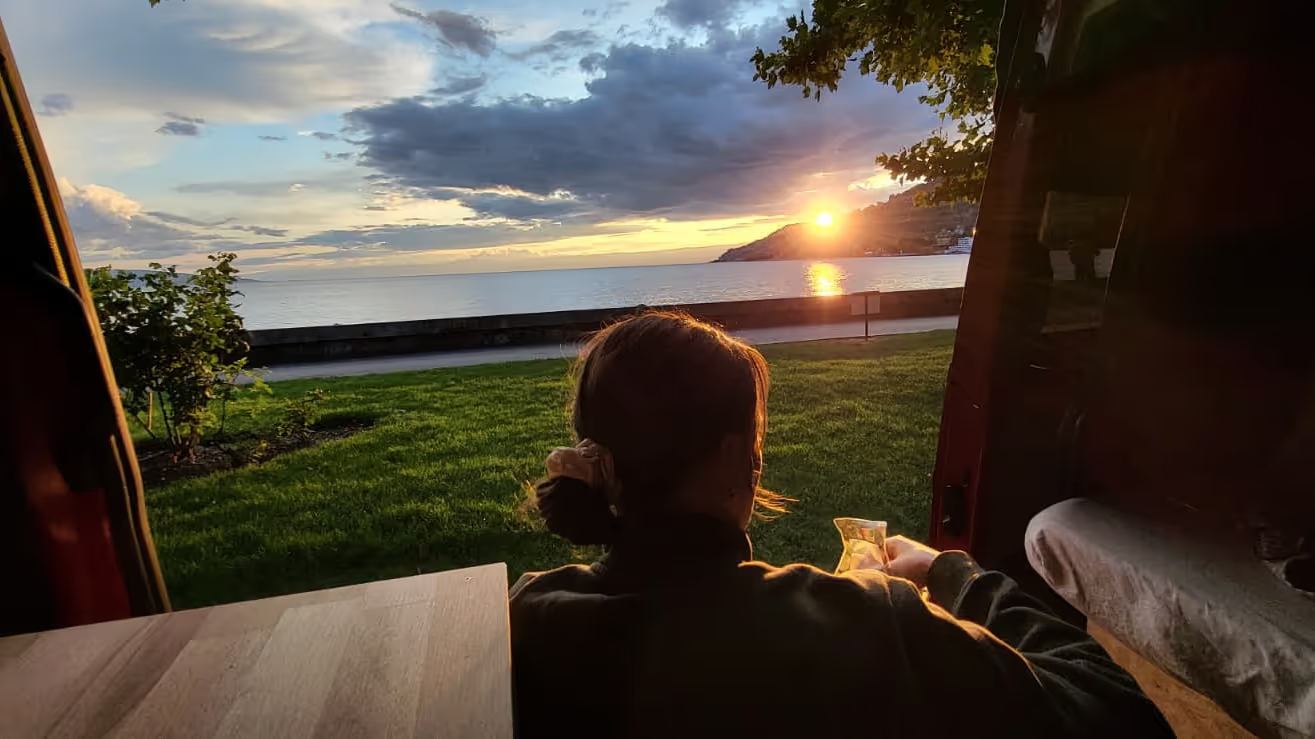
Summer campervanning in Europe is a different experience. The van gets extremely hot. Every campsite is full. The coastal roads are congested. Parking near anything interesting requires patience and in Southern Europe particularly, the heat inside a campervan on a summer afternoon is not comfort. It is endurance.
We moved out of our home in November deliberately. The winter months allow access to places that summer crowds make difficult. Campsites are available. Coastal towns are quiet. There is space to move. The cold requires layers and a good sleeping bag, but cold is manageable. Heat in a metal box with no air conditioning is its own category of discomfort.
The upcoming November return to the road after the six-month Portugal sit will follow the same logic. Portugal and Spain during the colder months, gradually moving north as the temperatures rise, arriving in Scandinavia in summer when the days are long and the weather is finally on the right side. At least that is the plan. There is also a possibility we fly to Australia instead. That is the other thing about this lifestyle: the plan can change. The campervan will still be there.
Advice for Your First Inter-Sit Drive
If you are about to chain two sits for the first time and are nervous about the logistics, the planning principles are simple.
Do not drive more than four to five hours per day. Arriving tired at a new sit is the worst possible start. The homeowner wants to hand you their keys, not meet someone who has been driving since dawn.
Build in a rest day at the end of the journey. The day before the sit starts should involve very little driving and no stress. Sleep well, have a proper breakfast, arrive calm.
Apply for sits that are on your route rather than redirecting your route for sits. A house sit should upgrade the trip, not constrain it.
Use Park4Night with the star filter for overnight stops. Stops rated four stars or higher are almost always reliable, comfortable, and safe.
Keep a spare day in the schedule for everything. Ferries run late. Weather changes plans. Roads that look passable on the map are sometimes not. A spare day absorbs all of this without the sit suffering.
Read our guide to what to ask a homeowner before a sit and our pre-sit video call guide to make sure the sit itself is set up well once you arrive.
Conclusion
The campervan and the house sit are not separate things for us. They are the same lifestyle at different speeds. The van is movement and freedom. The sit is stillness, recovery, and productivity. The combination of the two across six months has produced the most varied and sustainable form of travel we have found.
Germany to Cortona. Sicily to Albania. The Balkans to Portugal. Manosque, Valencia, Tavera, six months in one place. Every stage made sense because the destination gave the trip direction and the sits provided the anchors.
Leave home with a destination in mind. Drive slowly enough to actually see the places you pass through. Apply for sits on the route you were already taking. Arrive rested. The rest figures itself out.
For the country-by-country breakdown of where this lifestyle actually works best, our best countries for van life and house sitting guide covers France, Australia, and everywhere else we've ranked honestly. Read our house sitting and remote working guide and our digital nomad visa guide for the broader lifestyle picture, our campervan setup guide for the practical living side, and see our is house sitting worth it guide if you are still deciding whether to start
Join TrustedHouseSitters with 25% off and DM us @housesittersguide on Instagram. We answer everyone.
Caro and I have completed 20 house sits across 12 countries, driven 19,000km in Australia and 24,000km in our 1998 VW T4, and saved over $26,500 in accommodation costs over three years of house sitting.

Frequently Asked Questions
How do you plan a campervan route around house sits?
Start with a destination, not a sit. Decide roughly where you want to be and when, then use the THS app map to identify sits along that route. Apply for sits that align with your direction of travel rather than redirecting the route to reach a specific sit. A sit should upgrade the trip, not define it.
How do you find overnight stops between house sits?
We use Park4Night, filtered to four stars and above. The app maps verified campervan stops contributed by the community, and the filter removes unreliable locations. A four-star or higher stop in Europe almost always means good views, basic facilities, and other considerate campervanners. For new campervans, this is the most reliable shortcut to good overnight stops in unfamiliar countries.
How much does campervan travel cost between house sits?
Approximately €16-20 per 100km in fuel for a VW T4, plus total daily expenses of around €50-60 covering food, camping, and all other costs. A 500km inter-sit leg typically costs €80-€100 in fuel. House sits eliminate accommodation costs entirely. The average two-week sit saves significantly more than the travel cost to reach it. Our house sitting cost guide covers the full financial picture.
What is the maximum distance to drive between two sits?
There is no fixed maximum. It depends entirely on how much time you have. A 1,000km drive with ten days available and interesting countries along the way is a pleasure. The same distance in one day is punishing. Our practical daily limit is four hours of driving. Anything beyond five leaves both of us tired. Always leave a rest day at the end of the journey before the sit starts.


Responses
What are your thoughts on this post?